Fitness, Nutrition, Health and Sports Blog In the HSNstore Blog you will find tips about Fitness, sport in general, nutrition, and health – HSNstore.com

Where does the energy come from to do a Wod in CrossFit?
In this series of articles, I’m going to try to explain the different mechanisms our body uses for the generation of “ATP” (human fuel). Through ATP (adenosine triphosphate), a series of reactions occur that allow muscle contraction, and therefore movement production.
Aerobic metabolism
Aerobic metabolism, also known as “cardio,” might be the energy pathway most trained by casual recreational athletes (we all know the boom that disciplines like running or triathlon have had in recent years).
However, it’s also the most forgotten among CrossFit practitioners or sports where intensity plays a key role (MMA and contact sports in general, Rugby, American football) because they are “anaerobic” specialties (energy production without oxygen), as we’ll see, this is a widespread but not entirely accurate belief.

This “bad rep” that low-intensity cardio has gotten in favor of high-intensity interval methods (HIIT) among others, is due to several reasons:
- The only athletes who should work this pathway are endurance specialists
- Those who need to lose weight and use fat as fuel
- Athletes in the “anaerobic” specialties mentioned above should only work their “cardio” by doing intervals, since low-intensity work causes overlaps or interference with their specific training
This biased view of low-intensity aerobic work, besides being wrong, will end up limiting the performance of high-intensity specialists who ignore its development.
Let’s discover how CrossFit and Energy Pathways work
Aerobic energy pathway
As we’ve already pointed out, the aerobic energy system uses oxygen to produce ATP, it’s the system responsible for producing energy for long-term activities, or when we’re inactive or doing any low-intensity activity (walking, sleeping, reading…), so it’s the system mainly responsible for producing our daily energy to perform basic functions.
It’s also the only one capable of synthesizing and using fats as fuel to produce ATP besides carbohydrates: producing up to 9 calories per gram of fat, compared to 4 calories per gram of carbohydrate
On the flip side of this tremendous energy production capacity, it happens at a much lower rate than anaerobic pathways, so the power generated through this pathway is low compared to others. In short, the ATP generation rate per unit of time decreases, mainly due to 2 factors:
- It depends on oxygen supply
- There are more processes and chemical reactions needed to produce ATP aerobically than anaerobically
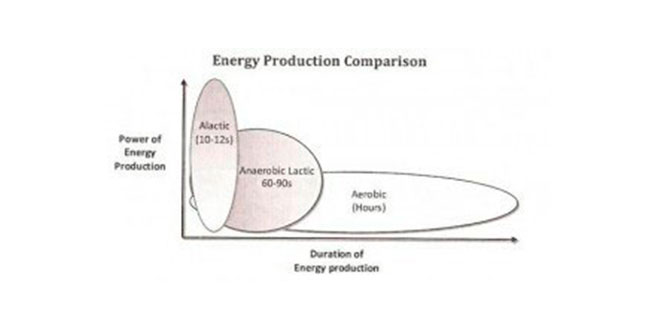
As you can see in the figure above, even during the first 2 minutes, the aerobic system is responsible for producing the most energy in activities with maximal and submaximal intensities.
Energy production through anaerobic metabolism is much more limited and leads to premature fatigue.
The only byproducts of aerobic metabolism are CO2 and water. Also, aerobic energy production is limited only by oxygen supply from the cardiovascular and cardiorespiratory systems, oxygen use by the muscles themselves, and enzyme and substrate availability.
The aerobic system and CrossFit
Probably, CrossFit is one of the disciplines with the highest demand for a high energy production rate, its intensity is very high, in fact its ultimate goal is to test the athlete’s work capacity, which could be similar to:
energy production + energy efficiency applied
It’s precisely because of this that most athletes and coaches focus on anaerobic development, without realizing the underlying importance of a properly developed aerobic system at any intensity level.
Not only producing most of the ATP muscles need for any time domain over 2 minutes as we’ve pointed out, but the aerobic system also plays the role of “recharging” the anaerobic systems.
As we know, as the use of our anaerobic pathways increases, so does the production of metabolites and byproducts, which leads to fatigue.
Once fatigue appears, your body uses aerobic pathways to clear these byproducts and restore anaerobic metabolism mechanisms. What does this tell us? That without a properly developed aerobic system, your anaerobic pathways will also be limited because it will take longer to produce energy again through this pathway.

In this scenario, the higher the ATP production via aerobic pathways, the less involvement of our anaerobic systems in producing the ATP demanded by the activity, and therefore our conditioning will be better.
Not only that, but higher aerobic power means our aerobic system can recharge faster and be available when you need it.
Energy power from the aerobic system
It’s true, as we’ve emphasized, aerobic systems are far from the energy production rate of anaerobic systems. But that doesn’t mean we can’t significantly increase how much aerobic power our system can produce:
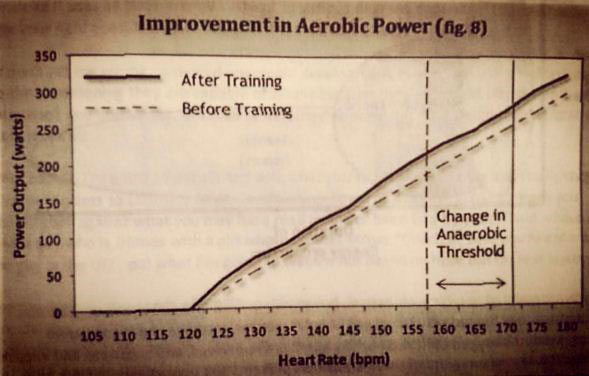
From the graph, we distinguish two components regarding aerobic power improvement:
- First, we see the anaerobic threshold line has shifted to the right. This threshold, typically highlighted by a specific heart rate, represents the limit of your aerobic energy production capacity, and also marks the range where your body will start experiencing fatigue due to anaerobic processes kicking in. Obviously, the longer you can delay this point, the better your conditioning.
- High-level endurance athletes usually have anaerobic thresholds at a very high percentage of their max heart rate, allowing them to generate a high aerobic power rate, and it’s rare they need to rely on anaerobic processes to produce the energy they need. This point is key.
Aerobic power and anaerobic threshold
Increasing your aerobic power means your anaerobic threshold also increases, so a higher percentage of your total energy production will come from this pathway.
- As you can see in the previous graph, less energy will have to come from anaerobic pathways.
- Before training, the athlete could only produce 200w at their anaerobic threshold; after training, they can reach 300w.
We also see how the line marking power has risen on the y-axis as a result of increased aerobic power. This change reflects an increase in total energy produced over time and greater muscle contractility. Simply put: it means an increase in the total ATP your body can produce aerobically, as well as how effectively muscles can use that ATP to do work.
This greater energy production results from an increase in what we call “biological potential” when your cardiac, neuromuscular, hormonal, and metabolic systems develop properly, meaning:

In the next post, we’ll look in detail at the adaptations we’ll need in our aerobic system, as well as the most effective methods to produce them, significantly increasing our athletic capacity for CrossFit.
Related Posts
- Why Train CrossFit?
- How to Train in CrossFit?
- Crossfitter vs Decathlete, who’s fitter?
- CrossFit: Aerobic Capacities Seminar
- CrossFit and Nutrition