Fitness, Nutrition, Health and Sports Blog In the HSNstore Blog you will find tips about Fitness, sport in general, nutrition, and health – HSNstore.com

Let’s review some aspects before learning about functional training for basketball… Basketball training is a multifactorial process and we have to take into account what are the main aspects that affect the performance… Oh, you do not know what we are talking about? Fortunately, you can read this article where I tell you all the secrets about professional basketball players.
Then, we need to consider the workout principles. Otherwise, it will be pointless to do the exercises of Lebron James, with the structure of Stephen Curry and the progressions of Luka Doncic.
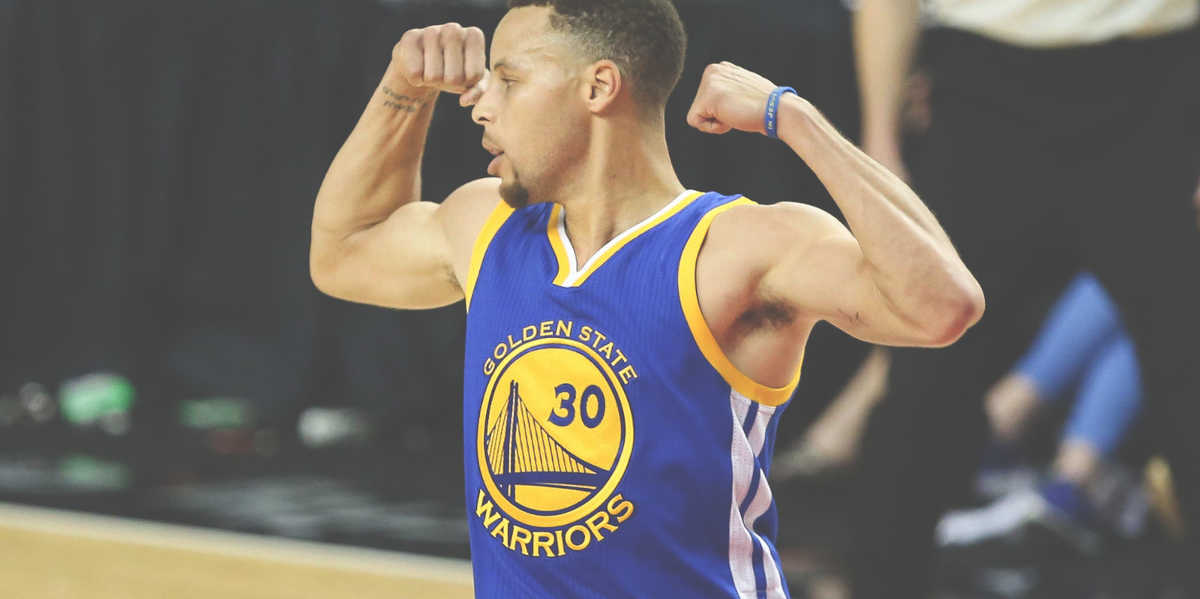
You are you and your workout plan should be unique! (although this does not mean that you cannot use parts of the workouts from other players).
What is functional training?
The first part of the article is possibly the most difficult one. Then, what is functional training?
Because functional training is a misunderstood concept, that is how Siff defined it on 2002 in an article for the NSCA Journal. But I do not want to confuse you with theories and nuances about what functional training is.
Therefore, functional training is a type of workout routine that can be used for a specific situation. It is that simple.
Will a biceps curl work? If your work consists of transporting objects, then it could.
In fact, there are no functional exercises or workouts in basketball. There are exercises that are easier to transfer than others and workouts that are more replicable than others. However, there is not (nor there cannot be) and established norm.
Is this Functional Training?
For example, this video is titled functional training, but is it?
Without any doubt, it will be useful if you live in the jungle and you have to move from branch to branch, if your are an OCRs runner, maybe a climber… But let me tell you something, except for a couple of exercises from this video, none of them are really useful for basketball.
You can find plenty of examples of functional training for basketball on the internet, however…
Then, what is this good for? Well, it could be a good workout for slamball, for example.
Do not panic, the first movement from the video is completely legal in this sport.
If you are interested in learning more about training on unstable surfaces, click here.
Then, where should I start?
As I mentioned previously, the first you need to do is knowing what is functional of the sport you practise. But as you may have already realized… it depends, right?
Today, we are going to focus on a functional training for basketball. So, a point guard does not have the same demands as a center.
Although we can discern certain common pattern among basketball players, because all of them:
- Throw
- Make short passes
- Bounce the ball
- Swing
- Jump
- Run 20-25m at a high intensity
- React to offensive and defensive stimuli
There are some actions that are common to all players, these are the ones that we can use as a reference for our functional training.
Reminder: Functional training for a basketball player should not be going to a gym and doing squats on a bosu. Absolutely not!
Although playing basketball games is not the only way, since sometimes we may want to develop specific physical capacities. That is why I am going to give you some general guidelines for a functional training for a basketball player.
1st Practical Example
Let’s start for the most simple and general stuff that is also functional training: Gaining strength.
Basketball players need to run, jump, hold a semi-flexed position of the hips and knees while defending. They need speed and muscle strength, if they do not have that, you can have a great technique and tactics but you will not have a good performance.
We need to gain strength in our lower body apart from working on our speed. Let’s not forget that:
W = F x d (Work = Force x Distance)
P= W/t (Potency = Work / Time)
You have to do this in order to know which one of these variables you need to work on, or even better, where do we want the curve to go.
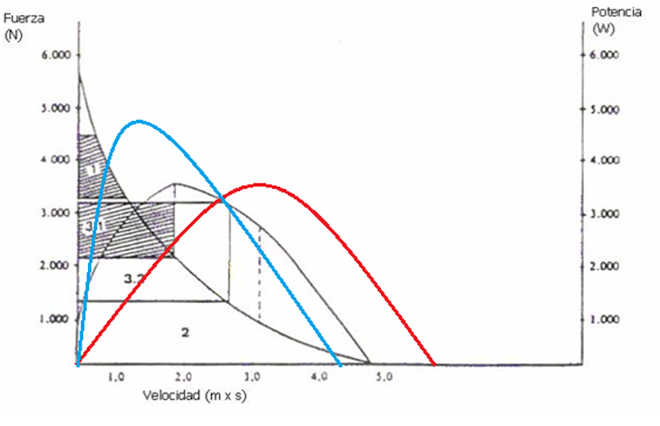
We need to find out our Strength/Speed profile in order to reach an optimal value.
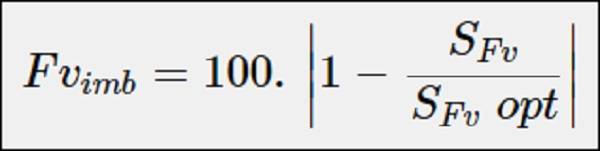
Samozino et al., (2012, 2014) studied this and determined that the optimal % between strength and speed was 0. In other words, it would equal a 100%. Therefore, if this relation reached a 90% it would mean that we would lack strength and if it reached a 110% it means that we would lack speed. This is the equation that was used to measure this:
Are you stronger or faster?
| Can you easily do 170kg squats but you do not jump very high? | You should work on your speed and move the curve to the right. |
| Can you run fast, change directions and speed but you cannot lift a 100kg squat? | You should work on your strength and move the curve to the left. |
Jiménez-Reyes et al. (2016) came up with a strength and potency training routine that will adapt to our needs. Do not follow it blindly, although it will be quite interest to find out exercises, weights and intensities with tested results. I have made a summary in the following charts:
1st Chart
| Your features | Group | Exercises |
| Very weak, very fast | Important lack of strength | 3 strength exercises, 2 strength-potency exercises 1 potency exercise |
| Weak, Fast | Mild lack of strength | Try doing 2 strength exercises Then 2 strength-potency exercises And 2 potency exercises |
| Balanced | Balanced | Do 1 strength exercise 1 strength-potency exercise 2 potency exercises Then, 1 potency-speed exercise And 1 speed exercise |
| Slow, Strong | Mild lack of speed | Do two speed exercises Followed by 2 speed-potency exercises Finally, 2 potency exercises |
| Very slow, very strong | Important lack of speed | 3 speed exercises As well as 2 potency-speed exercises 1 potency exercise |
2nd Chart
| What you have to work on | Useful exercises | Intensity |
| Strength | Back squat Leg press Deadlift | 80-90% 1RM 90-95% 1RM 90-95% 1RM |
| Strength-Potency | Clean Pull Deadlift Squat Jump Counter-Movement Jump | 80% 1RM 80% 1RM >70% BW >80% BW |
| Potency | Squat Jump Counter-Movement Jump Single Leg Squat Jump Single Leg Counter-Movement Jump Clean Pull Jump | 20-30% BW 35-45% BW BW
10% BW 65% 1RM |
| Potency-speed | Depth Jump Squat Jump Counter-Movement Jump High Box Jump | – BW 10% BW – |
| Speed | Max. Roller Push-off Abalakov | <BW BW |
*1RM: one repetition maximum | *BW: Body Weight
According to a workout program of:
- 9 weeks
- 6 exercises / week
- 3 sets / exercise
All the groups (lack of strength, lack of speed and balanced) improved:
- Lack of strength -> 14.2%: all improved.
- Lack of speed -> 12.7%: all improved.
- Balanced -> 7.22%: all improved.
- Uncontrolled routine -> 2.33%: a 5.5% got worse, a 55.5% did not change, a 38.8% improved.
- Without training -> -1.43%: 45% got worse, 50% did not change, 5% improved.
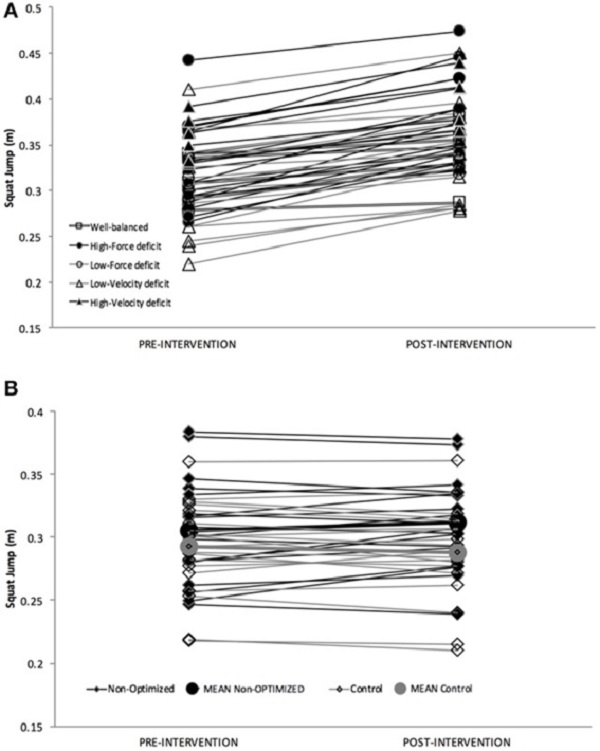
Representation of the jump reached in pre and post-intervention CMJ. (A) Controlled group, (B) group without workout or with uncontrolled workout. (Jiménez-Reyes et al., 2016)
It looks important, right? Even though this is not strictly standardized, it does not adapt to each on of us. This workout program is a good reference to know what you are, how to improve and how to do effectively.
2nd Practical Example
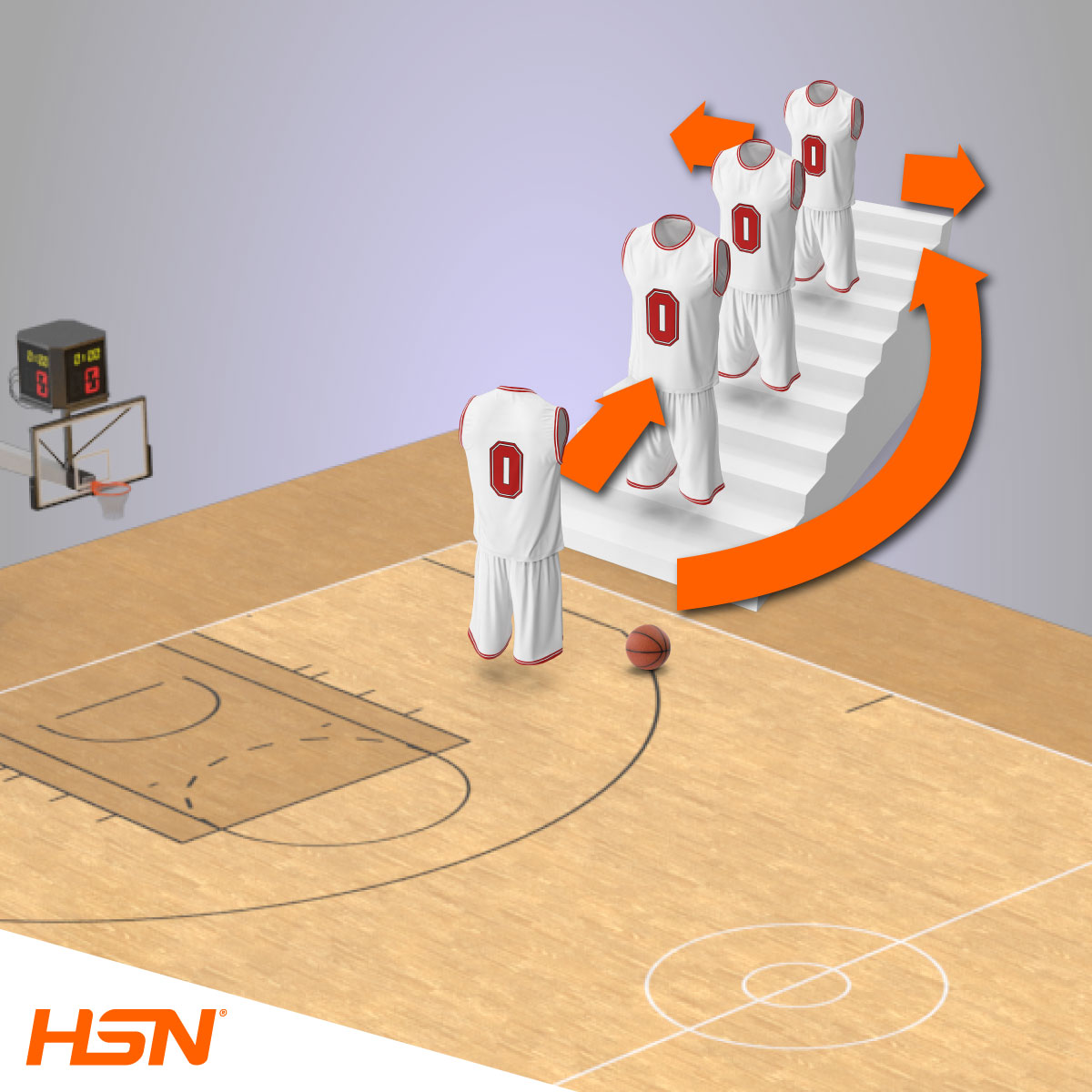
Let’s imagine that we want to improve our ability to maintain a high cyclical and defensive intensity, offensive intensity and selective attention.
- Place the team in the stands of a stadium, approximately with 45cm between each other.
- Divide the team in groups of 5 and limit the width in equal sections.
Place 3-4 players on the stands, each one in a step, without a ball, their hands in low defense position. Then, they should swings to the sides without losing the balance.
- A player stands on the first step of the stands with the ball. The objective is to climb each step without losing control of the ball while the rest try to prevent this from happening.
- If the player loses the ball, they will be replaced by the one that made them lose control. The rest of the players that came after have to go down one step. Finally, the player that was attacking will climb until the last step.
Moreover, the player with the ball has 30″ to climb each step.
Variants:
- If the exercise is extremely difficult for the player with the ball, the rest will not be able to use their arms.
- On the contrary, if the exercise is too easy for the player with ball, there will be 2 players per step. At the beginning of the exercise, they will have to face the walls and turn with the first bounce of the ball.
Ideally, the players at the highest steps should not be just standing still, just like the ones that have been overcome. In fact, they should do other exercises in the meantime.
For example, the latter could go to the basketball court to face each other in defensive superiority (1×2) until they have to go back to the stands.
And what about the other players?
Can you think of an exercise that they can do while they wait?
Let me know in the comments below!

3rd Practical Exercise
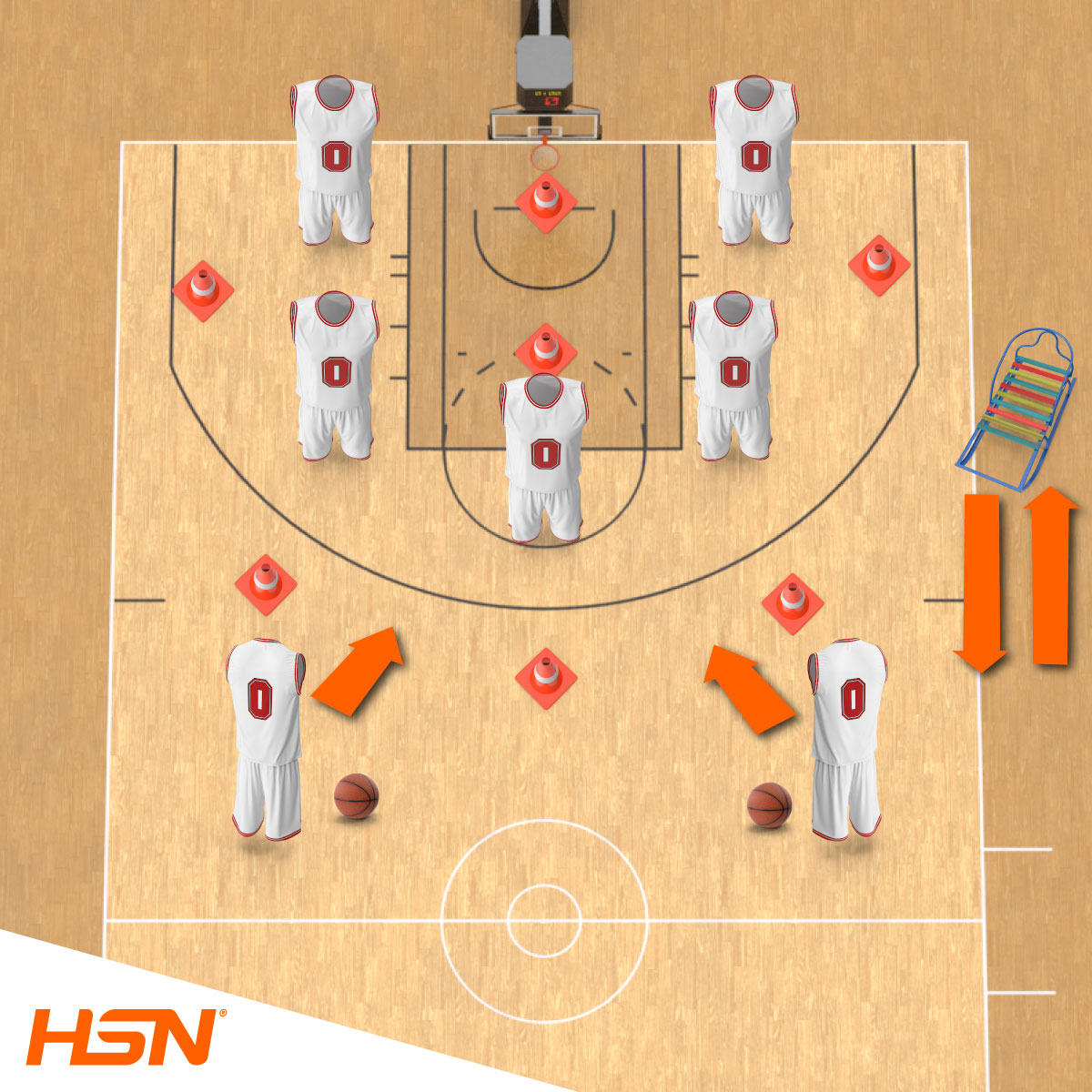
- Distribute 7-8 cones randomly on the court.
- Put 5 players on defensive position, there should be more cones than players defending.
- The cones are “bases” and the players need to prevent the two players with the ball from stealing them.
However, if the players with the ball manage to steal the cones, the defenders need to get out of the court and do 6 potency pushes of 5 meters of distance with a sled.
It should be enough with two sleds (one heavier than the other). If two players have to push the sled at the same time, one of them can push it first and the other brings it back where it was.
If a defender steals the ball from another player, they will switch places.
Variants:
- If the exercise is too difficult for the player with the ball, increase the number of cones or add another player.
- On the contrary, if the exercise is too easy for the player with the ball, use special glasses to make it harder to see. The player with the glasses will not be able to look to the ground in order to bounce or pick the cones.
4th Practical Example
Yes, I know, these exercises are quite straightforward, this one may even sound familiar.
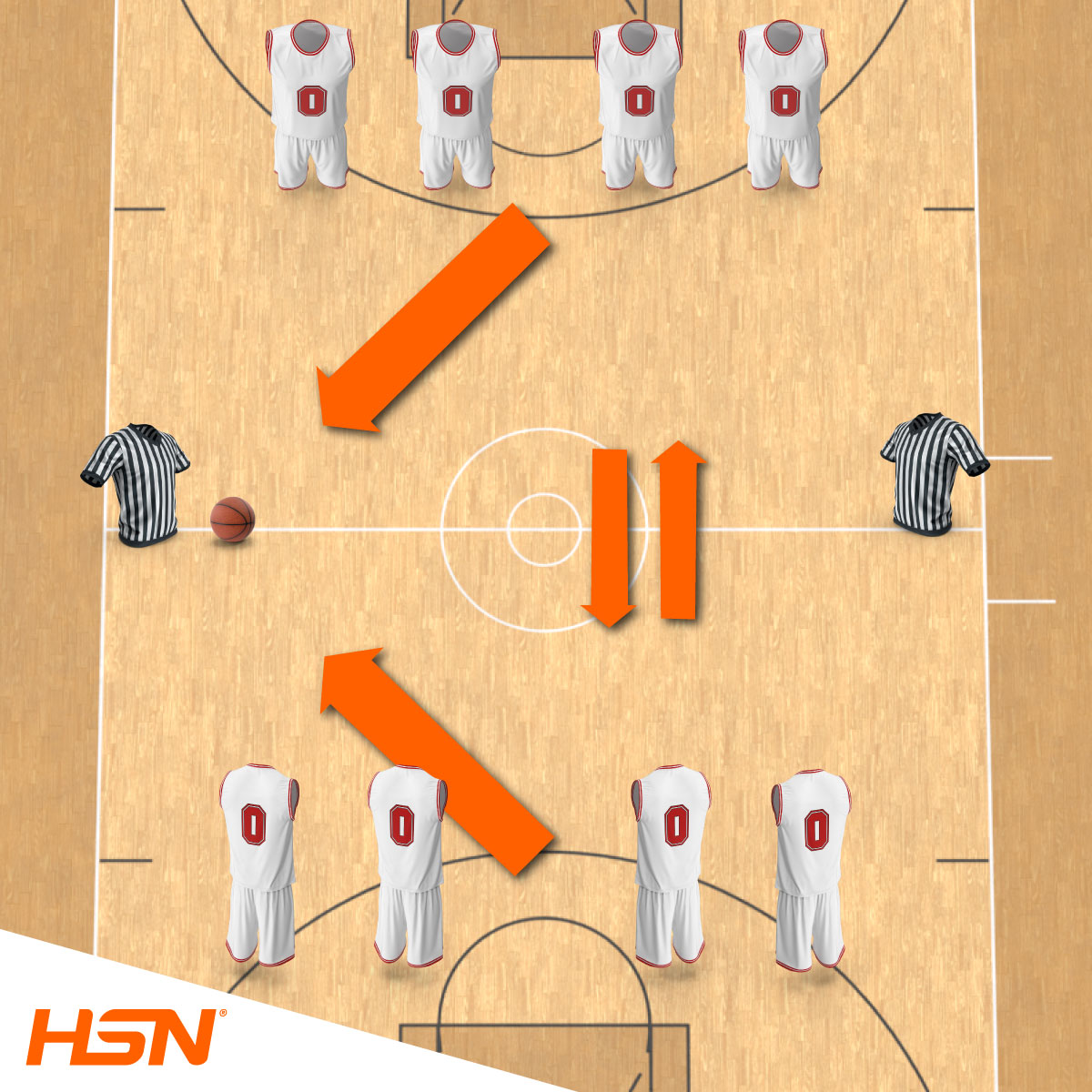
- Split the team in two groups and assign a number to each player (from 1 to X).
- Distribute them on both sides of the court.
- Just between the two teams, put:
- The coach on the right side.
- A helper on the left side with a ball in their hands.
The coach has to call out a number and the players with said number need to run, take the ball and cross the line of their team by bouncing the ball without the other player touching them.
Variants:
- If the game is too difficult for the player that takes the ball, the other player may have to lay on the ground and stand up when the other player takes the ball and then try to catch them. Although this rule does not make sense if we play in a small court because the other player would never be able to catch them.
All in all, this is a great exercise to work on the control of the ball, speed, direction changes, selective attention, reaction speed… And it is also quite fun!
Something as simple as these activities will encourage the players and make them laugh and feel more motivated. Moreover, I can guarantee that they are quite intense.
Play wisely, so that the members of the team will become true basketball players!
Then, players need to recover from these workouts. Despite the entertaining aspect of these activities, they are extremely exhausting. In fact, they produce EIMD (Exercise Induce Muscle Damage), a factor that will condition future workouts. In order to improve the recovery, they will need to be able to carefully control their diet.
Functional Training for Basketball: Supplementation
Supplementation plays a quite relevant role when it comes to improving the recovery from muscle damage, delayed onset muscle soreness and inflammation. Moreover, it will help to improve the muscle function. Here you have an interesting combination:
- 1000mg of vitamin C after the workout.
- 1000mg of curcuminoids with piperine, distributed in two servings (morning and night).
- 5g of L-glutamine after the workout.
You can also take:
- 4-6mg of caffeine per kg of body weight, 1 hour before the workout.
- 0.3g of creatine per kg of body weight (for 5 days before the start of the season) + 0.1g per kg of body weight.
Moreover, you should take at least 1.4g of protein per kg of weight a day and around 5g of carbohydrates per kg of weight. Although this is just an approximation.
The heaviest athletes may not be able to reach these numbers just with food. That is why they can also use:
- Evowhey 2.0
- Amylopectin 2.0 (waxy maize starch)
A winning combo to complement your daily diet in an efficient and tasty way of meet your nutrient requirements.
Bibliography
- Ciacci, S., & Bartolomei, S. (2018). The effects of two different explosive strength training programs on vertical jump performance in basketball. Journal of Sports Medicine and Physical Fitness, 58(10), 1375–1382.
- Harty, P. S., Cottet, M. L., Malloy, J. K., & Kerksick, C. M. (2019). Nutritional and Supplementation Strategies to Prevent and Attenuate Exercise-Induced Muscle Damage: a Brief Review. Sports Medicine – Open, 5(1), 1.
- Jiménez-Reyes, P., Samozino, P., Brughelli, M., & Morin, J. B. (2017). Effectiveness of an individualized training based on force-velocity profiling during jumping. Frontiers in Physiology, 7(JAN), 677.
- Kerksick, C. M., Wilborn, C. D., Roberts, M. D., Smith-Ryan, A., Kleiner, S. M., Jäger, R., … Kreider, R. B. (2018). ISSN exercise & sports nutrition review update: Research & recommendations. Journal of the International Society of Sports Nutrition, 15(1), 38.
- Samozino, P., Edouard, P., Sangnier, S., Brughelli, M., Gimenez, P., & Morin, J. B. (2014). Force-velocity profile: Imbalance determination and effect on lower limb ballistic performance. International Journal of Sports Medicine, 35(6), 505–510.
- Samozino, P., Rejc, E., Di Prampero, P. E., Belli, A., & Morin, J. B. (2012). Optimal force-velocity profile in ballistic movements-Altius: Citius or Fortius? Medicine and Science in Sports and Exercise, 44(2), 313–322.
- Siff, M. C. (2002). Functional training revisited. Strength and Conditioning Journal, 24(5), 42–46.