Fitness, Nutrition, Health and Sports Blog In the HSNstore Blog you will find tips about Fitness, sport in general, nutrition, and health – HSNstore.com

In order to make a protein classification, we need to know what they are made up of first
Proteins are macromolecules made up of a series of amino acids that are bound together by peptide bonds. Moreover, they are involved in each and every single one of the processes carried out by the metabolism.
In general, we take them from the diet and the body breaks them down in the stomach in order to synthesize its own proteins.
1. Amino acid types
This article is going to focus on the different types of proteins that exist.
Before we continue, it is indispensable to mention two types of amino acids in order to understand their structure properly.
These are the ones:
- Essential amino acids. These are all those amino acids that our body cannot produce. Therefore, it is necessary to obtain them from the diet.
- Non-essential amino aids. These are the ones that the body can synthesize from the essential ones.
2. Origin of Proteins
It is possible to make a differentiation between the proteins that come either from animals or plants.
In fact, the quality and intrinsic features of each type are quite different…
This would be the first criteria for protein classification:
Animal Protein
Evidently, animals have a genetic code that is much similar to ours than that of plants. Consequently, the amount of amino acids from their proteins is quite similar to ours.
That is why they have a high biological value
In fact, animal meat has all the amino acids our body needs and just in the right amounts.
Vegetable Protein
Vegetables are also excellent sources of amino acids. However, the problem is that they do not have all of them or the right amounts.
Therefore, we would need to combine several types of vegetables in order to obtain all the amino acids that we need.
3. Simple and Complex proteins
Once we understand the differences between the proteins from different foods, it is time to talk about their composition.
Therefore, another way to make a protein classification would be to talk about two big groups, which are:
Simple proteins
These are the ones that are only made up of amino acids or derivatives.
Moreover, they produce unique amino acids when they are hydrolyzed by enzymes, acids or alkalis.
Complex proteins
To put it simply, we use this term to talk about all those simple proteins that have a non-protein element within their structure.
There are known as protein groups
- Nucleoproteins (protein plus nucleic acid).
- Glycoproteins (protein plus carbohydrates).
- Phosphoproteins (protein plus phosphate).
- Chromoproteins (protein plus chromatic pigment).
- Lipoproteins (protein plus lipid).
- Metalloproteins (protein plus metal ion).
4. Types of protein according to their organic function
As we previously mentioned, the proteins that we take from the diet have to be broken down and metabolized. Therefore, our body will be able to produce different proteins that will help us perform many functions.
In fact, this process involves breaking down peptide bonds and separating the amino acids to produce completely different proteins.
Structural proteins
These are indispensable for all the tissues from our body, which is why they are structural proteins.
Inside this group, we can also find:
- Collagen, which is in charge supporting the connective tissue from the cartilage, skin, tendons, bones and muscles.
- Keratin, which is part of the nails, teeth and hair.
- Elastin, a macromolecule that provides flexibility and elasticity to the tissues and organs.
Hormonal proteins
To put it simply, hormones are protein released by the cells that make up the endocrine hormones.
Its main function is to send signals between the different cells that make up the organism. That is why they constantly travel through the bloodstream which is why they are also called “chemical messengers”.
Enzymatic proteins
Enzymes are in charge of supporting the reactions that take place inside the cells, that is why they are also known as catalysts.
In general, these proteins are in charge of transforming glycogen and glucose. Moreover, they play an indispensable hepatic and digestive functions apart from supporting the blood coagulation.
Defense proteins
Did you know that antibodies are essentially proteins?
Moreover, immunoglobulins are also made up of these type of macromolecules.
Therefore, they are in charge of protecting the organism against viruses, bacteria, fungi and, in general, all the microorganisms that could threaten our health and well-being.
Transport proteins
Without this type of proteins, the nutrients obtained during the digestion would not be able to reach the cells.
But they also transport many other types of substances and elements
For example, hemoglobin carries the oxygen from the lungs to each and every single one of the tissues so that they can function properly.
Then, myoglobin absorbs this oxygen and gives it to the muscle. In addition, albumin is in charge of transporting fat through the bloodstream.
Storage proteins
Our organism is always ready for periods of scarcity. That is why it always stores all kinds of substances in order to be able to deal with a potential deficiency.
This process is carried out by storage proteins, which are the ones in charge of storing some minerals. For example, iron, an indispensable mineral for the formation of hemoglobin.
Contractile proteins
The two main ones are actin and myosin, which are present in all the muscle tissues that make up the organism.
In fact, its main function is to regulate the contraction strength and speed
Receptor proteins
Have you ever wondered why are you thirsty or why you feel like eating a specific food?
Well, these reactions are due to receptor proteins. Their main function is to control the substances that enter and come out of all the cells. For example, minerals, water and all nutrients in general.
That is why, in case of detecting a deficiency of a substance, they will stimulate the endocrine glands in order to release hormones such as insulin, epinephrine or the digestive enzymes.
Conclusions
Perhaps, before reading this article, you may have though that proteins were only used to create muscle tissue.
In fact, if you are an athlete you probably take protein supplements in order to gain muscle and have bigger and more defined muscles. But you are also getting all the energy you need in order to perform vital processes.
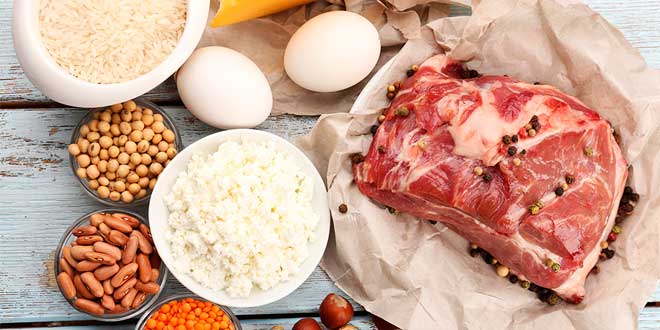
That is why you should also take care of your diet and balance the intake of animal and vegetable products
Related Entries
- Protein Synthesis
- What are Proteins?
- What are proteins used for?