 Fitness, Nutrition, Health and Sports Blog In the HSNstore Blog you will find tips about Fitness, sport in general, nutrition, and health – HSNstore.com

Anyone who follows my posts will know my relationship with the ketogenic diet is a love-hate one. I firmly believe that in cases like epilepsy or other pathologies, carb restriction should be a must-have tool to fight them. However, when it comes to fat loss, the ketogenic diet doesn’t offer any benefits you can’t get with a low-carb diet.
The problem we face is the food industry pushing us to eat carbs, the more the better…
Every day we get hit with messages like: “Our brain needs glucose to work,” “If you don’t eat carbs, you’ll get hypoglycemia and dizziness,” or “Eating too few carbs damages your kidneys.”
How would you feel if I told you none of these claims have a single study backing them up? You’d probably want to strip me of my pharmacist degree and lock me up somewhere like in “Shutter Island.”
Throughout this series of articles, you’ll see firsthand how our body is way more efficient than most people think, being able to live a normal life with minimal carb intake.
Myth 1: Carbs to avoid hypoglycemia
When our diet is low in carbs (and therefore glucose), our body kicks in a bunch of mechanisms that change the cell’s energy source, cutting down glucose use to burn fatty acids instead.
This way, your body saves glycogen for emergencies or higher priority needs, like keeping blood glucose stable or providing energy to cells that can’t use anything else, such as red blood cells, retina cells, or kidney medulla.
Even with zero carbs in the diet, our body can produce between 100-200 g of glucose from amino acids and fat (gluconeogenesis).
This effect on amino acid metabolism has led many experts to say athletes need to up their protein intake on a ketogenic diet. Personally, I don’t think you need to increase protein during keto since most athletes (and a good chunk of the general population) already cover their protein needs easily.
Plus, we have to keep in mind two important points:
- On one hand, there’s some evidence that ketone bodies reduce protein breakdown, which helps protect muscle mass.
- On the other, certain amino acids tend to be used to make glucose, like alanine or glutamine, which is why some think protein-rich foods can kick you out of ketosis.
In my view, glucose production can be split into 4 phases—or even 3 if you see glycogenolysis and gluconeogenesis as happening simultaneously. In the image below, you’ll see how the body can keep supplying glucose even after 40 days without food (3):
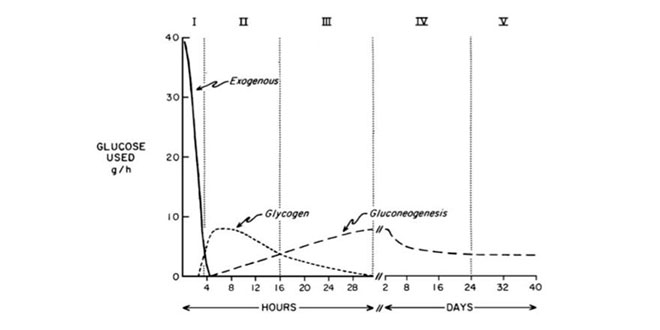
To break it down, here are the 4 phases:
Phase I
After several hours without carbs, the body cuts down glucose use by cells, making fatty acids the main energy source.
Phase II
The body taps into liver glycogen to keep glucose supply steady. Muscle can’t break down glycogen to release glucose into the blood, so its stores barely change.
Phase III
Liver glycogen starts running low, so the body turns to amino acids and fatty acids to make glucose. This is the transition phase.
Phase IV
Liver glycogen is gone, so gluconeogenesis becomes the main source to meet glucose needs for the coming weeks.
Standard Diet VS Low-Carb Diet Comparison
Like I said earlier, the glucose produced is enough to cover certain tissues’ needs. In fact, if you look at the big picture, glucose only accounts for about 10% of total energy needs (the other 90% comes from fatty acids and ketone bodies).
This situation doesn’t change much on a zero-carb diet; many effects of the ketogenic diet also happen during prolonged fasting.
Since I know some critics will say keto isn’t the same as fasting, let’s see what happens to blood glucose on a low-carb diet. Check out this study (2) where participants ate a “standard” diet with 60% carbs, 30% fat, and 10% protein for 2 days.
After those 48 h, they switched to the same calorie amount but with 5% carbs, 60% fat, and 35% protein for a week. Here’s what happened:
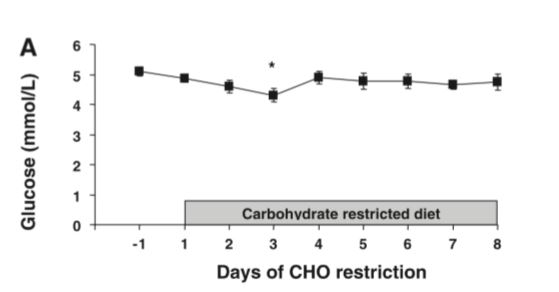
Despite a slight dip in glucose during the first days, it bounced back to pre-intervention levels by day 4 and stayed stable after that. One key detail: just 24 h on keto cut glucose use as an energy source by 43%.
Personally, I think on very low-carb diets, the body avoids burning glucose system-wide to help store it, as shown in the chart below:
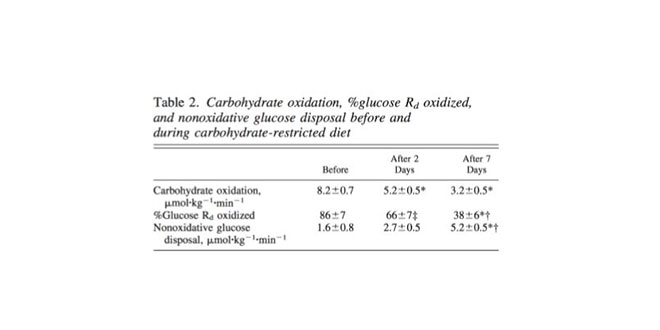
Lower %Rd oxidized glucose could explain why glucose made by gluconeogenesis isn’t used as energy
Conclusions
In short, there’s no need to eat carbs every 3 hours or stuff yourself with them to avoid hypoglycemia. Our body has several ways to keep glucose supply steady—even for weeks without eating glucose.
So don’t let yourself be fooled by ads promising morning energy or scare tactics about not giving your kids “dinosaur cookies.” Your health and theirs will thank you.
Sources
- 1.Low-carbohydrate nutrition and metabolism. Eric C Westman, Richard D Feinman, John C Mavropoulos, Mary C Vernon, Jeff S Volek, James A Wortman, William S Yancy, and Stephen D Phinney
- 2.Alterations in carbohydrate metabolism in response to short-term dietary carbohydrate restriction. Matthew P. Harber, Simon Schenk
- 3.FUEL METABOLISM IN STARVATION. George F. Cahill
- 4.Alterations in carbohydrate metabolism in response to short-term dietary carbohydrate restriction Matthew P. Harber,1 Simon Schenk