Fitness, Nutrition, Health and Sports Blog In the HSNstore Blog you will find tips about Fitness, sport in general, nutrition, and health – HSNstore.com

When we talk about protein synthesis, we know it’s key for building lean mass; but do we really know how muscle proteins are synthesized from the proteins we eat? In this post, we break down the process in a simple and visual way.
Proteosynthesis
It’s the process by which new proteins are made from the twenty essential amino acids. The process has two stages:
- Messenger RNA translation, where the amino acids of the polypeptide are precisely ordered based on the information in the DNA nucleotide sequence.
- Post-translation modifications that the formed polypeptides undergo until they reach their functional state.
In this process, DNA is transcribed into RNA. Protein synthesis happens in ribosomes located in the cell cytoplasm. During this, amino acids are carried by transfer RNA (tRNA) to the messenger RNA (mRNA).
Messenger RNA carries the info for protein synthesis, meaning it determines the order in which amino acids join. This info is coded in triplets, every three bases form a CODON that specifies an amino acid. The matching rules between codons and amino acids make up the genetic code.
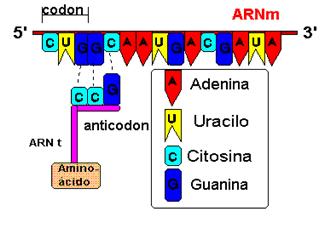
Once the amino acid is on the mRNA, the codon of the amino acid pairs with the anticodon of the transfer RNA by base complementarity (like a puzzle), placing them in the right spot.
The process has 4 phases:
- Activation of amino acids
- Joining of the smaller and larger ribosomal subunits to form the active or ribosomal complex.
- Elongation of the ribosomal chain.
- Protein synthesis termination, where so-called nonsense triplets, also known as “stop codons,” appear. These triplets are UGA, UAG, and UAA. There’s no tRNA with a complementary anticodon. So, synthesis stops, signaling the polypeptide chain is complete.
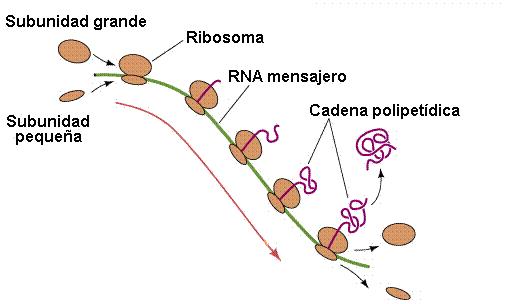
Once protein synthesis finishes, the messenger RNA is free and can be read again. In fact, it’s common that before one protein finishes, another is already starting, so the same mRNA molecule is being used by several ribosomes simultaneously.
Sources
- Calderón Montero, FJ. (2007). Applied Physiology to Sport (2nd ed). Tébar Ed. Madrid.
- Ganong, WF. (2006). Medical Physiology (18th ed). El Manual Moderno Editorial. Mexico City.
Related Posts