Fitness, Nutrition, Health and Sports Blog In the HSNstore Blog you will find tips about Fitness, sport in general, nutrition, and health – HSNstore.com

In this article, you’ll discover the importance of playing with carbohydrate amounts to maximise your performance.
If you’ve followed me for a while, you’ll know that I’m a big fan of cycling both calories and carbohydrates.
As I’ve written in some articles before, following a low-carb days protocol with 1-2 days of REFEEDSs (days with high carbohydrate intakes) helps improve fat loss thanks to its effect on T3 and leptin (among other factors).
Carbohydrates and Type of activity
Carbohydrates play an important role in training, especially in two specific situations:
- Long-duration training (+ 3 hours), such as with people training for a marathon or Ironman.
- High-intensity workouts (above 80% VO2max), where glucose consumption at the cellular level skyrockets.
However, for endurance athletes, it’s good to use both metabolic pathways, both fats and carbohydrates.

For this, the cell (especially the mitochondria) must be efficient when using the different substrates.
When carbohydrates are restricted, a greater expression of enzymes related to the oxidative capacity of the cell (1) is achieved, in other words, it favours the use of fat as an energy source.
This phenomenon is due to the fact that when we have a low amount of glycogen (glucose), a series of mechanisms are put in place that can save glucose by using more fatty acids, although as they show in this study, “it does not translate into higher performance during high intensity exercise”.
Cellular expression and training
Muscle contraction (especially weights) is a powerful stimulator of gene expression related to the synthesis of mitochondria (greater number of mitochondria, greater performance), in addition to providing other benefits at the muscle level.
At a mitochondria level, the training acts in four ways , with 2 of particular interest:
- Control of the expression of mitochondrial DNA genes by the transcription factor Tfam
- Mitochondrial fission and fusion mechanisms
And the fusion of mitochondria helps the muscle become much more “effective” when using energy (5,6). Training, along with low-carb diets, helps increase this process.
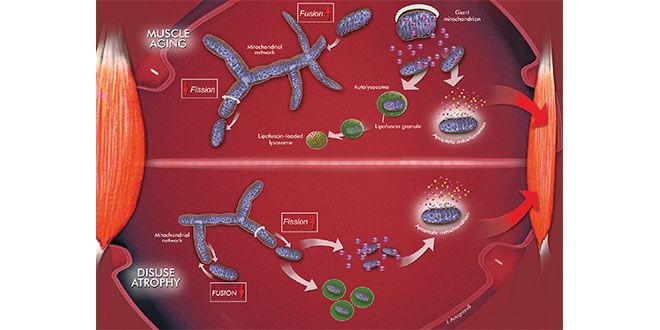
When mitochondria fusion decreases, the likelihood of muscular atrophy increases
Post-workout Carbohydrate Suppression
This study (10) shows how the intake of carbohydrates or post-training placebo affected the expression of proteins related to the synthesis of mitochondria (where the p38 that I just mentioned is found).

HI-LO = SUBJECTS WHO CONSUMED PLACEBO POST-TRAINING
HI-HI = SUBJECTS WHO CONSUMED POST-TRAINING CARBOHYDRATES
The expression of p38 was much higher in the group that consumed post-workout placebo during the afternoon training session than in those that consumed carbohydrates.
My personal opinion is that the intake of carbohydrates or fats lower the AMPK pathway, altering the “adaptation” generated by training.
What about post-workout protein?
Other studies have found that this does not occur with post-workout protein.
Athletes with type I fibres
If we focus on the type of fibre, the most beneficial are those of type I, as the presence of mitochondria and oxidative capacity is very high.
What athletes have a high number of these fibres?
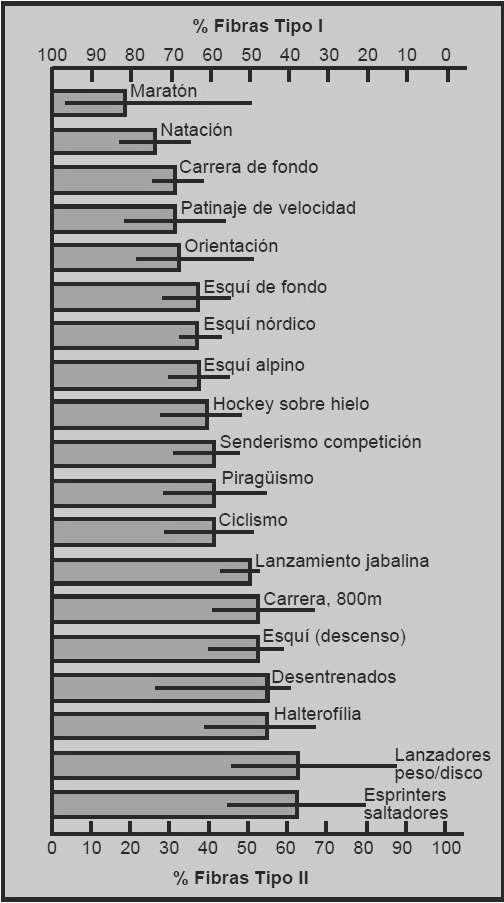
If you look at the dat, those with the most type I fibres are people who do marathons, swimming, cross-country running…etc.
It is in this group of people that the most benefits will be seen when increasing the number and size of mitochondria, as they’ll generate more energy from less substrate, what I call “metabolic effectiveness“.
This means that the athlete will delay the onset of muscle fatigue by making less use of glucose.
Conclusions
As I always say, the best way to improve performance is using both fuels, don’t base your peri-training on only carbs or fats. Your muscles will thank you.
Cheers! S.Espinar
Bibliographic Sources
- Reduced carbohydrate availability does not modulate training-induced heat shock protein adaptations but does upregulate oxidative enzyme activity in human skeletal muscle. Morton JP1, Croft L, Bartlett JD, Maclaren DP, Reilly T, Evans L, McArdle A, Drust B.
- The effect of squat depth on multiarticular muscle activation in collegiate cross-country runners. Gorsuch J1, Long J, Miller K, Primeau K, Rutledge S, Sossong A, Durocher JJ.
- Control of gene expression and mitochondrial biogenesis in the muscular adaptation to endurance exercise. Joseph AM1, Pilegaard H, Litvintsev A, Leick L, Hood DA.
- Association of the mitochondrial transcription factor (TFAM) gene polymorphism with physical performance of athletes. Akhmetov II
- Mitochondrial Fission Contributes to Mitochondrial Dysfunction and Insulin Resistance in Skeletal Muscle. Huei-Fen Jheng
- New Insights into the Role of Mitochondrial Dynamics and Autophagy during Oxidative Stress and Aging in the Heart. Yoshiyuki Ikeda
- Exercise stimulates Pgc-1alpha transcription in skeletal muscle through activation of the p38 MAPK. Akimoto T
- AMP-activated protein kinase (AMPK) action in skeletal muscle via direct phosphorylation of PGC-1alpha. Jager. S
- Regulation of 5=-AMP-activated protein kinase activity and substrate utilization in exercising human skeletal muscle
- Carbohydrate feeding during recovery alters the skeletal muscle metabolic response to repeated sessions of high-intensity interval exercise in humans.
Cochran AJ1, Little JP, Tarnopolsky MA, Gibala MJ. - Mitochondrial functional specialization in glycolytic and oxidative muscle fibers: tailoring the organelle for optimal function. Martin Picard
- http://www.altorendimiento.com/revista-alto-rendimiento/05-entrenamiento-velocidad-triatlon-nutricion-ciclismo/1496-velocidad-potencia-y-explosividad
Related Entries
- Have you heard of Carbohydrate Rinsing? Check out this post.
- All about Post-Training Carbohydrates! Click here.