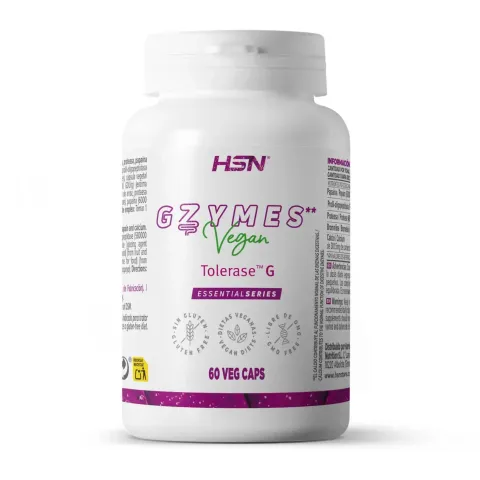
Gzymes (Enzyme Blend) will become your greatest ally
Gzymes (Enzyme Blend) from EssentialSeries is a food supplement in vegetable capsules, made with a specific blend of enzymes for use in food and calcium.
HSN Gzymes (Enzyme Blend) combines calcium carbonate, as calcium contributes to the normal function of digestive enzymes, with prolyl oligopeptidase, papain, bromelain and protease.
Try this blend of 4 high-concentration enzymes!
Gzymes (Enzyme Blend) formula - here’s everything you need to know!
Where did the idea come from?
At HSN, we research and have specialist teams studying what the market needs. Our products have a clear purpose: to help improve quality of life. That’s why you won’t find formulas in our range without a clear goal, or ones based on marketing ideas that sound appealing but lack substance. Our formulas are tailored to people’s needs.
Gzymes (Enzyme Blend) has a specific formula based on enzymes for use in food, including a patented prolyl oligopeptidase registered by DSM as Tolerase™ G.
Discover Gzymes (Enzyme Blend)!
How we chose the enzymes
The enzymes in the Gzymes (Enzyme Blend) formula were selected for the synergy they may have with one another.
Gzymes (Enzyme Blend) contains:
- Papain.
- Prolyl oligopeptidase.
- Protease.
- Bromelain.
All are present at optimal concentrations. Together with their enzyme activity**, they make Gzymes (Enzyme Blend) a complete, high-quality food supplement you won’t want to miss.
Why does it contain calcium?
You might be wondering why we’ve added calcium to a product that combines enzymes for use in food. Why?
Every ingredient in our formulas is there for a well-founded reason, not because of mysticism. Calcium has been added to Gzymes (Enzyme Blend) because it contributes to the normal function of digestive enzymes.
Tolerase™ G: discover an innovative patented ingredient
Tolerase™ G is the registered trademark DSM uses for its patented process for developing the endopeptidase enzyme prolyl oligopeptidase.
This patented ingredient is internationally recognised, not just because of the reputation of the company behind it, but also because of the studies supporting it (see References) and its unique, specific structure.
Some key features of DSM’s patented enzyme are:
- Prolyl oligopeptidase is an enzyme preparation with an activity above 580 000 PPI/g (1).
- Thanks to its chemical composition, prolyl oligopeptidase is a peptidase enzyme capable of hydrolysing proline bonds (prolyl). Gluten is a prolamin, a protein naturally rich in proline (2).
- Tolerase™ G is stable and active in the acidic environment of the stomach.
- It is resistant to digestion by pepsin.
- It isn’t synthetic - It’s an enzyme developed from food-grade Aspergillus niger.
High-concentration enzymes with high activity** - how to recognise them
With enzymes, there’s more to consider than with other ingredients, which are traditionally measured only by mass. For a compound like creatine, the key figure is the amount used: once you know that, you know its effects. Enzymes work differently:
For enzymes used in food, it’s not just the amount that matters (though it does). Their activity**, or the enzyme capacity of each one, is also important. We’ve taken this into account, both when researching the activity levels** associated with a positive property and when choosing a raw material with the highest certified concentration.
Our Gzymes (Enzyme Blend) has the following nutritional composition:
| Enzyme | Concentration | Activity** / dose |
| Papain | 6000 USP/mg | 300000 U |
| Prolyl oligopeptidase | 580000 PPI/g | 87000 U |
| Protease | 450000 HUT/g | 25500 U |
| Bromelain | 2500 GDU/g | 250 U |
The abbreviations used for concentration refer to units of activity** measured against a substrate:
- UPS: units as defined by the United States Pharmacopeia.
- PPI: one PPI is defined as the amount of enzyme needed to release one picomole of pNA from Z-Gly-Pro-pNA in 1 s under the assay conditions.
- HUT: haemoglobin units on a tyrosine basis (a measure of proteolytic activity).
- GDU: gelatin digestion units (another measure of proteolytic activity).
More products in this category you might like
At HSN, we have a wide range of products designed for different gut-related purposes.
Explore our probiotics, other enzyme products such as lactase, fibres such as psyllium or glucomannan, and more.
Find all the products in our 'Digestion' category.
References
- (1) Specifications for the prolyl oligopeptidase enzyme preparation, Annex I, COMMISSION IMPLEMENTING DECISION (EU) 2017/1387 of 24 July 2017 authorising the placing on the market of a prolyl oligopeptidase enzyme preparation produced with a genetically modified strain of Aspergillus niger as a novel food ingredient under Regulation (EC) No 258/9.
- (2) Safety of proline-specific oligopeptidase as a novel food pursuant to Regulation (EC) No 258/97 Safety of proline‐specific oligopeptidase as a novel food pursuant to Regulation (EC) No 258/97 (wiley.com).
- SCIENTIFIC OPINION: Scientific Opinion on the substantiation of health claims related to calcium and maintenance of bones and teeth (ID 224, 230, 231, 354, 3099), musclefunction and neurotransmission (ID 226, 227, 230, 235), blood coagulation(ID 230, 236), energy-yielding metabolism (ID 234), function of digestive enzymes (ID 355), and maintenance of normal blood pressure (ID 225, 385,1419) pursuant to Article 13(1) of Regulation (EC) No 1924/2006 https://efsa.onlinelibrary.wiley.com/doi/epdf/10.2903/j.efsa.2009.1210
- Salden, B. N., Monserrat, V., Troost, F. J., Bruins, M. J., Edens, L., Bartholomé, R., … Masclee, A. A. (2015). Randomised clinical study: Aspergillus niger-derived enzyme digests gluten in the stomach of healthy volunteers. Alimentary Pharmacology and Therapeutics, 42(3), 273–285.
- Tanner, G. J. (2021). Relative Rates of Gluten Digestion by Nine Commercial Dietary Digestive Supplements. Frontiers in Nutrition, 8, 784850.
- Dunaevsky, Y. E., Tereshchenkova, V. F., Belozersky, M. A., Filippova, I. Y., Oppert, B., & Elpidina, E. N. (2021). Review effective degradation of gluten and its fragments by gluten-specific peptidases: A review on application for the treatment of patients with gluten sensitivity. Pharmaceutics, 13(10).
- Stepniak, D., Spaenij-Dekking, L., Mitea, C., Moester, M., De Ru, A., Baak-Pablo, R., … Koning, F. (2006). Highly efficient gluten degradation with a newly identified prolyl endoprotease: Implications for celiac disease. American Journal of Physiology - Gastrointestinal and Liver Physiology, 291(4), G621-9.
- Yoosuf, S., & Makharia, G. K. (2019). Evolving therapy for celiac disease. Frontiers in Pediatrics, 7(MAY), 193.
- Mitea, C., Havenaar, R., Wouter Drijfhout, J., Edens, L., Dekking, L., Koning, F., & Dekking, E. H. A. (2008). Efficient degradation of gluten by a prolyl endoprotease in a gastrointestinal model: Implications for coeliac disease. Gut, 57(1), 25–32.
- The Efficacy of Plant Enzymes Bromelain and Papain as a Tool for Reducing Gluten Immunogenicity from Wheat Bran.
- Combination of Gluten-Digesting Enzymes Improved Symptoms of Non-Celiac Gluten Sensitivity: A Randomized Single-blind, Placebo-controlled Crossover Study.
** Prolyl oligopeptidase 580000 PPI/g | Bromelain 2500 GDU/g | Protease 450000 HUT/g | Papain 6000 USP/mg.