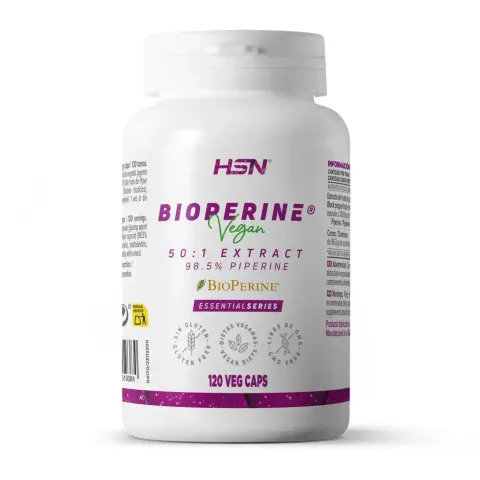
A quality black pepper extract: BioPerine®
BioPerine® black pepper extract (50:1) 20 mg from Essentialseries is a capsule-based supplement of patented black pepper extract, developed by Sabinsa Corporation in 1996, and over the decades has stood as the international reference for high‑piperine black pepper extracts. HSN's formula includes a source of chromium to help improve blood glucose control.
It’s a patent that has been used in hundreds of scientific studies since its launch. It’s so established and considered so normal that it’s the best option for black pepper extract that many people know the main active compound of black pepper not as 'piperine' but as 'bioperine.' Sabinsa’s patent has been manufactured with the quality control and production standards of HSN dietary supplements.
HSN’s black pepper extract uses the best raw material for this extract, with a high unit concentration of 20 mg per vegetable capsule.
BioPerine® is the reference patent for piperine
What is BioPerine® and why is it so well known?
BioPerine® emerged as a revolution in the field of dietary supplements, since it’s a very important phytonutrient: Piperine, from a natural source in a very high concentration.
Over the years, researchers in the botanical use of plant species for nutritional goals have chosen this raw material for its high purity and practicality; and over time it has firmly established itself as the absolute market reference.
BioPerine® can be defined as a natural extract from sustainably cultivated black pepper fruit in India, concentrated 50 times more than its source material and providing a guaranteed, high-purity content in the main bioactive of the species: piperine. It’s also recognized as GRAS in the US, vegan, kosher, halal, and not genetically modified.
Sabinsa: a leading company in R&D of phytochemicals
Sabinsa Corporation is a multinational health sciences company focused on research and one of the world’s leading producers of nutraceuticals, cosmeceuticals, standardized herbal extracts, and probiotics. It was founded in 1988 by Dr. Muhammed Majeed, a scientist and internationally renowned entrepreneur.
Sabinsa has made a name for itself thanks to its broad support for research for its clients and products, and the scientific credentials of its key technical staff.
Sabinsa’s mission is to provide proof-based natural products for functional nutrition and human well‑being.
In the last 30 years, Sabinsa has launched over 100 standardized botanical extracts and privately funded several clinical studies in collaboration with prestigious institutions in support of these products.
With more than 120 full-time scientists conducting ongoing research in India and the United States, Sabinsa continues to develop and patent phytochemicals for the global market.
All consumer products are Kosher and Halal certified.
HSN Formula - with chromium for optimal effectiveness
At HSN we didn’t just encapsulate BioPerine® raw material, we’ve given the product our personal touch by adding a significant amount of chromium picolinate, since this element is important for maintaining blood glucose balance.
Enjoy maximum product effectiveness thanks to HSN’s formula, more complete yet fully preserving the essence of the purest quality black pepper extract, without complex formulations.
Animal‑free development in vegetable capsules
In HSN’s formula we’ve added good stuff like chromium picolinate, along with high‑capacity vegetable capsules to hold the 20 mg of BioPerine®, precisely dosed per unit; but what we didn’t add is anything bad.
Our product gives you more, with less; it contains no animal additives in its formula, so it’s completely vegan friendly, and it’s also cleaner label, because it barely contains additives, and the ones it does contain are nutritional compounds, like leucine to help prevent clumping; or calcium phosphate, a mineral salt used for the same purpose.
No endless ingredient lists or product overload! BioPerine® from HSN is a simple and effective development.
High concentration: 20 mg of BioPerine® per capsule
The black pepper extract, specifically piperine as the main active compound of greatest interest, has a dosage range from about 5 mg up to 20 mg, being the reference dose for single‑ingredient products where piperine isn’t part of a complete formula, but a single compound intended to pair with other nutrients based on user interest.
Many market products are dosed universally at '5 mg' due to lack of research and knowledge, which causes part of BioPerine®’s potential to be lost; at HSN we’re committed to scientific research and have evaluated different dosages for our product, leaning toward the higher concentration that guarantees effectiveness and safety for effective pairing with other products like turmeric extract, vitamins, or amino acids.
With just one vegetable capsule you’ll get all the benefits of the maximum effectiveness of black pepper extract in your nutrition.
Sustainably grown black pepper from India
Black pepper is a plant that, like any other, must be cultivated, harvested, and treated according to the quality criteria needed to obtain a good product.
Due to the culinary interest sparked by black pepper, used as a spice in kitchens around the world, and with Indian origin being the most valued, pepper from India has been exploited and plantations of this species are causing a large negative impact on the environment in the region.
At HSN we reject exploitation in farming and livestock in all our products and we don’t use raw materials that don’t meet quality criteria, not only nutritionally but ethically; that’s why our herbal extracts are prepared with sustainable‑grown plants, something Sabinsa also guarantees and that has led us to unambiguously choose BioPerine® as the best patent.
Key compounds to use BioPerine® with
Piperine has traditionally been used in combination with many other compounds, which is why it appears in so many HSN formulas and those of other brands, most commonly paired with turmeric extract, but not all pepper extract combinations are limited to turmeric; other options include:
Have the BioPerine® black pepper extract on hand always to pair with your favorite compounds!
Why use an extract rather than regular black pepper?
The BioPerine® black pepper extract is standardized, meaning the content of piperine is standardized and always the same.
This is a big plus since there’s no variability, unlike the traditional black pepper fruit, which, not being standardized, can show highly variable piperine concentrations depending on harvest, soil, irrigation, exposure to environmental factors, etc.
Additionally, BioPerine® extract has a high purity around 98.5% piperine, while the native pepper fruit is around 5% piperine.
In short:
- To take advantage of the nutritional and physiological effects of black pepper: the extract is the best option.
- To take advantage of culinary applications, flavor and pungency: the fruit (whole or ground) is the ideal option.
References
- Kesarwani, K., & Gupta, R. (2013). Bioavailability enhancers of herbal origin: An overview. Asian Pacific Journal of Tropical Biomedicine, 3(4), 253–266.
- Hegde, M., Girisa, S., BharathwajChetty, B., Vishwa, R., & Kunnumakkara, A. B. (2023). Curcumin Formulations for Better Bioavailability: What We Learned from Clinical Trials Thus Far? ACS Omega, 8(12), 10713–10746.
- Srinivasan, K. (2007). Black pepper and its pungent principle-piperine: A review of diverse physiological effects. Critical Reviews in Food Science and Nutrition, 47(8), 735–748.
- Fernández-Lázaro, D., Mielgo-Ayuso, J., Martínez, A. C., & Seco-Calvo, J. (2020). Iron and physical activity: Bioavailability enhancers, properties of black pepper (BioPerine®) and potential applications. Nutrients, 12(6), 1–12.
- Haq, I. U., Imran, M., Nadeem, M., Tufail, T., Gondal, T. A., & Mubarak, M. S. (2021). Piperine: A review of its biological effects. Phytotherapy Research, 35(2), 680–700.
- Badmaev, V., Majeed, M., & Prakash, L. (2000). Piperine derived from black pepper increases the plasma levels of coenzyme q10 following oral supplementation. Journal of Nutritional Biochemistry, 11(2), 109–113.