Fitness, Nutrition, Health and Sports Blog In the HSNstore Blog you will find tips about Fitness, sport in general, nutrition, and health – HSNstore.com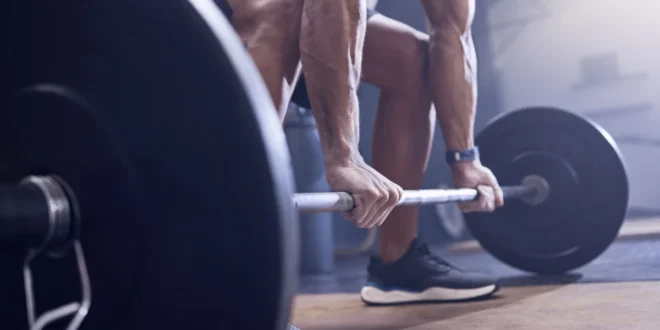

Following on from our posts on High Intensity Workout, it’s time to use a new element or “tool”. It is none other than the barbell and discs that we’ve all used at some point or other. Only this time we’re going to do things a little differently, performing exercises that provide us with advances in cardiovascular training in combination with strength-resistance.
Why Train with a Barbell?
Your barbell workout may have been limited to conventional sets before, likely with squats or deadlifts
But I’m going to propose a type of training through which you can obtain similar benefits to cardio or hiit, that’s enjoyable, fun, motivating… the only material needed is a bar and discs to load it! Up to the challenge?
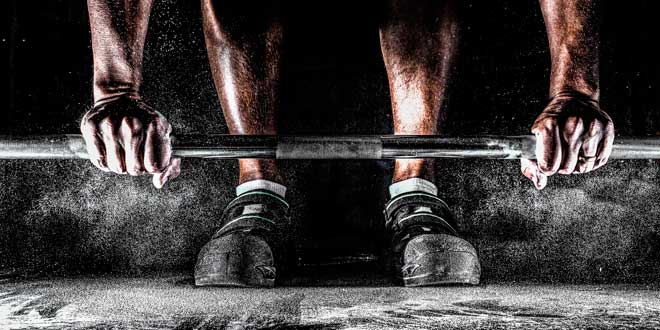
During this training, you’ll spend a lot of time at the barbell, and it’ll become an ally for performance improvement and obtaining an aesthetic and functional body.Little by little, you’ll become obsessed with it!
Barbell Complex
This is a series of exercises performed consecutively using the bar itself, executed in an explosive but controlled way.
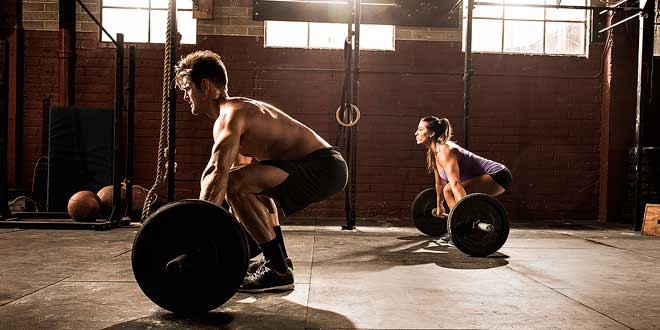
It’s the closest thing to doing a training circuit but with the barbell as the only element
Benefits Barbell Workout
In terms of benefits for our body and performance:
- It improves cardiovascular capacity
- It increases muscle endurance
- It preserves muscle mass, especially for low-calorie diets, without the need for cardio, avoiding the dreaded effect of cortisol. This hormone is the so-called stress hormone, and it’s primarily responsible for our body storing fat in certain places, such as the lower abdomen, and above all producing greater deterioration of muscle tissue
- It creates a hormonal anabolic environment, thanks to the type of exercises that are carried out, of a multi-joint nature, which will help us reduce fat, as we achieve with standard cardio, but at the same time accentuating the processes of creating new muscle tissues
- It burns a high number of calories and promotes post-burning effect
- It requires little time to perform
- They are fun exercises, unlike standard cardio. It’s much more enjoyable to exercise with the barbell
- It’s fully customisable for the user, with the number and type of exercises, the number of repetitions and sets…
After-Burn Effect
As always with the articles I write, I like to emphasise the internal process that takes place through performance of the exercises I recommend. For the case in question, the main focus of the barbell complex is the effect on fat burning, even after the end of the training session.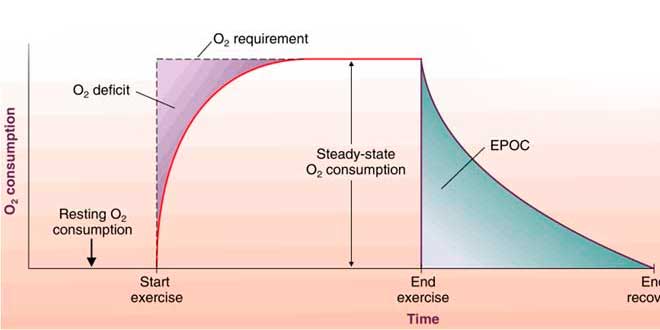
After an exercise exceeds a threshold of a certain intensity, something called EPOC (Excess Post-exercise Oxygen Consumption) occurs, where the body “still” needs oxygen at a high rate. It’s also known as oxygen debt, meaning the oxygen that the body needs to recover after exertion.
What happens during EPOC?
- Replenishment of energy sources. The quickest of these is the immediate energy source, the phosphate system, composed of phosphocreatine or creatine phosphate (PCr) and ATP (adenosine triphosphate). Added to this is the transformation of lactate, a metabolic residue produced by high-intensity exercise, to pyruvate, for use as a fuel. The body will tend to restore the muscle glycogen consumed during exercise
- Blood re-oxygenation and Restoration of Circulatory Hormones. Over the course of the sports session, large amounts of oxygen will have been metabolised as an energy substrate. And the body continues to need reoxygenation immediately after the activity ends
- Reduced Body Temperature. With the release of energy by the muscle tissues, the temperature rises. Thus, during EPOC, the body must expend energy to return to the starting point, the baseline temperature
- Return to Normal Breathing and Basal Pulse. Both rhythms have risen during activity, and gradually return to their previous state
EPOC and Weight Loss
High intensity exercise causes a greater disruption (or greater impact…) of homeostasis, and because of this the body will have to work harder to return to its previous state, as reflected in the processes above.
This also causes the consumption of a greater percentage of calories, and especially of fat. If you add to this a proper diet to it, and you continue to do so, in a short time you’ll see big improvements in your figure.
Things to Consider When Performing a Barbell Complex
The main points to consider are related to:
Technique
Most of these barbell exercises, being multi-joint, require the use of a large set of muscles, and correct technique is essential in order to avoid possible injuries and to help us progress. 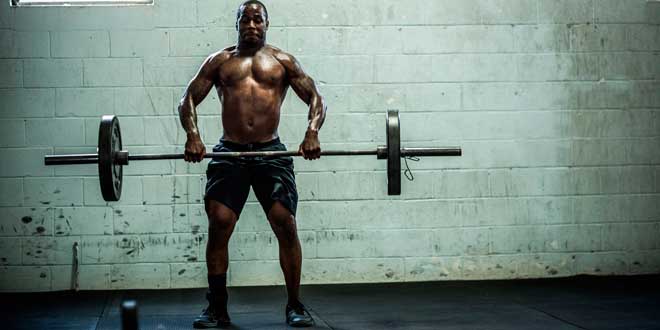
If you have a coach available in the room who can explain the exercise correctly, that would be ideal. If not, then practice, practice, practice…
Physical Condition
Although the intensity is imposed by the person themselves, after several repetitions their physical condition will start to show, for better or worse. My recommendation here would be to increase your endurance and cardiovascular capacity.
Barbell “Flow”
This term refers to how although the movements in the sequence are not the same, they will maintain a certain harmony between them.
So for example, if we start with a push press, and then perform a power clean, they don’t work well together, as we start from the vertical and then move to the low plane. If you want to combine another sequence, starting with a power clean, then a front squat followed by a push press would be much better.You can see the correlation between movements in the sequence, with everything more fluid.
Don’t worry, you’ll see it more clearly in the description of exercises…
Barbell Workout Exercises
A number of exercises can be carried out with the available material, although some of them will need to be worked on, especially in terms of technique. You’ll have to start with less weight and more repetitions to master the movement first.
This should be done thoroughly, otherwise our ability to progress and increase the amount of kilograms on the bar will be impaired.
Deadlift
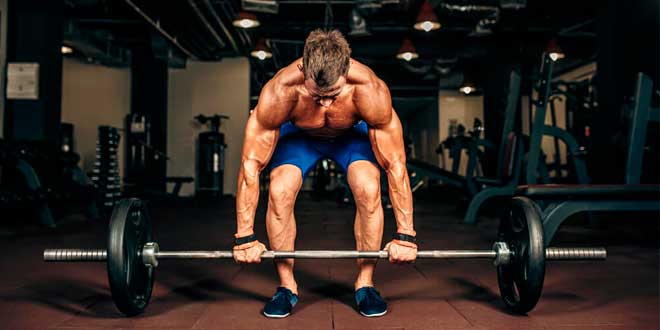
Like the traditional deadlift, but this time adding a “touch & go” feature. Every time you do a rep, the bar must touch the ground. Another variable is the Snatch Grip Deadlift, which generates a certain deficit. The weight to be lifted in the latter will be less than the conventional one.
Squat
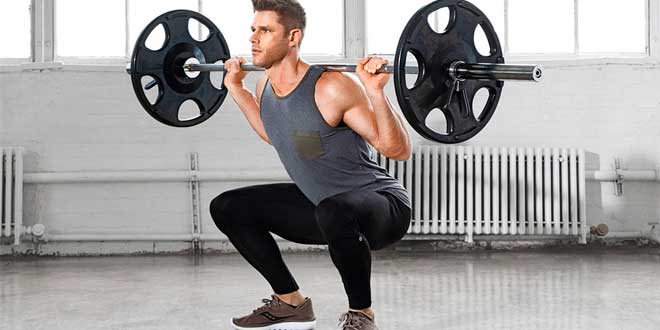
“Our squat”, the one you’ve been doing since forever, is one of the best exercises to work the lower body.
Front Squat
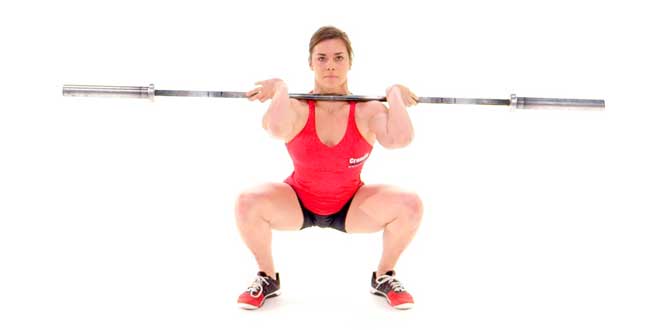
Very similar to the previous one, but with the grip in front. Wrist mobility is essential for correct movement and of course to prevent injury.
For more information, check out the post on the Benefits of the Front Squat45 Row
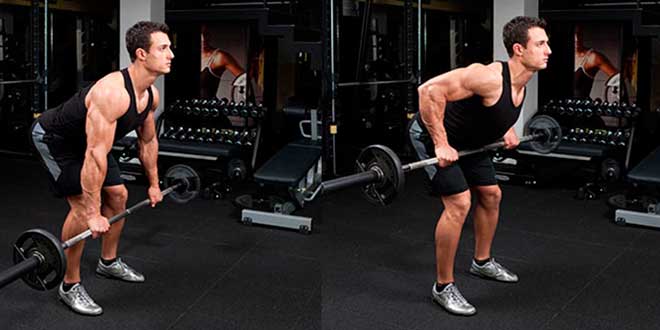
This exercise is the conventional standing row performed in weight routines. You can use a normal or reverse grip. There is little more to say about its execution, except that the position of the lower back is somewhat arched, bringing the buttocks back, and sticking out the chest.
Lunges
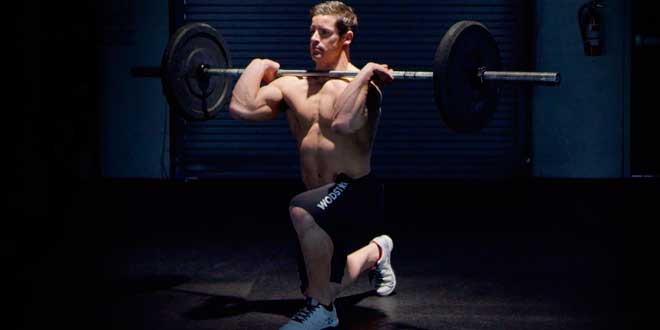
An extraordinary unilateral exercise for legs. The bar can be placed in front (like a front squat) or behind (like a back squat). Or we can also “walk” forwards, or backwards (reverse lunge).
“Good Morning”
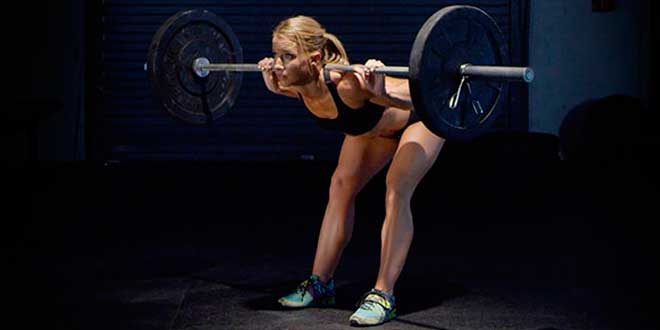
This is the exercise par excellence for working the posterior chain… For its execution, we’ll start from the same position as the squat, then lean forward, with the legs almost straight, noting the hyperextension of the femorals and glutes.
Weightlifting Exercises
These exercises are needed to consecutively chain the different exercises. If we start with the bar on the ground, how do you expect it to end up on your shoulders, or from there on the back of your neck for the squat…?
Power Clean
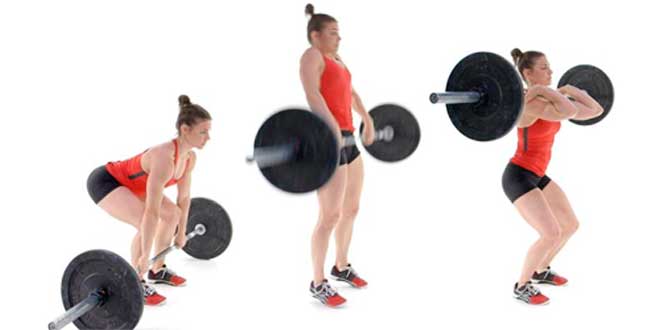
This exercise is a variant of the power clean, but with the bar received in the middle of the squat. This consists of bringing the barbell, placed on the floor, up to your shoulders, receiving it in a quarter squat position.
In the following links, you’ll find a complete description of how to perform these movements:- Power Clean
- Hang Power Clean
Hang Power Snatch
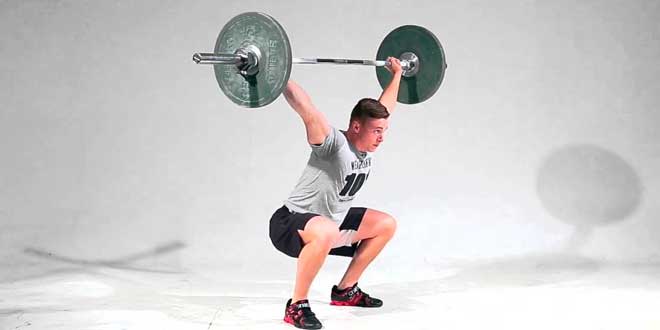
Of my favourite exercises, this one tends to fatigue you the most. It’s very similar to the Hang Power Clean, but now the grip is much wider.
In this link you’ll find a more detailed explanationPush Press
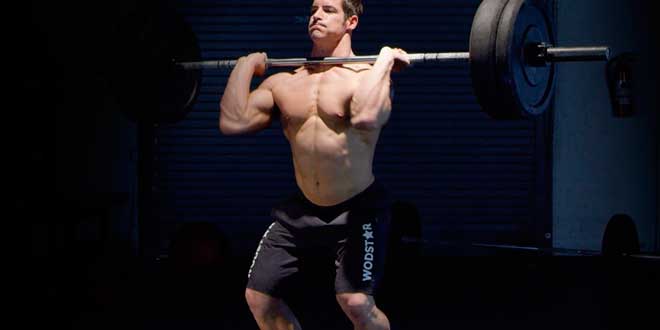
It’s very similar to its cousin, the standing military press. On this occasion, to lift the bar upwards, we set ourselves up by slightly bending our knees, and once they’re settled, we push upwards, with the bar remaining above our head.
There’s also the “Snatch Push Press”, which is quite similar, but with the difference of having a grip behind the head, as explained hereOverhead squat
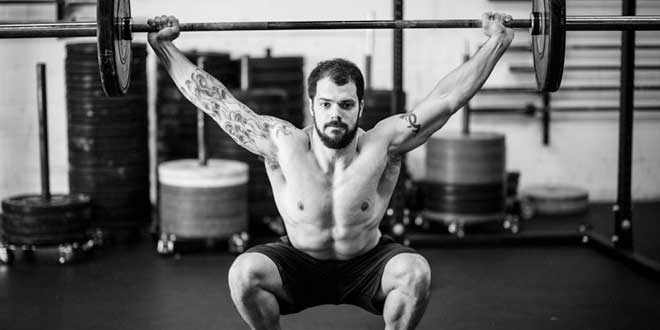
Be careful, this one is quite dangerous, and if you’re not used to it, you might get a surprise in the form of a trampoline jump… The bar is placed above the head, with your shoulders at their widest point, you should be able to rotate the bar backwards, and the moment your body shape doesn’t allow you any more range of movement, that will be your grip width. When you perform the movement, you should be focused on what you’re doing, tighten your abdomen, maximum tension, and go down and up!
You can find more information about this exercise in this article on the Snatch Grip Squat
How do you train it?
Given the theory and the possible exercises, it’s now time to bring everything together!
For me, this type of training shouldn’t be carried out on the days we usually train weights, due to their muscle involvement. Moreover, as I said at the beginning, it seems to me perfectly feasible to replace one day of cardio or hiit with this routine. In my case, I do it after a hit session, which leaves me incredibly stimulated…
Combo
A combo is a combination exercises performed consecutively and in a linked manner, or in a flowing sequence.
Sets, Repetitions and Rest Time
This will be determined by the amount of disks loaded onto the bar. The higher the load, the faster we get fatigued and therefore the fewer repetitions we can perform. I think a range of 5-8 repetitions would be fine. We can plan a number of sets according to our capacity, our physical condition that day… I would advise doing at least 5 sets.
And as far as rest time is concerned, if you train with a partner, their active time should be your recovery time.If you’re only to train alone (how sad… 🙁 ), wear a watch and try to leave the minimum amount of time. But be careful! It’s not worth performing the combo again without correct technique resulting from inadequate rest.
Example
Combo 1
5 sets of 5 reps
- Power Clean
- Front Squat
- Push Press
- Lunge
Combo 2
3 sets of 7 reps
- Deadlift
- 45 Row
- Hang Power Clean (after the last rep, we do a “Push Press” and place the bar on the back of the neck)
- Good Morning
Combo 3
8 sets of 5 reps
- “Snatch Grip” Deadlift
- Snatch Grip 45 Row
- Hang Power Snatch
- Snatch Grip Squat
Related Entries