Fitness, Nutrition, Health and Sports Blog In the HSNstore Blog you will find tips about Fitness, sport in general, nutrition, and health – HSNstore.com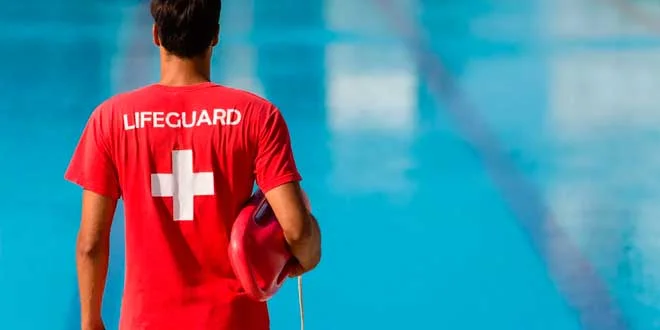

The Best Guide for Lifeguard Training
How should a lifeguard train? Let’s break down the recommended methodology if you’re preparing for lifeguard tests or if you’re already one.
How should a lifeguard train?
In this article, we’ll look at the key parameters that should be part of a professional aquatic lifeguard’s training, especially those related to physical condition development and the more specific technical aspects of the job.
The aquatic lifeguard
Lifeguards play a crucial role in public safety. Their physical condition directly impacts their ability to perform rescues efficiently, whether working in aquatic facilities or natural water environments.
A proper physical training plan tailored to the demands of their profession, along with suitable nutrition strategies, will be essential to maintain good physical condition.
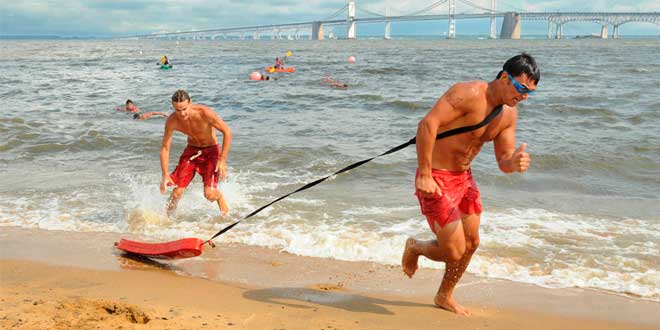
Something really important to be a good pro (Palacios, 2008)
Drowning Process
Before listing the most relevant training aspects for lifeguards, it’s important to explain how drowning by submersion happens:
- At first, the person in the water suffers respiratory failure because they can’t keep their head above water.
- From there, a panic response kicks in (Olshaker, 2004).
- At this point, the person holds their breath and struggles vigorously to stay afloat.
- This only lasts a few seconds before a forced breath happens, where water enters the larynx and pharynx.
- This whole process doesn’t last more than 2 minutes (Orlowsky, 1987).
This is when cerebral hypoxia begins, as liquid intake (water in this case) causes loss of consciousness, leading to respiratory arrest and finally cardiac arrest and death (Orlowski et al, 1989).
Physical condition of the aquatic lifeguard
The aquatic lifeguard, especially those working in natural water environments, faces changing weather conditions day after day
Because of this, lifeguard training must include a comprehensive development of all physical capacities (Palacios, 2008). Also, lifeguards need to adapt all aspects related to strength, speed, and endurance to the demands of their job.
Strength Training
Strength training is essential because lifeguards have to swim medium distances at high intensity and must be able to move drowning victims both in the water (controls, turns, pulls, grips) and out of the water (extractions and lifts) (Reilly et al, 2006).
Lifeguard strength training will focus on developing dynamic strength, being able to turn, pull, and lift a victim.
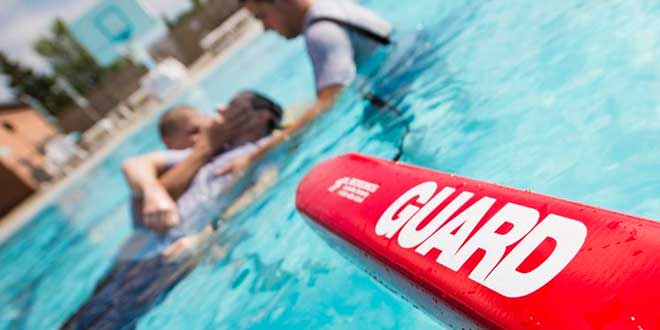
Work should be balanced between upper and lower body
Strength-Endurance
Finally, regarding aquatic rescue, lifeguards must develop strength endurance during the stroke, since the rescue time between approaching the victim and returning to shore can often exceed 5 minutes (Barcala-Furelos et al, 2016).
Strength tasks can range from:
- General exercises (squats, deadlifts, bench press, pull-ups), to
- Specific exercises (stroke simulation with resistance bands, leg extensions with resistance, etc.).
The goal in strength training is to increase the ability to generate tension, meaning boosting muscle strength to then perform specific water exercises where resistance to muscle fatigue is key to handle rescues of 100, 200, or even 300 meters.
Speed Training
The aquatic lifeguard usually isn’t involved in pure speed tasks (explosive efforts of 5-10 seconds)
Shorter rescues in natural water environments usually happen at 30-40 meters from shore.
Also, a lifeguard may cover a 100-meter wide surveillance zone, so a rescue could last around 50-60 seconds from running to the incident, entering the water, swimming to the victim, controlling and transferring them to shore, and extracting them to land.
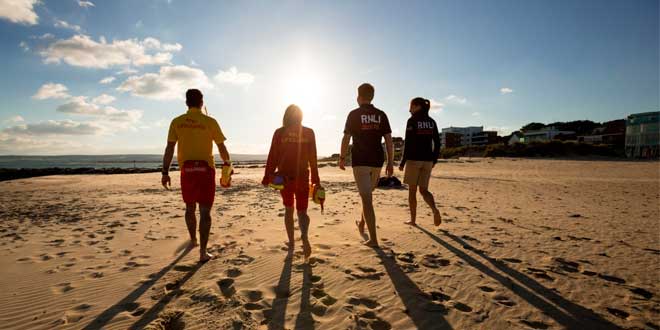
That’s in the best-case scenario
Endurance Training
The energy demands of an aquatic rescue, regardless of distance, are very high (Prieto et al, 2010)
This has been shown by analyzing three main performance parameters:
Heart rate
Heart rate is the most studied variable in exercise physiology
It’s known to increase linearly with exercise intensity, making it a good reference to gauge workload intensity (López-Chicharro and Fernández-Vaquero, 2006).
Maximum oxygen consumption
This term refers to the amount of oxygen the body can take in, transport, and use per unit of time (López-Chicharro and Fernández-Vaquero, 2006).
It’s an indicator of functional capacity, i.e., aerobic power. Oxygen consumption demand during aquatic rescue is also high, often exceeding 80% of VO2 max (Prieto et al, 2001; Reilly et al, 2006).
Blood lactate
Finally, lactate is a product derived from lactic acid, a compound that, due to its high acidity, is mostly dissolved as lactate and H+.
Both lactate and H+ have been studied for their relation to exercise fatigue (López-Chicharro and Fernández-Vaquero, 2006).
In aquatic lifeguarding, rescues from 50 to 200 meters caused lactate accumulation over 9 mmol/L, both in pools (Gulbin et al, 1996; Prieto et al, 2001) and at the beach (Reilly et al, 2006; Salvador et al, 2014).
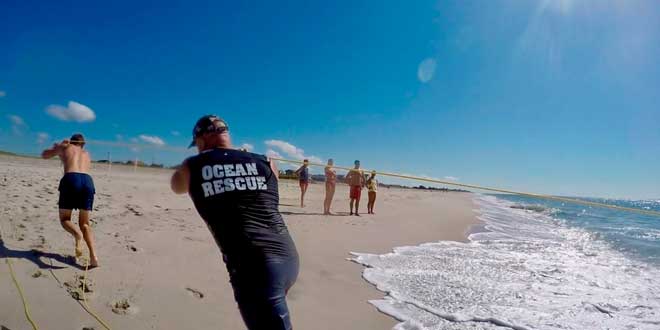
Thanks to all these studies, we can get a sense of how aquatic lifeguard endurance training should be
Endurance training protocols in aquatic lifeguarding
From a training perspective, aquatic rescue (between 200-400 m) is defined as a medium-duration endurance test (RDM), like the 400 m freestyle swim or even 200 m if the swimmer’s time is over 2 minutes.
Aerobic zone training protocols
They can be continuous or interval-based
To improve aerobic capacity, continuous and interval training near VO2max intensity will increase the ability to sustain high workloads without entering acidosis.
Anaerobic zone protocols
Usually interval-based
Focusing on aerobic power, interval training at or slightly above VO2 MAX intensity maximally stimulates aerobic and anaerobic metabolism, improving VO2 max and anaerobic capacity simultaneously.
Anaerobic lactic training aims to use anaerobic glycolysis as an energy source.
Practical guidelines for endurance training
Considering all the above, the most important thing for lifeguards to train to improve aquatic rescue performance is:
Aerobic Capacity
Important to maintain intensity near VO2 Max throughout the rescue
For aerobic capacity training, aiming to extend time at intensities near max oxygen consumption (VO2 Max), we can use a repetition method called “Intensive Interval Training of Medium Distances (200-500 m).”
This method stimulates absorption and maintenance of VO2 Max. It uses distances from 200 to 500 meters totaling 1200-1800 m to provide enough swim duration to reach max oxygen consumption.
Aerobic Power
VO2 Max is used at max, so training intensity must be high
For aerobic power training, aiming to increase VO2 Max, we use a repetition method called “Intensive Interval Training of Short Distances (50-150 m).”
This involves very high efforts over short distances (50-150 m) totaling 1600-2000 m. Heart rate will be 15-5 bpm below max for 80% of training time, with the remaining 20% at max intensity (95-100% max HR).
Anaerobic Capacity
Important to handle high lactate concentrations once VO2 Max is reached
Anaerobic lactic endurance lets swimmers maintain high speeds using anaerobic glycolysis despite pH drop and lactic acid buildup.
This anaerobic training focus is especially important for 200 and 400 meter swimmers, the typical distances for aquatic rescues in natural water environments.
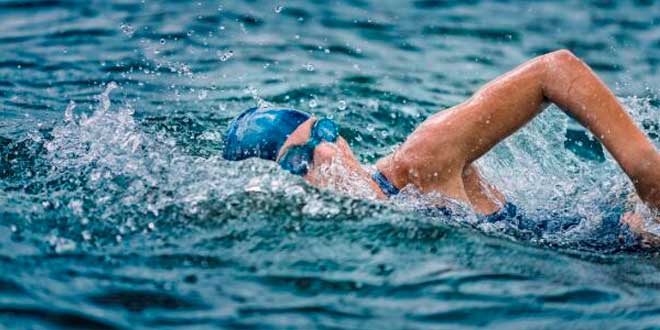
Lactate levels should rise near max and stay elevated as long as possible
Other performance aspects in aquatic rescue
Mastery of the aquatic environment
Lifeguards must not only know how to swim but also master the aquatic environment and all its features, especially in natural settings like beaches (Palacios, 2008).
Mastery of the aquatic environment is crucial because without it, effective rescue is nearly impossible.
- Entry into the water,
- Swimming approach to the victim,
- Victim control techniques, and
- Transfer techniques to land.
Use of rescue equipment
The aquatic lifeguarding field is constantly evolving, with new gear designed to improve lifeguard performance during rescues
Use of “handheld” rescue equipment, excluding boats, has shown great effectiveness in facilitating and reducing rescue time (Palacios, 2012).
Among these, fins are the most studied and have shown the most benefits. Fins help maintain proper victim position during rescue, increase safety, and reduce rescue time whether on beaches or pools, with greater impact on longer-distance rescues (Palacios, 2008).
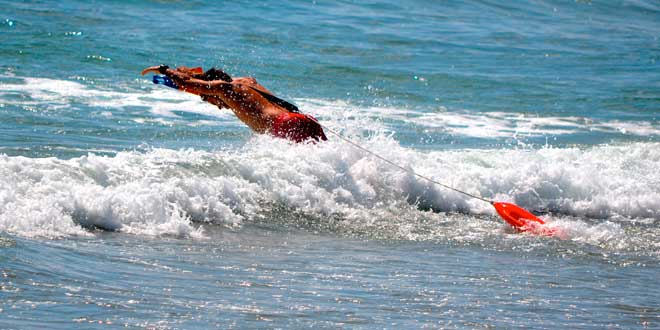
A study on beach rescues (Palacios, 2010) showed that using short-blade fins reduced a 50-meter rescue time by 10%, and long-blade fins by 13%
Finally, in 100-meter rescues, short-blade fins improved time by 15% compared to no equipment, and long-blade fins by 18%.
A more recent study (Sanz-Arribas, 2017) showed fins improve rescue time, especially for lifeguards with lower skill levels.
Conclusions
We can wrap up this article by stating that, regardless of distance, lifeguards undergo high physical stress during aquatic rescues
Heart rate and oxygen consumption values are very high (over 80% max), indicating a strong demand on aerobic capacity during rescues.
Also, blood lactate levels are very high (>9 mmol.L-1) in both short (50 meters) and long (300 meters) rescues, showing significant anaerobic metabolism involvement.
Finally, mastery of the aquatic environment is essential for a successful rescue, especially in natural water settings.
References
- Barcala-Fuerlos, R., Abelairas-Gómez, C., Romo-Pérez, V., and Palacios-Aguilar, P. (2013). Effect of physical fatigue on the quality of CPR: a water rescue study of lifeguards physical fatigue and quality CPR in a water rescue. American Journal of Emergency Medicine. 31: 473-477.
- Barcala-Furelos, R., Szpilman, D., Palacios, J., Costas-Veiga, J., Abelairas-Gómez, C, Bores-Cerezal, A., López-García, S., and Rodríguez-Núñez A. (2016). Assessing the efficacy of rescue equipment in lifeguard resuscitation efforts for drowning. American Journal of Emergency Medicine. 34(3): 480-485.
- Gulbin, J. P., Fell, J. W., and Gaffney, P. T. (1996). A physiological profile of elite surf ironmen, full time lifeguards and patrolling surf life savers. The Australian Journal of Science and Medicine in Sport. 28(3): 86-90.
- López-Chicharro, J., and Fenández-Vaquero, A. (2006). Exercise Physiology. 3rd edition. Editorial Panamericana. Barcelona.
- Olshaker, J. S. (2004). Submersion. Emergency Medicine Clinics North of America. 22(2): 357.
- Orlowski, J. P., Abulleil, M. M., and Phillips, J. M. (1989). The hemodynamic and cardiovascular effects of near-drowning in hypotonic, isotonic or hypertonic solutions. Annual Emergency Medicine. 18: 1044-1049.
- Palacios-Aguilar, J. (2010). Lifeguarding today, a vital and increasingly complex activity: The benefit of using fins in Aquatic Lifeguarding. IV International Congress of Aquatic Rescue, Rescue and Cardiopulmonary Resuscitation. September 24, 25 and 26, 2010; Posadas. Misiones. Argentina.
- Palacios-Aguilar, J. (2012). The importance of training in aquatic activities, lifeguarding and rescue. Techniques to incorporate in rescue: The benefit of using fins in aquatic lifeguarding. II International Congress of Aquatic Activities, Rescue and Lifeguarding. October 12, 13 and 14, 2012. Posadas. Misiones. Argentina.
- Prieto-Saborit, J.A., Egocheaga-Rodríguez, J., González-Díez, V., Montoliu-Sanclement, M.A., and Alameda, J.C. (2001). Determination of the energetic demand during a rescue in the sea with and without auxiliary equipment. Selección, 10(4), 211-220.
- Prieto, J.A., Del Valle, M., González, V., Montoliu, M.A., Nistal, P., Egocheaga, J. Et al. (2010). Physiological response of beach lifeguards in a rescue simulation with surf. Ergonomics, 5(9), 1140-1150.
- Reilly, C., Iggleden, M., and Tipton, M. (2006a). Occupational fitness standards for beach lifeguards. Phase 1: the physiological demands of beach lifeguarding. Occupational Medicine, 56, 6-11.
- Salvador, A., Penteado, R., Lisboa, F., Corvino, R., Peduzzi, E., and Caputo, F. (2014). Physiological and Metabolic Responses to Rescue Simulation in Surf Beach Lifeguarding. Journal of Exercise Physiology, 17(3), 21-31.
- Sanz-Arribas, I., Aguado-Gómez, R., and Martínez-de-Haro, V. (2017). Influence of fins on execution time in rescues of victims with cardiopulmonary arrest. Retos. 31. 133-136
Related Posts
- First Aid: What to Do in an Emergency?
- Effects of Linear VS Non-Linear Periodization
- Sports Planning: Optimize Performance