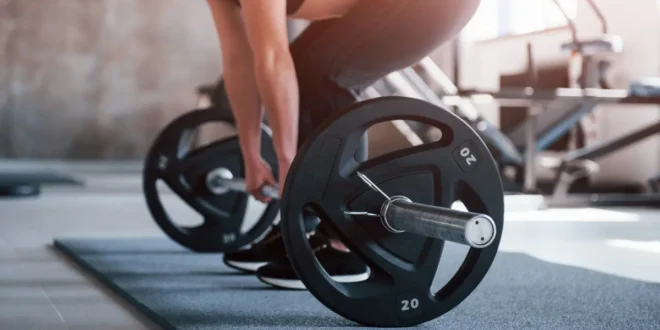
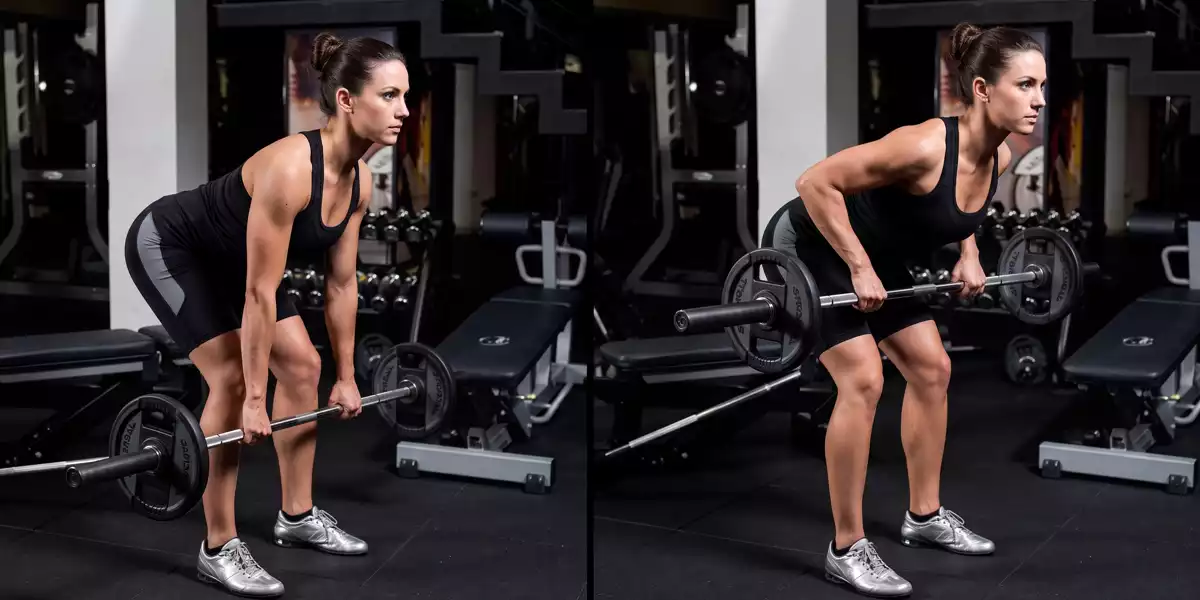
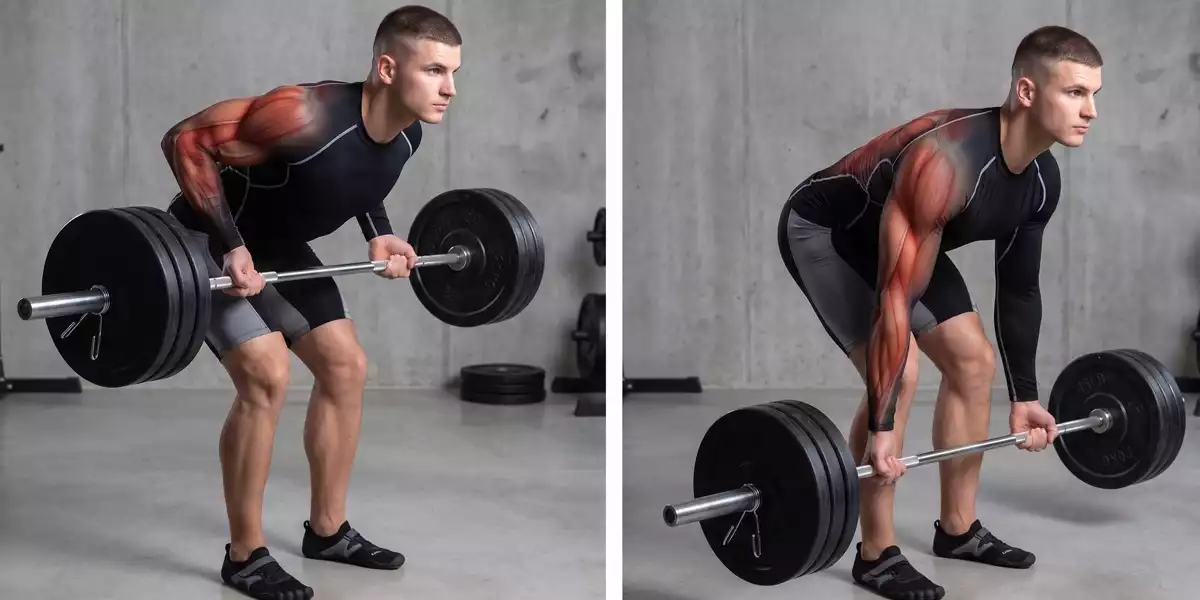
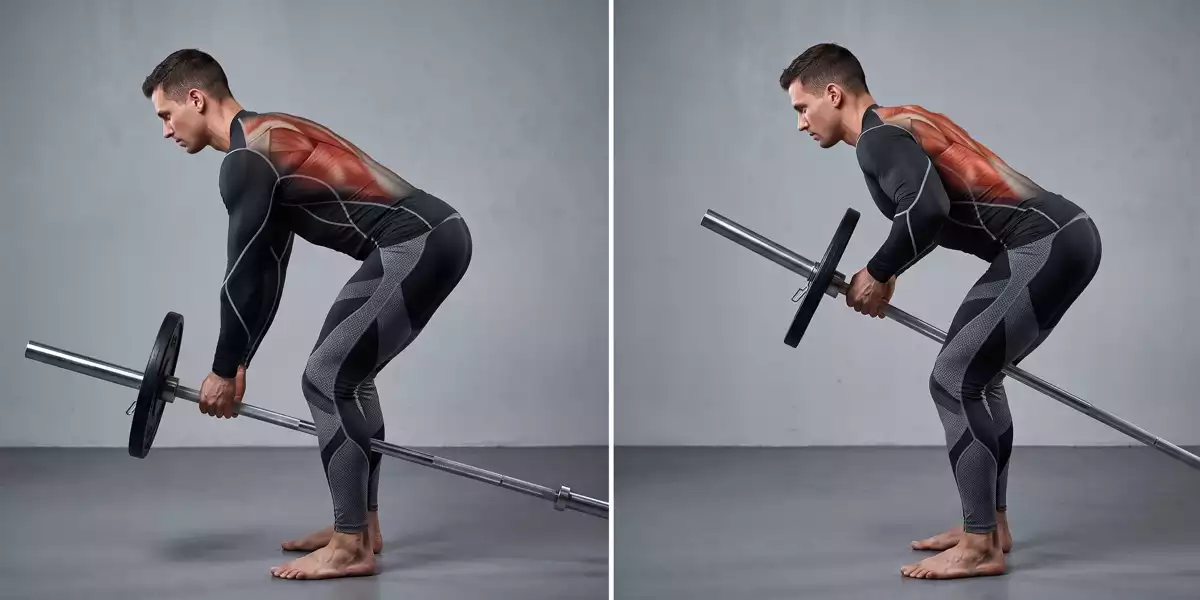
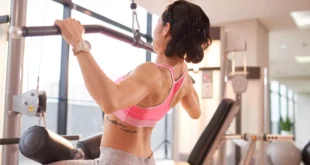
The Bar Row exercise that stimulates the biggest amount of muscle mass, is the variant which places the bar to rest on the ground on completing each rep (inclining the torso 90 degrees )
Index
Muscles involved in the Bar Row
The Bar Row involves a large number of muscle groups, both directly and indirectly.
- Bench Press -> Horizontal Thrust
- Bar Row -> Horizontal Pull
The muscles and areas that will be worked out as part of the Bar Row are:
Upper Back
When performing the pull, we notice a scapular contraction, lifting up the bar until it touches our chest. Therefore, we are working on the area of the lats, trapeziums, and posterior deltoids.
Lower Back
The lumbar region must be neutral, to avoid any risk of injury. Gravity causes the back to bend, as this is determined by the vertical force vector by the bar. In this way, we can perform opposing force and strengthen the muscles along the spine: the erectors.
Abs
The muscles of the abdomen must withstand the tension so that your lower sword is in a neutral position. This force will help work on getting the much desired “6-pack”, specifically, when working on the abdominal rectum. If you are looking to tone and define your abs through hypertrophic stimulus, this will help you to grow them. The other crucial part, of course, is diet…
Hips
The femoral and gluteal muscles work with muscle contraction, that is, through each execution, when moving the bar up from the ground. Your body will do this in order to maintain muscle curvature during the movement. This exercise stimulates and strengthens the hip muscles, through dynamic and static contractions.
Arms
The forearm muscles work to maintain grip on the bar. The biceps will allow you to bend your elbow and move your weight. Your triceps will bring the upper arm up to behind the torso, with the long head of the triceps meeting the shoulder blade.
If you are looking to create muscle mass and strengthen your back, while also obtaining great muscle mass, the Barbell Row with Deadlift is the best exercise to do and you can combine the two.
Rowing Technique with Barbell
Starting position
The starting position begins with placing the feet in line with the hips, with the tips of the feet facing outwards slightly, forming approximately an angle of between 30-45º, according to our flexibility, as is the case when performing a Deadlift .

It is important that the knees and feet are pointing the same direction. The bar will rest close to the tibia, not making contact, several cm apart, keeping it in between the feet (instep).
Grip the bar
The grip of choice here is the prone grip.
In this type of grip, we are going to fully grasp the bar, that is, the thumbs should wrap around the bar. This will mean that we can grip the bar tighter. In addition, a stronger grip leads to involving more muscle, and of course, being able to add more weight to the bar. It is recommended you grip close to the fingers and not in the middle of the palm.

For very heavy loads or series, you can use Straps or Grip Straps, to eliminate the grip limitation and get the maximum benefit from this exercise.
It also goes without saying that we should work on grip in general, through auxiliary exercises, since we should always be seeking to strengthen all parts of our body.
The width of the grip should be tighter than that of the Bench Press and slightly wider than that of the Deadlift. A broader grip (greater than that of the Bench Press) will shorten the range of movement, causing us to tilt our arms, and the upper body to lean further forward, bringing its position lower than 90º.
Wrists
The wrists are a weak point in any type of exercise, if we do not maintain a correct position during the execution of the movement.
In the case of rowing with a bar (Bar Row) this is no less true, in fact, it is even more serious and we could do ourselves a lot of damage if we perform a bad grip. As mentioned above, the grip must be a full one, that is to say, your thumbs should be fully wrapped around the bar, in a tight grip.

It’s important that the wrists stay straight, never bent, since we would lose our grip, and we could risk injury if the load of weight is high.
Elbows
The elbows should be in a locked position at the beginning of the movement. Any other position would create a risk of lower back injury, as the upper body will be lower than the desired position (perpendicular to the floor). Another important reason for this is to avoid picking up bad habits when doing exercises like the Deadlift. In this exercise, starting with the elbows in a locked position is crucial to avoid a serious bicep injury.
In a barbell row, bear in mind that we are not trying to perform a curl, since the purpose of the exercise is the strengthening of the muscles of the back (and as mentioned, indirectly strengthen the rest of the muscle structure).

In this case, the elbows guide the bar, that is, in the final position of the complete movement, the elbows should be kept behind the rest of the body
- Bringing the chest closer to the bar when we are near the end of the movement, without pushing the elbows back behind the torso
- Bending the wrists, to direct the bar to the chest, still keeping the elbows in good position
Both errors pertain to a situation where your weight load is too high, and reducing it is the wisest choice, which will result in a more correct and healthier movement. If you want to keep improving your technique, you can record your lifting and then view it afterwards
Torso
The Bar Row’s main aim is to strengthen the back muscles, and therefore, the position that we should take up for this exercise is 90º, that is, our torso (lower back muscles) will remain perpendicular to the ground at all times.
Any other variation that doesn’t involve this this posture means that you are involving other muscle groups such as the legs.

The lower back posture gives us a good idea of whether we are executing the movement correctly, in addition to of course checking that it is safe
Lower Back
The spine has natural curvatures (lordosis and kyphosis). Although these curvatures exist from an internal anatomical point of view, it isn’t seen like this “on the surface”, looking more like a straight line.
Tilting of the torso when lifting the weight load
In the starting position, we will start from a completely perpendicular position.

When lifting a load, especially a heavy one, our torso can maintain an angle of about 15º, which, however, we can maintain without involving the hip muscles</ em>
Execution of the Bar Row
Start
The bar starts in exactly the same position as when doing a deadlift. The bar rests above your feet, against the tibias (separating the bar from them implies putting greater tension on the lower back).
Generally speaking, being stood upright with your feet firmly on the floor takes away stress on the lower back and tends to better occupy the upper back in the first phase of movement.
- Grab the bar at roughly the same width you would do for a bench press (slightly less wide). This allows for a greater transfer to it and will greatly improve quality.
- The Bar Row should be done in an opposite movement.
- Although you can grip in both supine and prone techniques, it is recommended to use a prone grip with your thumb firmly around the bar.
- This is how it really transfers the exercise to the bench press.
Types of grip
If you opt for a supine grip, the width at which you grip the bar should be smaller, the closer the elbows are together the better, to allow for more work in the central area of the back.
Prone grips minimise the action of the biceps, particularly the false prone grip. The supine grip moves part of the effort to the biceps in a more stressed way and tends to shift the muscular action towards the middle and lower groups.
It’s important that the bar touches the chest. If the bar does not hit the chest or any solid surface, it is like only doing the exercise partially. You won’t allow yourself to properly finish the full movement for the exercise and as a result, won’t be getting the most out of the exercise.
When should I breathe?
We should take a deep breath in our starting position
This should be a very deep breath, holding in the air, tightening our torso, and proceeding to row! If we start out like this, it’ll prove to be a lifeline especially when lifting large loads.
Positioning the back
Always keep your upper back parallel to the ground. Be sure not to let your ego get the better of you by trying to do an inclined row
It is much better to use less weight and perform the exercise correctly, as doing things in this way will help you progress more generally. If your Bar Rowing ends up being a 45 ° Row, and you’re helping yourself with your legs, you are probably using too much weight. Lower it.
In general, as the vertical angle increases, the effort moves from the upper groups of the back to the lower and middle muscle groups.
Up to what point do I need to lift the bar?
The answer is simple, exactly to the same point where you rest the bar when doing Bench Press, or at least until you contact a solid surface
In general, bringing the bar up to the chest requires more stabilising action from the lower back, while bringing it to the stomach puts more tension on the upper and middle back.
Let your elbows guide you
Lift with your elbows
This is a trick that will help you focus your workout on the back, and not turn this row into a bicep exercise, with the knock-on risk that entails. Pull your elbows towards the ceiling instead of just pulling with your hands.
Scapular Retraction
This is simply mandatory and a technique that will be applied in other exercises, including the bench press.
End position
Try to tense and squeeze your shoulder blades together as hard as you can while pushing your chest upwards.
- It is not enough to simply retract the scapulae, it is also important to move them down for greater compaction.
- It is not necessary to keep the weight isometrically elevated. Touching the chest and going back down is more than enough for this exercise.
- Keep your head down. Don’t try to look in the mirror as this could result in neck ache. Don’t look at your feet either, your lower back could become rounded, and similarly to the deadlift, you could injure yourself.
- You just need to tilt your neck slightly.
Video of Bar Row (Rowing at 90º)
Biomechanical Analysis of the Bar Row
Both the bar or dumbbell row, in addition rowing with pulleys, lever machines and TRX are exercises which should definitely feature as important components of any workout routine.
Personally, training by movement is one of the methods that I most encourage given how easy it is to organize the workout and balance a routine. Therefore, rowing would constitute an exercise in horizontal traction since it is mostly executed in anteroposterior planes (although it depends on the inclination in their execution) with force vectors that run perpendicular to the body.
One of the appreciable differences is the inclination of the torso when doing them
Most rowing movements involve stabilisation of the spine, which involves intrinsic variables such as the weight on the spine, the degrees of movement of the spine and the ability to remain immobile during the movement.
Spinal load
Shear forces are more damaging to the spine than compression forces that occur with axial load, however the muscular activity of the spinal muscles to maintain posture can actually create compression forces.

Degree of spinal movement
Since the spinal column is subjected to significant shear forces during rowing movements, unless the muscles around the spinal column create forces to prevent its movement, these shear forces will cause flexion of the spinal column.
Despite the fact that a certain amount of movement in any of the three spatial planes is considered acceptable in most populations, reducing spinal movement is better for many individuals, especially flexo-extension or torsion movements.
The rotational movement is somewhat peculiar because in one-hand dumbbell rowing, as well as in exercise that is executed unilaterally, this flex is great and could even be the main advantage of the exercise depending on your goals..

The graph shows the movements of the spine in a normalised form, as well as a percentage of the maximum range of movement provided by the spine</ p>
Stiffness
Spinal stiffness describes the ability of the spine to remain stationary in the sagittal plane, while being exposed to high shear forces. If the spine moves little during high loads, it is generally considered a very good indicator of spinal stability.
Looking further than this individual exercise, this factor is determined by the person’s own core strength and resistance used.

Muscle activity
The Bar Row fosters increased overall activity of the back muscles, including the lower back, and further challenges spinal stability by creating high compressive forces and a tendency for flexo-extension movements.

Bar Row according to inclination
If we look at the information shown on the previous graph, it’s easy to see that the Bar Row is positioned as the best bilateral exponent of this type of exercise, although different variants of it can be observed.
This exercise will also strengthen and increase the size of agonists (ridges, rhomboids and trapezius more prominently), but also spinal erectors, and to a certain extent, glutes and hamstrings. When done correctly, the mechanics of the hip joint can transfer favourably to a deadlift in the maximum hip flexion phase (at the beginning of the movement).
From experience, I think the first thing that comes to mind when thinking about rowing is that of inclined rowing.
Far from being a complement to this exercise, the trend is to see this as the standard rowing in training; which in my opinion is a mistake. The upper body has a fairly vertical position (approximately 70 degrees from the ground), which allows us to lift heavier weights, and this is where it is often wrongly assumed that muscle activity will somehow be greater than in a Classic Row or Pendlay Row.
The activity carried out by the upper trapezius and biceps is certainly greater than that experienced in these rows mentioned above, but if the main objective is to work the dorsal as a whole (with greater emphasis on the dorsal and rhomboids), it should be replaced by the exercise that we’re going to see in the next article.
Conclusions
Without ruling out any variant, but always trying to achieve the most efficient training possible, the 90-degree Bar Row is the horizontal pull exercise that most works out the back as a whole
If the goal is muscle hypertrophy, the bar should not be rested between repetitions. At the most, you could allow it to lightly touch the ground.
When aiming for strength-power, the Pendlay Row seems to be better as long as there is a little muscle relaxation between repetitions, always bearing in mind that we shouldn’t lose the protection provided by the body’s core as a whole.
Bibliography
- Bradsley, C. (2012). How do rowing exercises differ?. http://www.strengthandconditioningresearch.com. Recuperado el 18 de mayo de 2015 de http://www.strengthandconditioningresearch.com/2012/10/24/how-do-rowing-exercises-differ/.
- Contreras, B. (2014). How to do a Bent-Over Row. http://bretcontreras.com/. Recuperado el 18 de mayo de 2015 de http://bretcontreras.com/how-to-bent-over-row/
- Fenwick, C. M., Brown, S. H., & McGill, S. M. (2009). Comparison of different rowing exercises: trunk muscle activation and lumbar spine motion, load, and stiffness. The Journal of Strength & Conditioning Research, 23(2), 350-358.
Related articles
- Rowing machine: Benefits
- Neutral grip in push exercises
Growth of back muscles - 95%
Effect on muscle mass - 95%
Easy to perform - 85%
Gain strength - 92%
Link to other exercises - 95%
92%

Blog about Fitness, Nutrition, Health, and Sport | HSN Blog In the HSNstore Blog you will find tips about Fitness, sport in general, nutrition, and health – HSNstore.com