Fitness, Nutrition, Health and Sports Blog In the HSNstore Blog you will find tips about Fitness, sport in general, nutrition, and health – HSNstore.com

- Despite the rise of low-carb strategies, which have a place in many (mostly clinical) scenarios, in sports where high intensity over sustained, lower intensity effort is the norm, carbohydrates are still the kings of performance.
- But those at the top of the podium almost invariably come down to proper programming, adequate energy intake and the topic of today’s discussion: optimal carbohydrate intake.
- Except for a privileged few with stratospheric performance, when intensities rise above 70-80% of VO2 max almost invariably our energy metabolism depends on carbohydrate oxidation.
How many carbohydrates are needed to perform in CrossFit?
The factor that best delimits the amount of carbohydrates needed is the training volume and intensity level (1).
Starting from a high intensity level (we are talking about CrossFit), we will only consider the training volume. To make it more “CrossFit”, we will add the categories “Scaled”, “Rx” and “Elite”.
Scaled
We are talking about people who have just joined a CrossFit BOX and want to improve their physical condition, being at the bottom of the learning curve and, therefore, having everything to improve.
We are talking about athletes who train no more than 3-5 hours a week.
Rx
These are more experienced athletes, who are starting to take CrossFit more seriously, who are starting to give up idle beer-related plans to train, who are going to their friends’ competitions and who can’t stop talking about their favourite sport.
This would be equivalent to 500-800 grams per day for a 100 kg athlete. To give you an idea, 100 grams of rice contains 28 grams of CHO (one kg = 280 grams).
Elite
The training volume of this kind of CrossFitter can reach up to 20 hours per week, as this sport is very much suited to split training sessions.
CrossFit and carbohydrates
Quantity matters, but so does type.
Taking these huge amounts of CHO from refined sources or processed products alone is not a good idea at all, and should be reserved for one-off situations.
It is therefore an obvious fact that the athlete should try to ingest most of his or her carbohydrates from unprocessed or unprocessed sources. We are talking about vegetables, fruits, legumes, root vegetables and whole grains.

Yes, I know what you’re thinking, it’s not easy for someone who has to eat 6000 kcals a day to eat only this type of food.
When to include processed carbohydrates?
There are also situations where rapid muscle and liver glycogen replenishment is needed (2):
The faster the better
For example:
- Between two training sessions.
- Between two HITs in the same training session.
- Between two WODs in a competition.
- Between one competition day and the next.
- In extreme events such as the previously mentioned rowing marathon, or all those that exceed 70 minutes (there are some).
Rapidly replenish glycogen
In these cases, we would need to keep the following in mind:
- Sports supplementation products that provide carbohydrates in liquid, gel or solid form may have a place.
- So do foods that do not fall into the “healthy diet” category: rice pudding, chocolate milkshake, etc.
In these situations where rapid glycogen replenishment is sought, we should aim for intakes of >8g/kg CHO per day if we have a day to recover.
Gels are often a very interesting option.

In the case of hours only, we would be talking about at least 1.2 g CHO/kg/hour during the first 4 hours after the test (3)
Carbohydrates during physical activity
In terms of intra-workout CHO intake, when the training demands it (we are talking about tests lasting >90 minutes), several reviews advocate intakes of a 6-8% solution of 0.7 g of CHO per kg per hour.
However, in CrossFit, we will rarely need to use intra-workout CHO (although mouthwashes with CHO have been shown to improve performance, although this is for another post) (4).
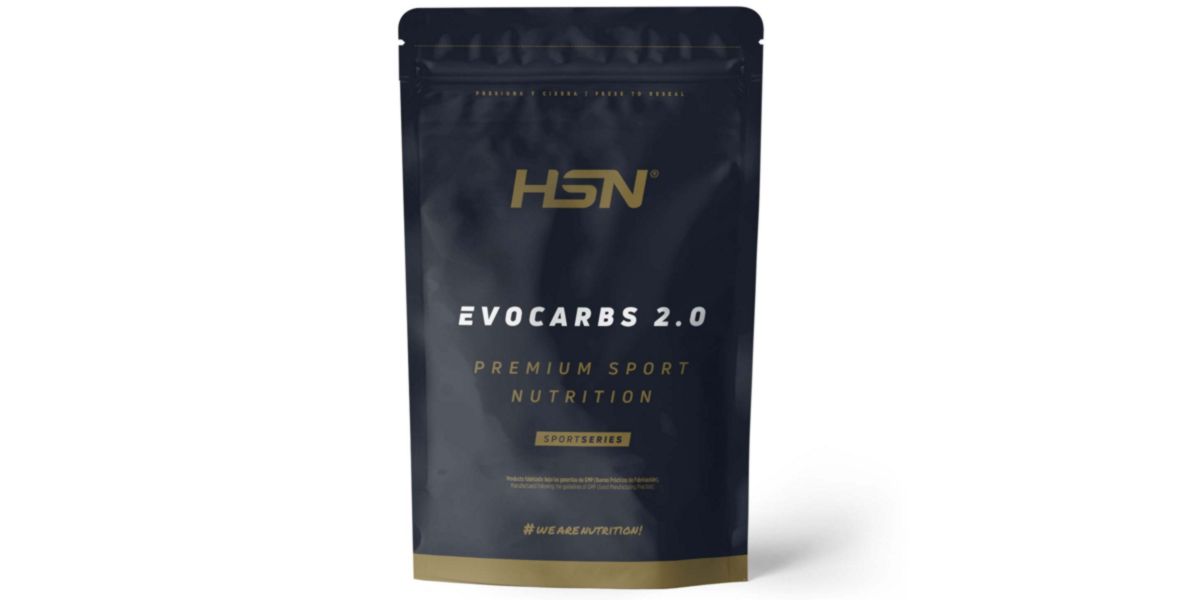
The combination of GLUCOSE + SACCHAROSE or MALTODEXTRINE + FRUCTOSE, as in the case of Evocarbs, seems to maximise CHO oxidation compared to the intake of one type of CHO alone.
Conclusions
Carbohydrates matter.
Also, in CrossFit they matter a lot. This doesn’t mean that more is better or that you have to eat rice pudding. But if you’re looking for performance, you do need to be aware of your carbohydrate needs (you can also train CrossFit to lose fat, gain muscle or just look better).
Bibliographic sources
- Cermak NM, Van Loon LJC. The use of carbohydrates during exercise as an ergogenic aid. Sports Medicine. 2013.
- Ranchordas MK, Dawson JT, Russell M. Practical nutritional recovery strategies for elite soccer players when limited time separates repeated matches. Journal of the International Society of Sports Nutrition. 2017.
- Currell K, Jeukendrup AE. Superior endurance performance with ingestion of multiple transportable carbohydrates. Med Sci Sports Exerc. 2008;
- Pöchmüller M, Schwingshackl L, Colombani PC, Hoffmann G. A systematic review and meta-analysis of carbohydrate benefits associated with randomized controlled competition-based performance trials. J Int Soc Sports Nutr. 2016;
- Oliver JM, Almada AL, Van Eck LE, Shah M, Mitchell JB, Jones MT, et al. Ingestion of high molecular weight carbohydrate enhances subsequent repeated maximal power: A randomized controlled trial. PLoS One. 2016.
Related Entries
- CrossFit, Nutrition tips
- The best supplements for CrossFit
- Post Workout Carbohydrates - Everything you need to know!