Fitness, Nutrition, Health and Sports Blog In the HSNstore Blog you will find tips about Fitness, sport in general, nutrition, and health – HSNstore.com

Today we analyse the Buddhist diet together with its lifestyle in an attempt to bring the good aspects of their customs to the West, and why not, also point out the drawbacks of the lifestyle.
We like Buddhists. Their friendly outlook, and with a smile on their face 24/7, makes us sympathise with them.
A Little History
Buddhism was founded in the 6th century BC in eastern India.
Its founder, Siddhartha Gautama, became the Buddha (the Enlightened One), whom hundreds of thousands around the world would later follow in order to eliminate suffering from their lives.

Lifestyle
The Buddhist way of life is outlined by different ethical precepts.
The difference between a precept and a mandate is that the latter is mandatory and the former is recommended (a positive point for our Buddhist friends).
These precepts are:
- You will not take life.
- You won’t take what hasn’t been given to you (you won’t steal).
- You will not have sexual misconduct.
- You won’t lie.
- You won’t ingest toxic substances which numb the mind.
What is the Buddhist Diet?
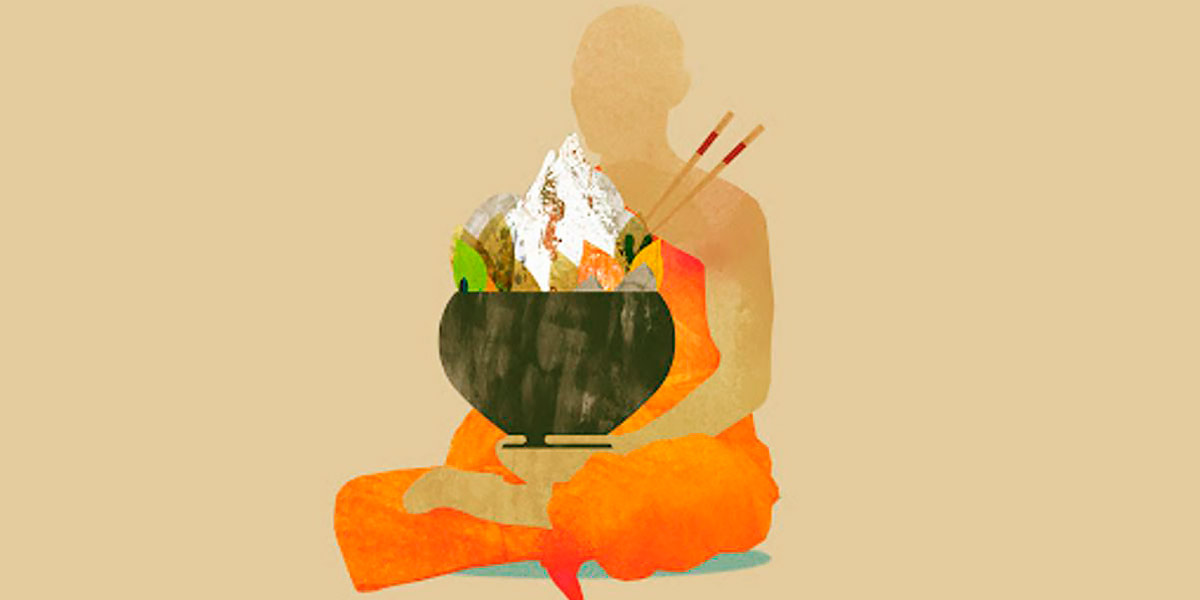
The Buddhist Diet is lacto-vegetarian.
That is, they include dairy and derivatives but they move away from other products of animal origin.
This pursues the fulfilment of the first precept (you will not take away life). Although there are Buddhist schools that are more flexible and eat animals as long as the animal has not been slaughtered exclusively for humans.
They totally exclude the intake of alcohol and other toxic substances, since they “cloud the mind” and could lead to the non-compliance of other precepts (another mini-point for our smiling friends).

Fasting and meditation
Lately everyone is talking about intermittent fasting, but Buddhists have been doing it for 2500 years without anyone having explained to them what autophagy is.
They don’t intend to get into a bikini or lose that 2% excess body fat. No, they practice fasting to strengthen self-control and will, which I find quite commendable.
In addition, they limit food intake to the hours of the sun, which in view of recent evidence, may be beneficial in maintaining our healthy biorhythms.
Other practices
Buddhism cannot be understood without talking about meditation, compassion, or empathy.
These practices are so intrinsic to the Buddhist school, and have also shown the scientific community that they have many health benefits:
- Better concentration
- Increased subjective sense of well-being
- Stress reduction
And many more which I would like to discuss in another post.

Let’s now turn to talk about the strengths and weaknesses of the Buddhist way of life.
Benefits of the Buddhist Diet
Vegetable-based diet
It is a healthy diet if well considered, and has been shown to reduce the incidence of multiple chronic diseases (including cardiovascular disease, killer number 1).
The intake of abundant polyphenols, antioxidants, fibre, vitamins and minerals together with a non-excessive energy intake make it an interesting choice here in the West.

Intermittent fasting
As I said, Buddhists are teachers of intermittent fasting, and benefit (without knowing) from all the benefits of it.
It is curious how all traditions have incorporated some fasting practice.
Surely mental peace (derived from the temporary increase in the concentration of ketones) is related to “getting closer to God”.
Limitations of the Buddhist Diet
But nothing is perfect. Let’s see:
Nutrient deficiencies
Certain vegan or vegetarian populations are known to have lower levels of essential nutrients such as vitamin B12, iron, vitamin D, zinc or omega-3, all of which are present in good proportions in food of animal origin.
Protein consumption
Like any vegetarian diet, without proper planning, reaching a sufficient amount of protein to prevent (or treat) sarcopenia can be difficult.
Lack of strength exercise
When mentioning Buddhism or its lifestyle, there is rarely talk of exercise.
Conclusions
Being smart about it, we have a lot to learn from the Buddhist community, and not just about their diet.
We’ll see you in the next post and keep it up!
Bibliography Sources
- Lee Y, Krawinkel M. Body composition and nutrient intake of Buddhist vegetarians. Asia Pac J Clin Nutr. 2009.
- Craig WJ. Nutrition concerns and health effects of vegetarian diets. Nutrition in Clinical Practice. 2010.
Related Articles
- Interested in knowing what doctors think of intermittent fasting? Click here.
- We give you a set of guidelines for “dying young as late as possible”. Visit this link.