Fitness, Nutrition, Health and Sports Blog In the HSNstore Blog you will find tips about Fitness, sport in general, nutrition, and health – HSNstore.com

Parkinson’s is a degenerative neurological disease characterized by the progressive destruction of the substantia nigra, a basal nucleus responsible for coordinating activity, muscle tone, and movements. It mainly occurs in older individuals, causing premature cell death of the neurons in the substantia nigra without replacement by new ones.
This leads to decreased dopamine production and increased inhibitory activity of GABA.

When 50 or 60% of these cells disappear, the first symptoms start to show. As it progresses, degeneration of this brain area can cause more serious problems.
Epidemiology
- 2nd most common degenerative disease. Prevalence varies: 50 – 350 cases / 100,000 inhabitants.
- 250 – 500 cases / 100,000 in people over 60 years old.
- 5 – 20 new cases / 100,000 inhabitants / year.
Diagnosis
Requires the presence of at least two of the following cardinal symptoms:
- Tremor: resting, slow. Increases in emotional tension situations. Disappears during voluntary movement and sleep.
- Rigidity: passive movements cause the “cogwheel” phenomenon.
- Akinesia: slowness in eating, dressing, and grooming; starting to walk or getting up from a seat; loss of arm movement while walking; slow writing; dysarthria and monotonous speech, etc.
Besides these, other secondary symptoms can and usually do appear:
- Anxiety; Depression.
- Cognitive decline and behavioral disorders.
- Sleep disorders (fragmentation; insomnia).
- Autonomic dysfunction (orthostatic hypotension).
- Sensory symptoms (olfactory dysfunction; paresthesias).
- Cranial nerve alterations.
- Respiratory and voice alterations.
- Urinary urgency or incontinence.
- Decreased libido and impotence.
- Less expressive facial expression.
Progression (Hoehn & Yahr Stages)
- Recently diagnosed patients (stage I) (unilateral involvement).
- Moderately affected (stages II and III) (mild bilateral involvement).
- Severely affected (stages IV and V) (severe bilateral involvement, with disability).
Treatment
It can be medical, surgical, or through physical activity. In any case, the disease is palliative, not curative.
In physical activity, it’s important in the early stages to focus on better coordination, movement control, balance, and precision. For this, low-intensity exercises with a high number of repetitions will be done, forcing the patient to coordinate movements.
Based on this, two types of goals can be set through physical activity:
Immediate Goals
- Reduce joint stiffness.
- Increase joint mobility.
- Prevent muscle weakness.
- Improve posture and balance.
- Improve gait.
Final Goals
- Objective and subjective improvement of quality of life and abilities.
- Prevent, delay, or reduce musculoskeletal problems.
- Improve associated depression symptoms in the short and long term.
Most Important Areas to Work On
- Postural correction and body alignment.
- Improvement and maintenance of gait.
- Improvement and maintenance of balance and coordination.
- Prevent muscle and joint shortening and stiffness to avoid pain.
- Maintain mobility.
Exercises
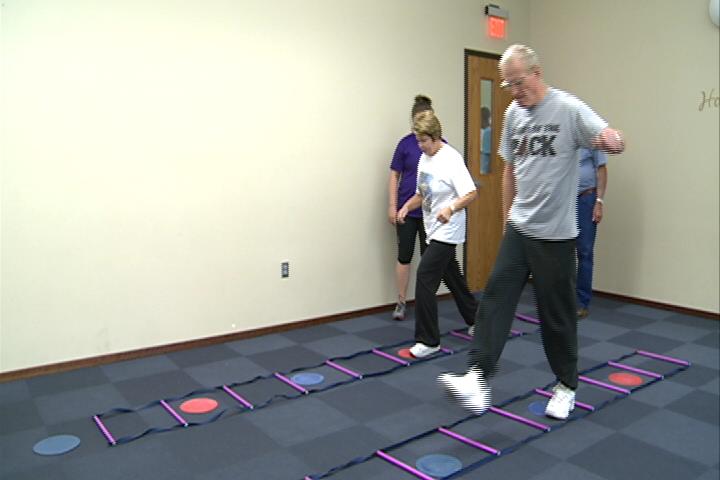
Exercises should be done daily, always while under the effect of medication. Fatigue should be avoided, so rest breaks will be taken as needed.
- Endurance exercise: It can be advisable, but low-impact activity at low intensity 40-60% of HRmax will be done, with rest breaks as needed, and daily exercise is recommended. Water exercise is very beneficial since it reduces muscle tone and thus rigidity, increases body awareness, improves voluntary movement motor control due to the calming and analgesic effect of water, and especially works the cardiorespiratory system. Since coordination, eye-hand coordination, and balance exercises must be done, ballroom dancing would be advisable.
- Strength exercise: Wide, repeated, and rhythmic movements with low load and a high number of repetitions should be done. It’s more advisable to use isotonic machines with free weights as they ensure stability and movement limits. Exercises should be repeated about 10 times:
- Flexibility training: Should accompany strength and endurance exercises, performing stretches before and after strength and endurance sessions, making up at least 1/3 of the total session volume.
If the physical capacity and disease stage allow, intense training in both strength and endurance (HIPT and HIIT), always with the lowest possible impact, seems to improve (or at least not worsen) neurological activity, thus delaying disease progression. This exercise method is easier to incorporate in patients with stage I disease.
Sources:
- Bayés Rusiñol, A (2003) Comprehensive rehabilitation in Parkinson’s disease and other parkinsonisms: practical exercise manual. Medicina STM editors.
- Chicharro JL (2008) Clinical exercise physiology. Madrid. Editorial Médica Panamericana.
- González Badillo JJ and Serna JR (2002) Foundations of strength training programming. Madrid. INDE.
- Madeleine E. Hackney, Gammon M. Earhart (2009) Health-related quality of life and alternative forms of exercise in Parkinson disease. Parkinsonism & Related Disorders Vol. 15, Issue 9, Pages 644-648,
- van der Kolk NM, King LA. (2013) Effects of exercise on mobility in people with Parkinson’s disease. Mov Disord. 28(11):1587-96.
Related Posts
- What is Superoxide Dismutase for?