 Fitness, Nutrition, Health and Sports Blog In the HSNstore Blog you will find tips about Fitness, sport in general, nutrition, and health – HSNstore.com

The heart is the pumping machine that supplies blood, oxygen and nutrients to all the cells in our body. This machine is practically perfect, it adapts to our physical effort according to the intensity at which it is forced to work.
Index
Heart and sport
The heart has an adaptive mechanism which, when it is usually brought to dangerous extremes of intensity, reduces the rate of its beating to allow a safety margin to withstand the limiting stress the next time.
The heart rate of a person who does not normally exercise, ranges from 75-80 beats per minute.
Through regular training, the heart protects itself by reducing its resting rate, for example, by reducing it to 60 beats per minute, so that when it is forced to pump at maximum intensity, its maximum will not rise above 190 beats, and it can maintain this rate for longer without the risk of heart failure or collapse.

What we essentially want to convey is that the heart has the ability to adapt to exertion by slowing down its resting rhythm.
Heart rate of a trained heart:
- 60 beats per minute * 60 = 3,600 per hour.
- 3,600 beats per hour * 24 = 86,400 per day.
- 86,400 beats per day * 365 = 31,536,000 per year.
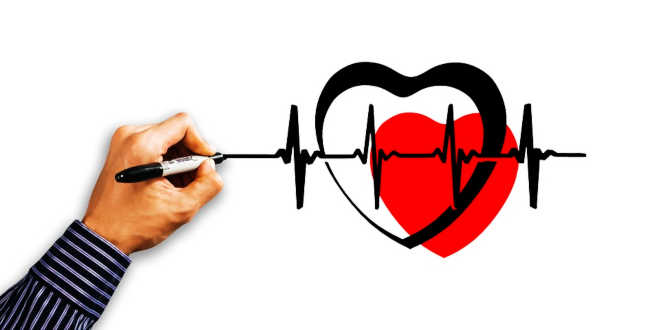
Heart rate of an untrained heart:
- 80 beats per minute * 60 = 4,800 per hour.
- 4,800 beats per hour * 24 = 115,200 per day.
- 115,200 beats per day * 365 = 42,048,000 per year.
We have just seen the difference between the work done by a trained heart and a sedentary heart in terms of the number of beats.
Tissue and heart rate
Heart tissue is a muscle that is constantly contracting and relaxing, and like any muscle, it hypertrophies with work and depends on blood supply for sustenance and nourishment.
An inactive person’s heart is normally small and weak, like any muscle that is not sufficiently worked and shows some atrophy.
Physical exercise widens blood vessels and increases the capillary network. A sedentary heart not only has less capillary infrastructure but also smaller blood vessels, sometimes clogged with debris that further reduces blood supply.
The proper functioning of the heart depends to a large extent on the quality of its muscle tissue and this in turn on vascularisation, which is a consequence of physical training.

A trained heart
A trained heart can reach its maximum effort below 180 beats per minute. The pumping capacity will be up to five times the rate of contractions at rest. It will also be able to maintain this rate for a long time.
In conclusion, it should be noted that physical training leads to an improvement in peak sporting performance, but not only that. What’s more, thanks to exercise, cardiovascular health improves significantly and with it the quality of life and life expectancy.
Related Entries:
- Athlete's heart
- Cardiovascular health - How to take care of our heart