Fitness, Nutrition, Health and Sports Blog In the HSNstore Blog you will find tips about Fitness, sport in general, nutrition, and health – HSNstore.com

- Nattokinase is a protein – a protease enzyme – that is naturally generated when boiled soybeans are inoculated with Bacillus natto bacteria and then fermented during the process of creating Nattō, a soy-derived food commonly consumed in Eastern countries such as Japan.
- Nattō has traditionally been associated with longevity and good health, in fact there are studies that show how natto consumption is somehow associated, from a scientific perspective, with better health and life expectancy in general.
Nattokinase seems to be responsible for the health-promoting properties of this food.
Nattokinase properties and benefits
Nattokinase has a positive impact on people’s health due to the direct and indirect effects it has on the protection of the cardiovascular system in several areas.
For the cardiovascular system
The main positive effect of nattokinase on human health lies in the fibrinolytic properties of this enzyme.
Fibre or fibrin, which is degraded by nattokinase, is formed, among other places, in cholesterol deposits that adhere to blood vessels due to hypercholesterolaemia, and which increase the risk of cardiovascular diseases due to ischaemic events (heart attacks and embolisms).

Such fibrin formation is a complication and a natural and irremediable process of the progression of atherosclerosis when people do not control their cholesterol for years, and it is a very dangerous condition, which is why the discovery of nattokinase has been so highly praised by the medical community.
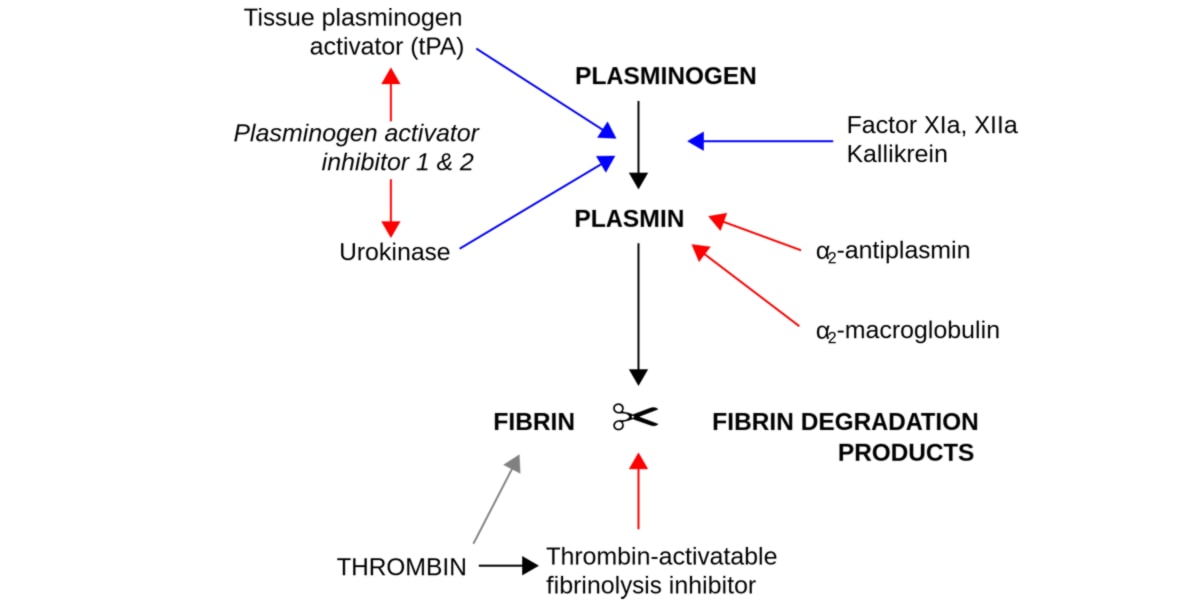
On the other hand, it not only acts directly, but also has indirect effects on fibrin degradation by increasing plasminogen activating factor in cells affected by fibrin networks, and reducing plasminogen activation inhibitory factor.
Plasminogen is the precursor of plasmin, an endogenous protein in our own body, which has fibrinolytic activity, so nattokinase stimulates the synthesis of something that confronts fibrin, and reduces the creation of another protein that in turn blocks the body’s synthesis of plasminogen.
Other properties on the cardiovascular system
By as yet unknown mechanisms, nattokinase is associated with a positive effect on hypertension and hypercholesterolaemia.
At some point in the processes that trigger these morbidity and mortality conditions that represent a serious medical concern to public health in the West today,
For the nervous system
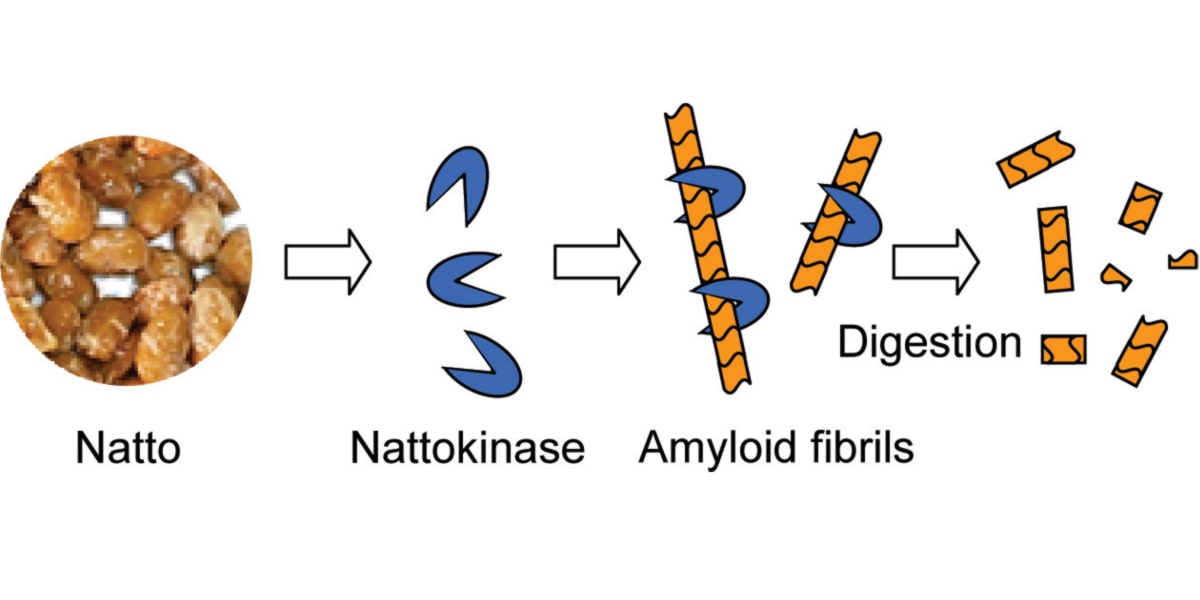
Nattokinase, thanks to its fibrinolytic properties, has been shown to have a positive effect on the development of amyloid fibrils in the nerve terminals of neurons:
Amyloid fibrils are created by genetic defects and enhanced by environmental causes, most of which have yet to be determined, leading to the development of amyloidosis, a condition associated with an abnormal amyloid protein disorder with significant negative health effects, one of the most recognised conditions being its link to Alzheimer’s disease.

How to take Nattokinase?
Nattokinase is an enzyme that can be used at any time of the day as a supplement, there is no one time or condition of use associated with it that is better than another.
Note that before it was isolated for its properties, it exerted its positive effects through the consumption of Nattō, which was taken with other foods in a meal.
We also have studies that administer nattokinase on an empty stomach, more for a reason of avoiding contaminating the results they intend to measure with other nutrients, than because this time of day is superior to another.
Regarding the dose, there is no absolute recommendation, but the recommended amount of nattokinase has been assumed based on its fibrinolytic activity in:
There are studies that administer up to 4 times this amount per day, but the positive effects with 2000 Units are reported, so unless this amount needs to be adjusted based on medical test data, it is the usual recommendation for people interested in benefiting from the positive effects of Nattō.
How long can it be taken?
You should consider that the scientific studies that have been carried out to demonstrate the short-term positive effects of nattokinase last between 1 month and 7 months; and that the most notable effects of nattokinase have been estimated from observational studies of Japanese people who consume Nattō throughout their lives, so a good and sensible recommendation, knowing that nattokinase has no reported adverse effects from long-term consumption, is to use nattokinase daily for as long as possible, ideally for years.
Natural Nattokinase sources
Nattokinase is an enzyme that is generated through the fermentation of soya, provided it is treated with the enzyme Bacillus natto, and when this is the case, what is being prepared is Nattō.
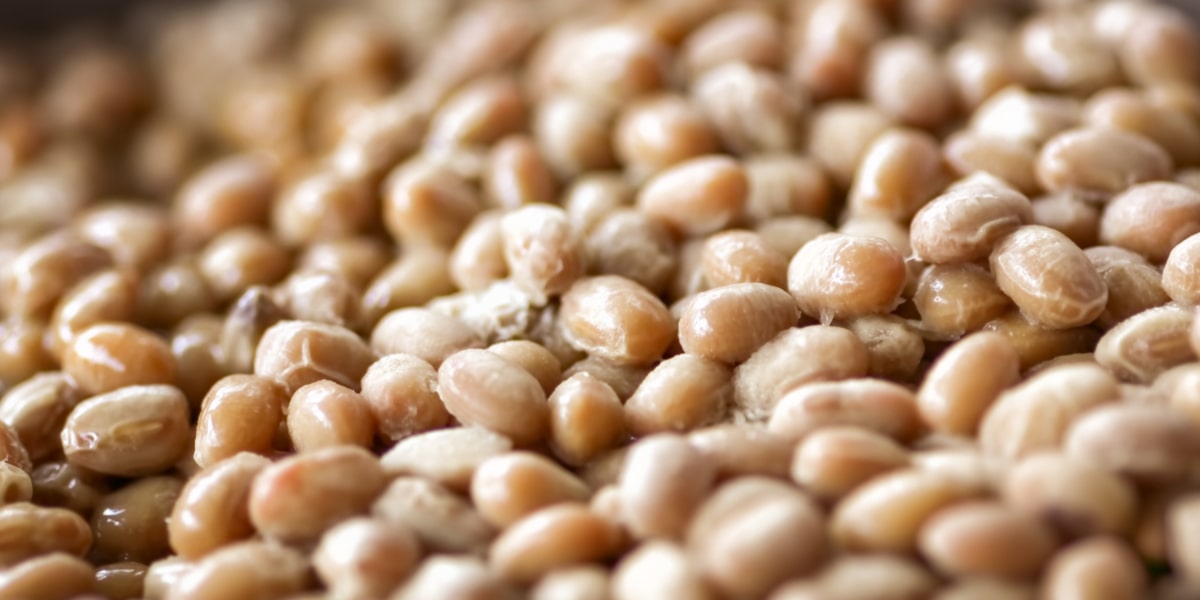
Fermented soya.
So while we could say that nattokinase is a protein generated from fermented soya, which is true, the reality is that for practical purposes it is only found in Nattō, contributing to its characteristic consistency.
Nattokinase supplements
There are many Nattokinase supplements on the market, in order to choose the best one you should focus on the following characteristics:
- It must be derived from soya
Nattokinase can now be obtained recombinantly (synthetically); although this should be equally valid, the science is sparse and the adverse effects of such a process are at least partially unknown.
Therefore, nattokinase purified from soya natto is the best choice.
- Its fibrinolytic activity must be established and have at least 2000 UF.
2000 UFs is the ideal dose, therefore:
- If a nattokinase only indicates mass quantity (mg) and not its units of fibrinolytic activity, discard it.
- If it provides quantities such as 200 or 400 UFs, or the units of measurement are different from Fibrinolytic Units; discard it too.
- It must be GMO-free
90% of the world’s soya contains or is harvested in the presence of Genetically Modified Organisms.
The effect of GMOs on health, although apparently not worrying, remains at least partly unknown, and the most critical sectors of science continue to recommend caution and, if possible, avoidance of GMOs.
Not to mention the negative impact this has on the flora and fauna of the location, forcing a change in the native ecosystem that puts the region’s plant and animal population at serious risk.
Nattokinase by HSN is your best choice:
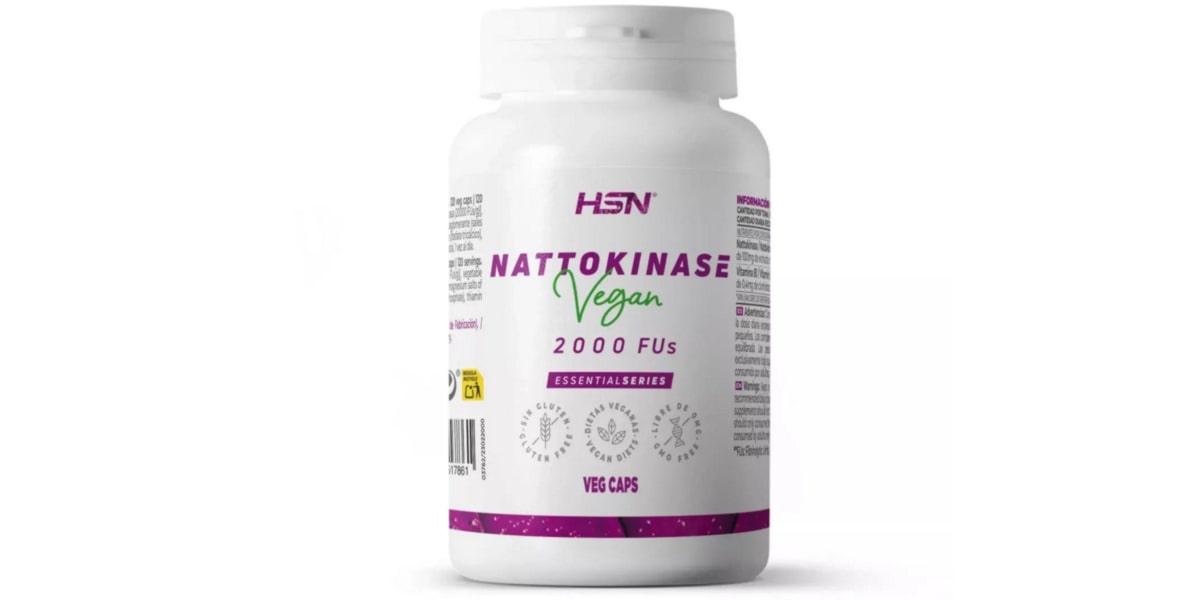
Nattokinase by EssentialSeries.
All you can ask for!
Bibliographical references
- Chen, H., Chen, J., Zhang, F., Li, Y., Wang, R., Zheng, Q., … Lin, Y. (2022). Effective management of atherosclerosis progress and hyperlipidemia with nattokinase: A clinical study with 1,062 participants. Frontiers in Cardiovascular Medicine, 9, 964977.
- Chen, H., McGowan, E. M., Ren, N., Lal, S., Nassif, N., Shad-Kaneez, F., … Lin, Y. (2018). Nattokinase: A Promising Alternative in Prevention and Treatment of Cardiovascular Diseases. Biomarker Insights, 13, 1177271918785130.
- Hsu, R. L., Lee, K. T., Wang, J. H., Lee, L. Y. L., & Chen, R. P. Y. (2009). Amyloid-degrading ability of nattokinase from bacillus subtilis natto. Journal of Agricultural and Food Chemistry, 57(2), 503–508.
- Kurosawa, Y., Nirengi, S., Homma, T., Esaki, K., Ohta, M., Clark, J. F., & Hamaoka, T. (2015). A single-dose of oral nattokinase potentiates thrombolysis and anti-coagulation profiles. Scientific Reports, 5, 11601. https://doi.org/10.1038/srep11601
- Selvarajan, E., & Bhatnagar, N. (2017). Nattokinase: An Updated Critical Review on Challenges and Perspectives. Cardiovascular & Hematological Agents in Medicinal Chemistry, 15(2), 128–135.
Related Entries
- Do you know these benefits of Omega-3 for the heart?