Fitness, Nutrition, Health and Sports Blog In the HSNstore Blog you will find tips about Fitness, sport in general, nutrition, and health – HSNstore.com

Chest dips are a compound calisthenics exercise that enhances upper-body muscle development and strength. By using only body weight, they strengthen “bodyweight” control and share the same philosophy as push-ups and pull-ups.
Thanks to their simplicity, only a pair of parallel bars is required, and they can be performed both in the gym and outdoors, making them an essential basic movement for those looking to improve strength and pushing capacity.
Depending on the variation, as we’ll see below, the hand position will generally match the width we usually use when performing push-ups, that is, slightly wider than shoulder-width.

- Lower the body by bending the arms while leaning slightly forward.
- Lower until the shoulders are below the elbows.
- Raise the body by extending the arms.
- Bring the elbows in at the top.
? A note: this exercise, especially for heavier individuals, can be stressful on the shoulders and elbows. Therefore, we limit the range of motion (ROM) to full arm extension at the top, locking the joint, and when lowering, we form a 90º angle between elbow and shoulder.
Recommended sessions and repetitions
| Level | Frequency | Sets x Reps | Rest | Tip |
| Beginner | 2 times/week (e.g. Mon & Thu) | 3 × 6–8 | 90–120 s | Use a resistance band or rest feet on a bench if you can’t complete the reps |
| Intermediate | 3 times/week (Mon, Wed & Fri) | 4 × 8–12 | 60–90 s | Once you reach the upper range, add 2.5–5 kg of weight to progress |
| Advanced | 3–4 times/week | 5 × 10–15 (weighted optional) | 45–60 s | Vary the tempo (e.g. 3 s lowering, 1 s pause, 1 s lifting) to increase tension |
Which muscles are worked?
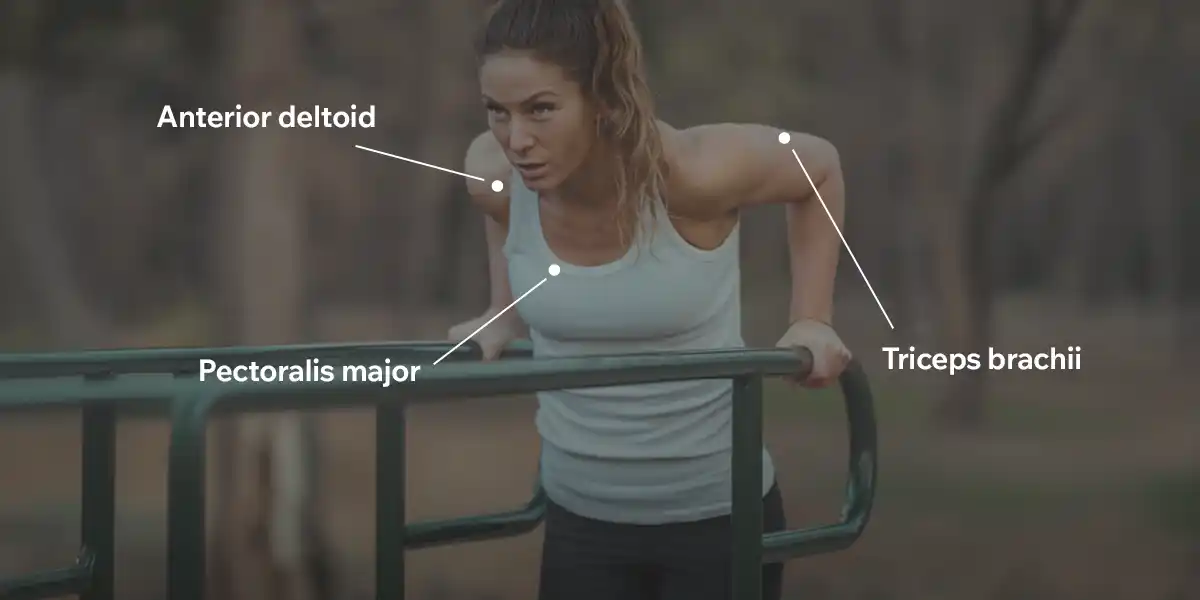
In chest dips on parallel bars, the main muscles worked are:
- Pectoralis major (especially the lower portion) → primary muscle when the torso is inclined
- Triceps brachii → heavily involved in the pushing phase
- Anterior deltoid → assists and stabilizes the movement
Secondarily involved:
- Serratus anterior → scapular stabilization
- Core (abdominals and lower back) → postural control
- Forearms and grip musculature → stability on the bars
? Technical key: the more you lean your torso forward and flare your elbows, the greater the chest activation; keeping the torso more upright shifts the emphasis to the triceps.
Chest dip variations
1 Rings
We are usually accustomed to performing dips using parallel bars, however, to add more complexity, performing ring dips is a major progression.

?️♂️ You must maintain tension (activation) throughout almost your entire body at all times, from arms and chest to the abdomen…
2 Adding weight
This is a progression step: once you have good control of the exercise, the next step is to increase intensity by adding extra load (to your body).
In my training, I usually use the following when I want to add weight:
- Leather belt, like the ones used to brace the abdominal muscles.
- Chain and carabiner.
- Weight plates.

?️♂️ For this, weighted belts or vests are commonly used, or even holding dumbbells between the feet, although in my opinion this is quite cumbersome.
3 Triceps dips
The most basic variation consists of narrowing the grip, therefore reducing the distance between the arms, resembling a shoulder-width push-up position. This places greater emphasis on the triceps.
?️♂️ An “easy” way to add weight is to place a plate on the legs, which are supported on another bench. Remember that unlike the chest, this muscle is smaller, so we must be careful with the loads used when adding weight.

4 Bench dips
A classic pushing exercise mainly focused on the pectorals, with strong involvement of the triceps and anterior deltoid, using body weight and a greater range of motion.

?️♂️ Keep your elbows open and shoulders back, lower in a controlled manner seeking a chest stretch, and avoid locking the elbows at the top to maintain constant tension and protect the joints.
If you can’t perform a chest dip
If you’re unable to perform several dips or are just starting out and lack sufficient pushing strength, you can use assisted machines, which you’ll find in any gym.
These allow you to place your legs and, depending on the load setting, provide more or less assistance during the lifting phase

Another option is to use resistance bands as a “swing.” Use a pair of benches, one to support your hands and another for your feet; if it’s still too difficult, support only your hands.
Why include chest dips in your routine?
Dips are a complete exercise that:
✅ Will make you strong: since it directly involves control over your body weight, if you can move it, you’ll be training muscles as diverse as triceps, chest, anterior deltoids, rhomboids, levator scapulae, etc. In other words, we apply intense work to muscles that many other exercises barely target.
✅ Builds muscle mass in the torso: this is conditioned by the previous point, as a demanding workload leads to greater development, provided the other factors (nutrition, rest) are met.
✅ Enhances the chest: something we all seek—displaying an upright, dominant torso that stands out visually. This exercise perfectly balances aesthetics and performance.
✅ Offers variability: by adding weight to increase intensity or varying grip width to emphasize different muscles.
✅ Transfers to other exercises: such as the bench press and overhead press, since elbow involvement is similar. For example, locking out the elbow in a dip closely resembles the final phase of the bench press.
✅ Fits into any routine: whether you follow a split routine and want a quick torso workout, or you include it on chest day.
Bibliographic Sources
Related Posts
- How to do more pull-ups
- 13 Push-Up Variations for Maximum Development
- Is locking the joint on every repetition effective?
- Best exercises for pectorals