 Fitness, Nutrition, Health and Sports Blog In the HSNstore Blog you will find tips about Fitness, sport in general, nutrition, and health – HSNstore.com

Mucuna Pruriens is associated with an improved male fertility (increase in testosterone and its precursors). Moreover, it can relieve the symptoms of Parkinson’s disease
What is Mucuna Pruriens?
It is a leguminous plant that grows in tropical climates
In fact, this plant is used to produce food supplements. Even though these products are sold as “Mucuna Pruriens”, they are actually and extract obtained from the seeds of this plant. This is where the active ingredients of the plant are.
Properties of Mucuna Pruriens
Traditionally, the Mucuna Pruriens has been used for its aphrodisiac and invigorating properties.
Particularly, this is due the fact that the seeds contain a high percentage of L-Dopa. Said amino acid is a precursor form of the neurotransmitter Dopamine. Above all, it performs many physiological functions (sleep control, mood, cognition, reward and addiction system, catecholaminergic, lactation…).

Therefore, Mucuna Pruriens is a powerful dopaminergic substance used to increase the dopamine levels.
What are the uses of Mucuna Pruriens?
Despite the fact that Mucuna has many physiological effects proven in human and animals, we will review two of the main properties of this substance in this article:
- Increasing the fertility (more testosterone and precursors)
- Buffering the symptoms of Parkinson
Mucuna Pruriens and Male Fertility
Above all, Mucuna Pruriens has been widely used to improve the fertility of men
This compound seems to improve the fertility by increasing the volume of ejaculate; density of spermatozoa (spermatogenesis); apart from improving their motility.
That is, it is a useful product to treat the 3 main pathologies caused by male infertility:
- Hypospermia (low volume of semen).
- Oligospermia (low number of spermatozoa in the semen).
- Asthenospermia (hypomotility of the spermatozoa present in the ejaculate; regardless of the amount).
Study 1
Shukla et al. (2009) conducted a study in which the participants took 5g of a Mucuna Pruriens seed extract supplement a day in a single dose.
Above all, it improved the amount of ejaculate, the % of motility of the spermatozoa and their amount. Not just for those who suffer Oligospermia or Asthenospermia, but also for those who are Normospermic.

In other words, subjects who do not suffer alterations in the sperm.
Study 2
The authors that we mentioned previously also participated in a later study by Gupta et al. (2011). In fact, they used the same dose once again (5g/day) in normospermic, oligospermic and asthernospermic subjects.
Once again, they reached the same conclusions, Mucuna improves the fertility of the subjects regardless of their conditions. But in this case they also measured the lipid peroxidation of the semen.
However, an excessive peroxidation can damage the sperm (Gadella et al. 2001, quoted in Membrillo et al., 2003). Consequently, buffering said process will improve the functionality of the spermatozoa and, in turn, the fertility.
Conclusions
The study also included an analysis of the different amino acid concentrations in the semen of the subjects through nuclear magnetic resonance spectroscopy.
Finally, the authors concluded that taking 5g of Mucuna Pruriens daily considerably improved the metabolic profile of the amino acids from the seminal plasma.
We do not exactly know the role of each amino acid on fertility. Moreover, the etiology of their concentration (eu- or dis-) is quite different. We just want to clarify that a proper balance of the metabolite spectrum from the different amino acids in semen will determine the degree of male fertility.
Mucuna Pruriens and Testosterone
Moreover, the authors conclude that this substance improves the male fertility through several ways that condition it. For example, one of them is the hormone balance, something many people are interested in.
How does it increase the Testosterone?
Above all, Mucuna Pruriens improves the hormone balance that depends on the HPTA:
- It increases the LH (luteinizing hormone) and T (Testosterone)
- Then, it reduces the FSH (follicle stimulant hormone) and PRL (prolactin)
In fact, these results are the same in several essays and with an interesting increase magnitude in subjects from all groups):
| GROUP | |||
| MARKER | Oligospermia | Normospermia | Asthenospermia |
| T | +39% | +27% | +17% |
| LH | +41% | +23% | +40% |
Chart I. Changes in the Testosterone (T) and Luteinizing Hormone (LH) concentrations from different groups after taking 5g/day of Mucuna Pruriens for 3 months. taken from Shukla et al. (2009)
Explanation
The action mechanism of Mucuna seems to improve the hormone environment due to the L-Dopa content from its seeds. In addition, it contains catecholamin active metabolites (epinephrine, norepinephrine and dopamine):
- L-Dopa crosses the BBB (Brain Blood Barrier) and increases the dopamine levels in the brain. Therefore, this inhibits the production of PRL in the anterior lobe of the pituitary gland.
- Then, this stimulates the production of GnRH in the hypothalamus.
- GnRH is the gonadotropin, a signalling stimulant of the LH production by the pituitary gland.
- At the same time, LH travels to the gonads (testicles) where the Leydig cell receptors increase the cAMP production from ATP. Consequently, this stimulates the Testosterone production.
Improved hormone homeostasis
All of us have heard about products that increase the serum testosterone, which inhibits the LH production by negative feedback, right?.
But Mucuna Pruriens is a very interesting supplement to recover the hormone homeostasis of those who have used this products.
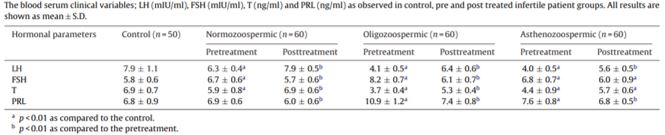
Figure I. Changes in the pre- and post-treatment serum concentrations of LH, FSH, T and PRL of infertile subjects that belong to normospermic, oligospermic and asthenospermic groups when compared to the control group.(Gupta et al., 2011)
Likewise, taking 0.5g of L-Dopa orally seems to significantly increase the growth hormone levels of healthy subjects. According to the information gathered by Chiara et al. (1986).
Mucuna Pruriens and Parkinson
Finally, we also wanted to mention is its potential to treat Parkinson.
This progressive neurodegenerative disease destroys the presynaptic neurons located in the black matter. Therefore, it significantly lowers the synthesis of dopamine.
Above all, people use a palliative treatment to slow down the symptoms of this disease, a combination of Levodopa and Carbidopa. However, Mucuna Pruriens seems to be more effective than the traditional treatment with Levodopa and Carbidopa. In fact, it increases the plasma dopamine levels sooner and more efficiently.
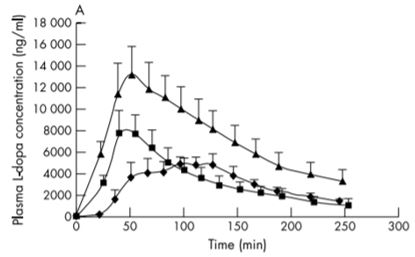
Figure II. Plasma concentration (axis Y) in time (axis X) after taking 200mg of Levodopa+50mg from carbidopa (rhombus), 15g of Mucuna Pruriens seed powder (square) and 30g of Mucuna Pruriens seed powder (triangle). (Katzenschlager et al., 2004)
Study
Particularly, taking 30g of Mucuna Pruriens produced a peak that was a 110% superior to the combination of levodopa+carbidopa. In fact, its area under the curve was a 165.3% higher and it lasted an average of more 37 minutes (21.9%) than the traditional treatment.
However, despite the good response of the subjects, without reported toxicity or side effects, the dose of Mucuna Pruriens was extremely high.
Maximum Dose
The AECOSAN (Spanish Agency for Consumer Affairs) concluded that the maximum dose (tested on animals) was 70mg/kg/day; and this maximum dose became toxic due to the neurotoxic effects of L-Dopa.
On the contrary, the lowest toxic dose for oral L-Dopa in humans is 4286mg/kg. However, we still need to be cautious, since Mucuna Pruriens does not only contain this substance.
Bibliography
- Membrillo Ortega, A., Córdova-Izquierdo, A., José Hicks Gómez, J., Olivares-Corichi, I., Manuel Martínez Torres, V., & de Jesús Valencia Méndez, J. (2003). Peroxidación lipídica y antioxidantes en la preservación de semen: Una revisión. Interciencia, 28, 699–704.
- Chihara, K., Kashio, Y., Kita, T., Okimura, Y., Kaji, H., Abe, H., & Fujita, T. (1986). L-dopa stimulates release of hypothalamic growth hormone-releasing hormone in humans. The Journal of Clinical Endocrinology and Metabolism, 62(3), 466–473.
- Katzenschlager, R., Evans, A., Manson, A., Patsalos, P. N., Ratnaraj, N., Watt, H., … Lees, A. J. (2004). Mucuna pruriens in Parkinson’s disease: a double blind clinical and pharmacological study. Journal of Neurology, Neurosurgery, and Psychiatry, 75(12), 1672–1677.
- Shukla, K. K., Mahdi, A. A., Ahmad, M. K., Shankhwar, S. N., Rajender, S., & Jaiswar, S. P. (2009). Mucuna pruriens improves male fertility by its action on the hypothalamus-pituitary-gonadal axis. Fertility and Sterility, 92(6), 1934–1940.
- Gupta, A., Mahdi, A. A., Ahmad, M. K., Shukla, K. K., Bansal, N., Jaiswer, S. P., & Shankhwar, S. N. (2011). A proton NMR study of the effect of Mucuna pruriens on seminal plasma metabolites of infertile males. Journal of Pharmaceutical and Biomedical Analysis, 55(5), 1060–1066.
- Santacruz, J. A., Sinovas, M. H., Carras-, M. I., Lorenzo, S. M., Valle, M. Y., Herrera, A. D. M., … Carrasco, M. I. (n.d.). Informe del Comité Científico de la Agencia Española de Consumo , Seguridad Alimentaria y Nutrición ( AECOSAN ) sobre el riesgo del uso de semillas de Mucuna pruriens en productos de artesanía.
Related Entries
- Top Supplements against erectile dysfunction
- Natural aphrodisiac products for Women
- Top 10 Foods to increase the testosterone