Fitness, Nutrition, Health and Sports Blog In the HSNstore Blog you will find tips about Fitness, sport in general, nutrition, and health – HSNstore.com

Article exclusively for women. We bring you a special diet: the 30-calorie rule.
If I got a euro every time I hear “there are no articles about diets for sporty girls”, you’d probably be reading the new owner of HSN or even with the leftovers I’d treat myself to some Inditex shopping.
It’s true that most articles online are aimed at men, and what little you find for women boils down to “get rid of cellulite with this detox diet”.
Still, it’s worth remembering that this blog already has several of my articles about women’s diets that:
- Focus on improving performance,
- Fat loss, or
- How it affects the hormonal side of the process.
Common Mistake: restricting calories to the max
When a girl decides to improve her body composition, or in other words, lose body fat while maintaining muscle mass, she restricts her diet
To do this, she cuts out most carbohydrates (or even fats), eating only lettuce, cucumber, a piece of fruit like an apple, and some processed stuff like turkey breast, thinking it’s a perfect food because it’s low in fat.

If we look at the calorie content of a cucumber, it’s no more than 20-30 Kcal per 100 grams, lettuce provides about 15-20 Kcal, or even other veggies like zucchini about 25-30 Kcal.
Putting aside the importance of fats and proteins and focusing purely on calorie value, we’ll see that the TOTAL intake for a day doesn’t go beyond 800-1000 Kcal. This causes a big amount of weight loss, since muscle tissue, glycogen, and water will be lost, even losing 2-3 Kg without counting fat loss.
What is the female athlete triad?
What many women don’t know is that following these restrictive diets can turn them into potential slaves of the famous female athlete triad.
We could say the triad is a series of harmful effects caused by a disruption in calorie intake. To sum it up, it boils down to 3:
- Lack of energy.
- Altered or lost menstruation.
- Poor bone health or even osteoporosis.
Maybe you’re thinking you suffer from this or know a girl close to you with these symptoms (especially the first two)
Which group of women are more prone to the triad?
We find women training at high intensity, as well as those aiming for body fat below 15-16% (remember essential fat in women is around 10-12%).
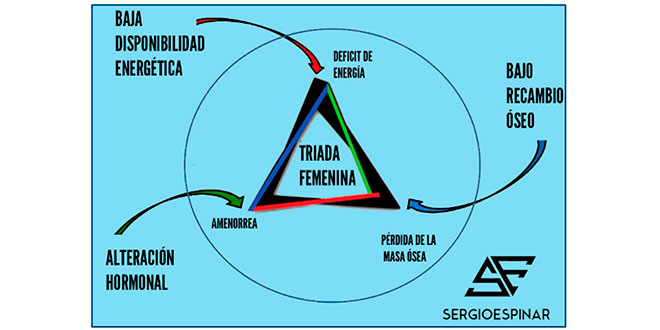
Female athlete triad. Restrictive diets cause poor bone health, lack of energy, and menstrual cycle disruption. Image adapted from femaleathletetriad.org
Causes of the Triad
If we look for what causes the loss or alteration in the menstrual cycle, it’s the disruption in the “pulses” of LH (Luteinizing Hormone) plus an imbalance in the hypothalamic-pituitary-adrenal axis (known as HPA).
Along with this, we can find low levels of estrogens and leptin, which if you remember from my article about the menstrual cycle, act on our hypothalamus reducing hunger sensation. Also, leptin affects the release of gonadotropins (which includes LH mentioned above).
Though the previous paragraph might sound weird, it’s easy to understand:
How to fix the problem
It’s no news that to lose fat you need to create a calorie deficit, or in other words, burn more calories than you consume…
We can achieve this in two ways:
- Either reduce the calories you eat.
- Or increase the amount of exercise you do.
Now, without considering scientific studies or expert opinions, be honest: what do you think is better for your body, cutting nutrients or upping your exercise?
The answer is obvious:
When sessions last over 90 minutes or exercise intensity is above 70% VO2max, alterations occur in the HPA axis we mentioned earlier, releasing more cortisol or even catecholamines.
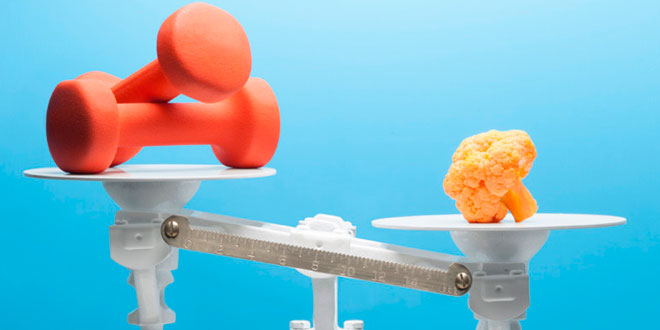
Don’t get me wrong, too much of anything is bad, even exercise
Deficit through diet or training
Now, does creating a deficit through training have the same impact on women as through diet?
This question was asked by Loucks AB’s research group[8], who put a group of women through physical training + moderate calorie diet versus a group creating a deficit with a very restrictive diet.

Later, results were compared with women on a moderate calorie diet without exercise
Results
The results were quite interesting:
- Women doing high-intensity training DID NOT alter luteinizing hormone (LH) release.
- Which DID happen in the low-calorie diet group.
This is important because some animal studies show that altered LH release strongly activates the HPA axis, releasing more cortisol.
To give you an idea, that’s a 100-200% increase, while exercise might raise cortisol levels by 10%[9], though as always, individual differences are big.
Who would’ve thought what you’ve been doing for years wasn’t right? Now, many of you are wondering how many calories you should eat to avoid these problems. That’s where my 30 Kcal rule comes in.
30 Kcal rule
The minimum intake you should have is 30 Kcal per kg of lean body mass / day.
That means if a girl weighs 60 Kg and after subtracting body fat she has 44 Kg lean mass, multiply 30 by 44, giving 1320 Kcal. These are the calories you must consume at LEAST to avoid entering the trouble zone.
Obviously, you should adjust calories to your training, so the actual amount you need is a bit higher
Conclusions
To sum up, we can simplify to:
- Cutting out foods is NOT the best way to lose fat.
- Very low-calorie diets cause hormonal disruption, leading to effects like amenorrhea, fatigue, or higher fracture risk.
- Exercise is a stressor, but if done in a controlled way with proper calorie intake, its benefits help improve body composition.
- To avoid problems, stick to the 30-calorie rule. Eat plenty of protein, around 2-2.5 g if hunger is high, fiber-rich foods like veggies, fruits, or even legumes. Base your diet on fiber, fat, and protein for your goal.

Just because your diet is based on the above doesn’t mean you should cut out carbohydrates
Hope this helps you, and little by little you reach your goal. Big hugs!
Sources
- Body weight, exercise and menstrual status among ballet dancers in training. Abraham SF, Beumont PJ, Fraser IS, Llewellyn-Jones D
- Prevalence of oligomenorrhea and amenorrhea in a college population. Bachmann GA, Kemmann E.
- Influence of high intensity training on menstrual cycle disorders in athletes, Dusek T
- Risk factors for stress fractures in track and field athletes: a twelve-month prospective study. Bennell KL, Malcolm SA, Thomas SA, et al.
- Bone mineral density in young, hypothalamic oligoamenorrheic women treated with oral contraceptives. Castelo-Branco C, Vicente JJ, Pons F, et al
- Bone mineral density after resumption of menses in amenorrheic athletes. Drinkwater BL, Nilson K, Ott S, Chesnut CH 3rd
- The decrease in luteinizing hormone secretion in response to weight reduction is inversely related to the severity of insulin resistance in overweight women.
Bützow TL1, Lehtovirta M, Siegberg R, Hovatta O, Koistinen R, Seppäla M, Apter D. - Low energy availability, not stress of exercise, alters LH pulsatility in exercising women. Loucks AB1, Verdun M, Heath EM.
- Alterations in the hypothalamic-pituitary-ovarian and the hypothalamic-pituitary-adrenal axes in athletic women. Loucks AB1, Mortola JF, Girton L, Yen SS.
Related links on the topic:
- A good question: How many calories do you need to build muscle?
- Women and sport
- Premenstrual syndrome and sport