Fitness, Nutrition, Health and Sports Blog In the HSNstore Blog you will find tips about Fitness, sport in general, nutrition, and health – HSNstore.com

Metabolic Tomb is a state where you burn few calories, do hours of cardio, and still don’t lose a single gram of fat
What is Metabolic Tomb?
This might sound like a horror movie plot to some of us, but it’s what many call the “metabolic tomb.” Or, in other words,
the inability to lose fat even when on a hypocaloric diet
But… is it really something that can happen?
Metabolic Tomb: Myth?
It’s no secret I’m against the famous “metabolic tomb” or “metabolic damage.” According to some experts, being on very restrictive diets combined with excessive physical exercise puts metabolism on high alert, making it barely burn calories even if we increase our calorie intake.
This hypothesis has led many to find a quick scapegoat for not losing all the fat they wanted
We constantly read comments like “…I eat 1000 calories and do 3 days of exercise but can’t lose weight…”, “…I barely eat and gain weight, my metabolism is damaged…”, “…I think my client has metabolic tomb because no matter what they do, they don’t lose…”
What happens when we do a Hypocaloric Diet?
When we start a hypocaloric diet (eating fewer calories than we need), our body activates several mechanisms to compensate for that loss and maintain the % of fat we have.
We must understand that our body doesn’t get diets
Our body doesn’t say “ok, you’re on a diet, take the body fat you need”… what it thinks is that you don’t have enough food available and goes into “alert mode.”
Basal Metabolism Decreases
One of the processes that most affects fat loss is a decrease in basal metabolism. So a very tight calorie deficit can cause a stall in fat loss after a few weeks, since the amount of calories that initially put us in deficit now places us in a maintenance diet, or in other words, the calories that were once insufficient now lead to a neutral balance (calories in = calories out).
Adaptive Thermogenesis
This slowdown in metabolic rate is known as adaptive thermogenesis and its effect depends on how big the calorie deficit is.
In short, we can say that people who consume very few calories will have a much bigger metabolic drop
Although many might think that eating very few calories is linked to muscle loss, the reality is different and it doesn’t happen in all cases. This is what some reviews say about very low-calorie diets:
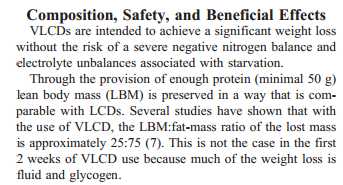
The gist is that very low-calorie diets don’t risk nitrogen balance (a marker of protein loss) and some studies show 50g of protein preserves fat-free mass (includes muscles, bones, glycogen, fluids, etc…), where a 25:75 ratio between fat-free mass and body fat was observed.
The Minnesota Experiment
Although many studies exist on how our body adapts to fat loss, one in particular pushes the human body to the limit:
Minnesota experiment
Methods
In this study, 36 participants followed a very low-calorie diet to observe emotional and physical changes. The experiment had 3 parts:
- First phase (12 weeks). Subjects consumed an average of 3,200 kcal, a calorie amount close to maintenance
- Second phase (6 months). Calories were reduced to 1500 kcal and psychological and physical changes were observed
- Third phase (12 weeks): They were allowed unlimited food intake.
It’s worth noting that all subjects were forced to walk about 25 km per week.
Results
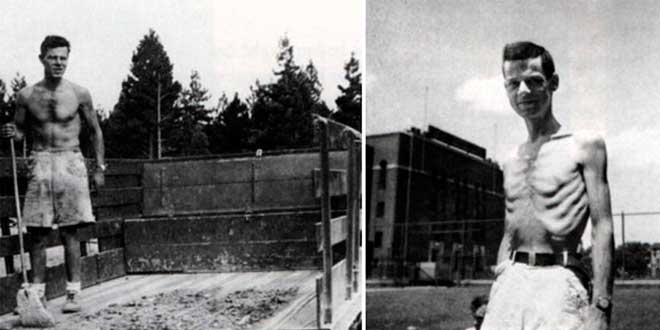
- Heart rate dropped from 55 to 35/min
- Edema formation occurred, which I believe is due to protein loss
- Metabolism reduced by 40%
- Body temperature decreased
- Depression, loss of sexual desire, and even delusions.
Although all these effects lead to a lower metabolic rate, most subjects reached 5% body fat. What does this mean?
It means that even with metabolic compensation, as long as there’s a deficit, weight loss will continue
Conclusions
This metabolic slowdown during fat loss is real but doesn’t work like an on/off switch.
Our body, even if it clings to keeping body fat, must use it when necessary. A special case is people with low body fat (under 10%), where the body prefers to use muscle instead of fat.
Why do we stop losing weight?
There are 3 reasons:
- We burn fewer calories during exercise than we think
- We eat more calories than we realize
- We keep the same calorie intake throughout the fat loss process.
We must understand that as we lose fat, our calorie needs decrease, so continuing to eat the same calories makes no sense, which combined with points 1 and 2 leads to a fat loss plateau.
However, saying “I’m eating fewer calories than I burn and I gained weight” is basically impossible
Adaptive thermogenesis only reduces fat loss but never stops it completely.
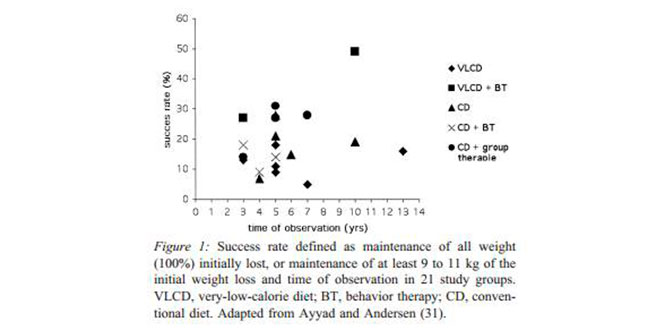
As shown in the graph below, over 21 studies with very low-calorie diets (VLCD) demonstrated 100% of fat loss was maintained up to 14 years later.
Can rebound effect happen?
Of course, but for rebound to happen, there must be a calorie surplus (hypercaloric diet).
Since adaptive thermogenesis creates an ideal environment to store fat, however, as I said above, you need to eat more calories than you burn; rebound can never happen on a hypocaloric diet.
People who suffer this rebound effect are those who were overweight or obese at some point:
They reach their weight goal and then increase daily intake, making it easier to store excess energy.
Does this mean very low-calorie diets are good?
Definitely not. As we saw in the Minnesota experiment, the physical and mental effects are quite severe.
Some participants even self-harmed
Excessively calorie-restricted diets increase food cravings (risk of anorexia or bulimia), depression, apathy, loss of sexual desire, exhaustion, and even paranoia in severe cases.
How to know if you’re in Metabolic Tomb?
The theory that our body can store fat even on a hypocaloric diet is wrong, unlike what some experts like Layne Norton say.
However, it’s true that very restrictive calorie diets and long low-intensity cardio sessions cause an adaptation that makes fat loss harder.
As I’ve shown, the main problem for someone dieting is that they quickly regain lost weight.
Example of “bad” habits
Imagine a girl named Nuria, 25 years old, who was obese during her teens. She currently has a normal fat percentage but due to a bad diet gains several kg.
Afraid of becoming obese again, Nuria follows a 800 kcal diet with 3h daily elliptical and treadmill.
She’s happy because she says she’s losing 1 kg/week and is back to her initial weight. But her joy is short-lived because she suddenly gains weight without changing her diet much, leading to despair.
How to ruin our metabolism
First, understand that people who were obese as kids are more likely to regain lost weight over time because they have more fat cells.
For those who don’t know, fat cells (adipocytes) are where our body stores fat
So it’s no surprise that more fat cells mean greater storage capacity.
Next is the extremely low calorie intake and excessive cardio people do to compensate for fat gain.
But in the long run, things change. We must distinguish between obese and lean people
Obese people
For obese people, a very low-calorie diet leads to significant prolonged weight loss. More than 20 kg can be lost (study).
This loss leads to a big reduction in waist and hip circumference, since 75% of lost weight is fat. In other words, an obese person on a very low-calorie diet can lose over 18 kg of fat in 12 weeks.
Lean people
For lean people, the situation is totally different. Muscle loss is much greater than in the previous case. This is because reducing fat cell size makes
The body resist using body fat as energy more
This doesn’t mean lean people burn less fat than overweight people. It means the fat their cells burn comes from the diet, not from stored body fat.
This is one reason why people with very low body fat burn more calories than sedentary people, but very little comes from fat stored in fat cells.
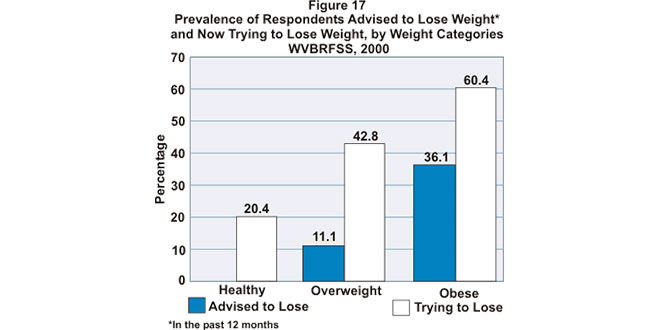
60.4% of people with obesity are trying to lose fat, weren’t they happy with their bodies?
How do I fix this problem?
Because these very low-calorie diets are also very low in carbs, once people increase calorie intake, they gain weight quickly because glycogen stores refill and water is pulled into cells.
Remember a 70 kg person can store about 500 g of glycogen.
Each gram of glycogen pulls 3-4 g of water
So in the first 48 h, body weight can increase by 1-2 kg. This is when many women and men get scared by rapid weight gain thinking it’s fat and cut calories again. MISTAKE!
As I said, this increase only happens in the first 48 hours after increasing calories. After that, if calories increase gradually, body weight won’t rise.
HIIT Training
With more calories, basal metabolism increases and so does fat burning at rest. But to keep this effect long-term, you need short, intense training like weights or HIIT.
Progressive calorie increase
The solution is clear: Increase calories gradually with intense training.
No need for 3-4 h daily on treadmill and elliptical at low pace. 45 minutes at high intensity increases basal metabolism by 190 kcal plus burns over 500 during training.
Obviously, this leads to muscle gain and fat loss simultaneously, as some researchers show.

As you can see, both men and women lost fat (Fat mass) and gained fat-free mass
“Eat more and move more”
The problem is that the advice “Eat more and move more” doesn’t usually stick because sedentary levels are quite high.
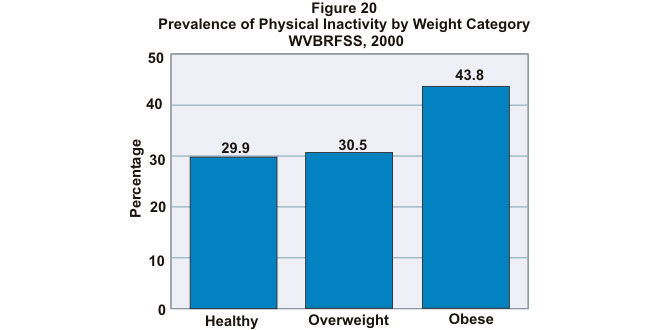
30% of “healthy” people don’t exercise, while in obese people, it jumps to almost 50%
Metabolic Tomb Case Study
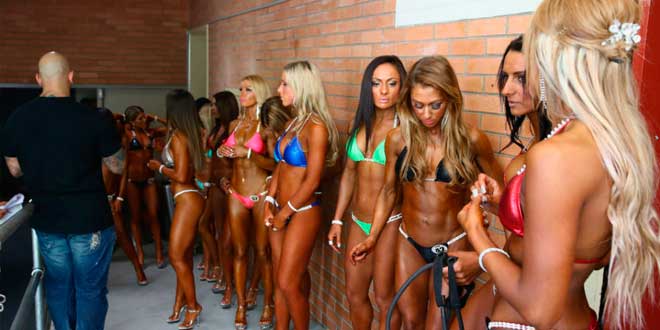
For this case study, hormonal and physiological changes in 7 men and 8 women were analyzed, divided into 3 periods:
- T1: Week before fitness competition
- T2: Week after competition
- T3: 4-6 weeks later
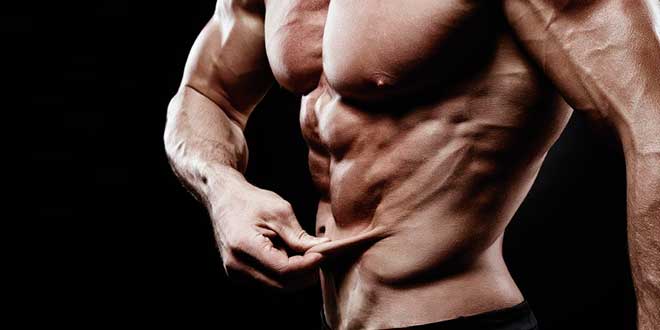
As many know, these competitions involve drastic calorie restrictions and even double training sessions (a light fasted one and a weights session in the afternoon).
With the goal of minimizing body fat % to get on stage.
What data was obtained from this observational study?
Weight gain, not fat
An increase in fat and carb intake was observed from pre-competition to post-competition week, without an increase in protein intake.
This is because during calorie restriction, subjects usually use very high protein diets for satiety and muscle preservation.
Regarding weight, there was a 3.9 kg increase from T1 to T3. Interestingly, from T1 to T2, weight increased by 2 kg but fat % stayed the same.
Maintaining that calorie increase for weeks DOES cause fat gain. I’ve said this many times:
No one gains fat by increasing calories for 24 h
Metabolism
Resting energy expenditure (calories burned to maintain vital functions) was 1612.1±265.7 kcal/day at T1, increasing to 1881.1±329.1 at T2.
Similarly, cortisol levels were higher at T2 (post-competition), decreasing at T3.
Finally, no changes were seen in leptin, ghrelin, or insulin
What conclusions can we draw from this study?
Two very clear conclusions we’ve seen before:
- Very restrictive diets cause worse hormonal environment, lower resting and exercise energy expenditure, worse mood, more hunger, and higher risk of eating disorders
- All adaptations from calorie restriction disappear when calorie intake increases, restoring hormones like testosterone, T3, and leptin, and increasing calories burned at rest and during exercise. That’s why many see their NEAT increase when eating more
Conclusions
In short, we see once again how evidence goes against the metabolic tomb hypothesis.
This fat loss plateau is largely due to a behavioral factor

For those who like trivia, this study was funded by the BioLayne foundation of Layne Norton, one of the main figures who argued metabolic tomb was real. To date, he hasn’t commented on these results
Calorie restriction makes people reduce daily activity (NEAT), which means lower total daily energy expenditure.
Sources
- Very-Low-Calorie Diets and Sustained Weight LossWim H.M. Saris
- Adaptive reduction in basal metabolic rate in response to food deprivation in humans: a role for feedback signals from fat stores.
- Biology’s response to dieting: the impetus for weight regain.Am J Physiol Regul Integr Comp Physiol. 2011;11:R581–R600. doi:
- MacLean PS, Higgins JA, Jackman MR, Johnson GC, Fleming-Elder BK, Wyatt HR, Melanson EL, Hill JO. Peripheral metabolic responses to prolonged weight reduction that promote rapid, efficient regain in obesity-prone rats
- Evidence for the existence of adaptive thermogenesis during weight loss. Br J Nutr. 2001;11:715–723. doi: 10.1079/BJN2001348.
- Long-term persistence of adaptive thermogenesis in subjects who have maintained a reduced body weight.
- Adaptive thermogenesis in humans. Int J Obes.2010;11(Suppl 1):S47–S55.
- Physiological changes following competition in male and female physique athletes: A pilot study. Eric T. Trexler1,2, Katie R. Hirsch2, Bill I. Campbell3, Meredith G. Mock2, Abbie E. Smith-Ryan1,2
Related Posts
- Nutrition and Female Athletes
- Peak Week: Pre-Competition Week
- When Exercise Doesn’t Work to Lose Fat