Fitness, Nutrition, Health and Sports Blog In the HSNstore Blog you will find tips about Fitness, sport in general, nutrition, and health – HSNstore.com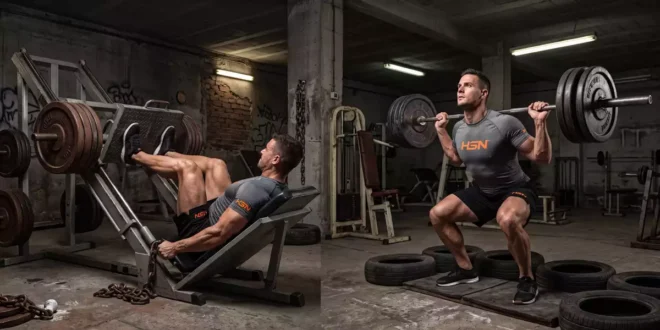

Few debates generate as much discussion in the gym as this one: squat or leg press? Some people defend one and dismiss the other, but from the perspective of biomechanics and training programming, the answer is far more interesting than simply deciding which one is “better”.
Both exercises are multi-joint movements aimed at training the lower body, but they differ significantly in terms of stability, freedom of movement and technical demands. Therefore, the choice will mainly depend on your goal, experience and individual characteristics.
Squat vs. leg press: advantages of each at a glance
| Goal | Squat | Leg press |
|---|---|---|
| Key advantage 1 | Greater transfer to free movements | Greater stability and easier technique |
| Key advantage 2 | Greater overall stabilisation demands | Greater focus on the lower body |
| When it is preferable | For developing strength, coordination and stability | For prioritising muscle work and accumulating training volume |
| Suitable for… | Full-body work and free movement patterns | Hypertrophy, beginners and certain rehabilitation processes* |
* In the event of injury or rehabilitation, exercise selection, range of motion and load should be individualised under professional supervision.
What are the biomechanical differences between the squat and the leg press?
At first glance, both exercises share a fundamental characteristic: they involve hip and knee flexion and extension against resistance. However, the way this resistance is applied and the stabilisation demands are different.
- These characteristics may make each exercise more suitable depending on the training goal.
Free-weight vs. guided exercise: differences in stability
In the free-weight squat, the feet remain planted while the body moves and must control the resistance throughout the entire range of motion. This requires coordination between the joints involved and significant involvement of the stabilising muscles of the trunk, hips and ankles.
In addition to producing force to complete the movement, the athlete must actively control their position and the path of the load.
In the leg press, by contrast, the backrest supports the trunk and the machine largely determines the path of movement. As a result, balance and overall stabilisation demands are reduced.
This does not mean that the leg press completely “isolates” the legs, but rather that it allows the work to be focused on the lower-body muscles with lower stabilisation demands than a free-weight squat.
Demands on the trunk and spine
In the barbell squat, the external resistance must be supported and stabilised by the body itself. Bar position, load magnitude, technique and the athlete’s anthropometric characteristics influence the forces acting on the spine and the joints involved.
For this reason, proper execution and good trunk stabilisation capacity become particularly important as the load increases.
In the leg press, the backrest supports the trunk and reduces stabilisation demands compared with a free-weight squat. However, this does not mean that the lumbar region is free from load.
The position of the backrest, the depth reached, individual mobility and pelvic control can considerably alter the mechanical demands during the exercise.
Therefore, it cannot be generally stated that either exercise is always “safer” for the back: the choice should be adapted to each person’s technique, tolerance and individual characteristics.
Muscle involvement: quadriceps, glutes and stabilising muscles
Both the squat and the leg press significantly involve the quadriceps and glutes, although the relative contribution of each muscle group may vary depending on factors such as range of motion, load, technique and the specific exercise setup.
One of the main differences lies in the stabilisation demands. The free-weight squat requires control of the position of the trunk and joints throughout the movement, whereas the leg press provides greater external stability.
This allows the athlete to focus their effort on the lower-body muscles and accumulate local training volume on the leg press without balance or trunk stabilisation normally being the main limiting factor.
Therefore, rather than referring to quadriceps isolation, it is more accurate to describe it as a greater focus on lower-body work.
When should you choose the squat and when should you choose the leg press?
According to your goal: strength, hypertrophy or rehabilitation
- Strength and performance: the squat can be particularly useful when the goal is to improve the ability to produce force in a free movement that requires whole-body coordination and stabilisation.
- Hypertrophy and training volume: both the squat and the leg press can form part of a programme aimed at increasing muscle mass. The leg press is particularly practical for accumulating specific lower-body work with lower stabilisation demands.
- Rehabilitation or musculoskeletal discomfort: there is no universally safer exercise. In certain cases, the guided nature of the leg press may make it easier to control the movement, but its suitability will depend on the injury, the range of motion used, technique and individual tolerance. The choice should be made under professional supervision.
According to your experience and mobility
Technical experience and ankle, knee and hip mobility can also influence the choice.
The leg press provides a more stable movement path and may make it easier for people with little experience to learn lower-body strength training. However, this does not mean that you need to master the leg press before learning how to squat.
Likewise, limited mobility does not necessarily mean that the squat should be avoided: depth, load or the squat variation used can be modified to suit individual capabilities.
The best option is not necessarily the exercise that allows you to move the most weight or achieve the greatest depth, but the one that can be performed with proper technique and progressed in a way that is compatible with your training goal.
Can you combine squats and the leg press in the same routine?
Yes. In fact, both exercises can complement each other perfectly within a training programme.
A common strategy is to use the squat as one of the main exercises when the aim is to develop strength, coordination and control in a free movement, and then use the leg press to add lower-body training volume with lower stabilisation demands.
This order is not mandatory. The way they are organised will depend on the primary goal, total training volume and the characteristics of each athlete.
Squats and the leg press do not have to compete with each other: combining them allows you to take advantage of the specific characteristics of both exercises within the same training programme.
Frequently asked questions
Does the leg press replace the squat?
Not necessarily. Both exercises work the lower body, but they have different stabilisation demands and degrees of freedom of movement. Depending on the goal, they can be used independently or complement each other within the same training programme.
Which exercise is better for the knees?
Neither is universally better. The load used, range of motion, technique and individual characteristics all influence how well the knees tolerate both exercises. In the event of pain, injury or a diagnosed condition, training should be individualised with the guidance of a healthcare or rehabilitation professional.
Which exercise allows you to lift more weight, the squat or the leg press?
In general, greater absolute external loads can be used on the leg press, due, among other factors, to the support provided to the trunk and the guided movement path. However, the kilograms used in the two exercises are not directly comparable, as their mechanics and the way resistance is applied are different.
Conclusions
There is no universal winner in the squat vs. leg press debate.
The squat stands out for the coordination and stabilisation demands associated with a free movement, while the leg press provides greater external stability and makes it easier to accumulate specific lower-body work.
Therefore, the choice should not be based on which exercise allows you to lift more weight or which is considered “better”, but rather on which exercise best suits each person’s goal, experience, mobility and tolerance.
And in many training programmes, the most useful answer will not be choosing between the squat and the leg press, but rather taking advantage of the benefits of both.
Related Posts