Fitness, Nutrition, Health and Sports Blog In the HSNstore Blog you will find tips about Fitness, sport in general, nutrition, and health – HSNstore.com

This article aims to convince those hesitant to do this type of strength training for cyclists, so let’s try to bust the traditional myths about these sessions.
Cycling is predominantly an aerobic sport, but if we want to maximize our performance, we shouldn’t forget strength training in our training program, as it seems to have a positive effect on a cyclist’s performance.
Over the years, strength training has gained followers, but many still hesitate to do it.
Myths about strength training for cyclists
You gain weight
In cycling, we always aim to improve the power-to-weight ratio, so gaining weight can be a big drawback performance-wise. Many cyclists avoid strength training because of the fear it creates about gaining weight.
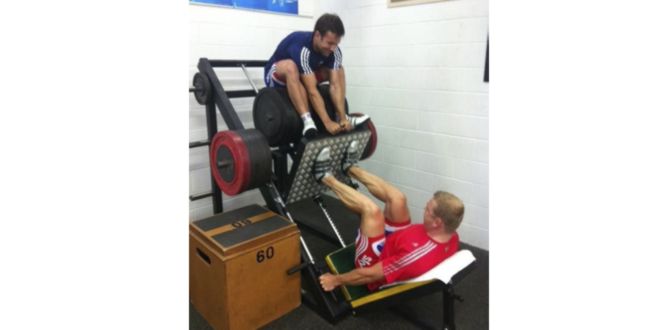
Illustration 1. Inclined leg press
It takes too much time
Time is tight, and when you have it, you usually want to spend it riding because you think that’s the best way to boost your performance, but that’s not always the case.
Higher risk of injury
Another fear is getting injured doing gym exercises, but science says the opposite. Working out in the gym actually reduces injury risk because it strengthens bones, tendons, and muscles, which in turn stabilizes joints.
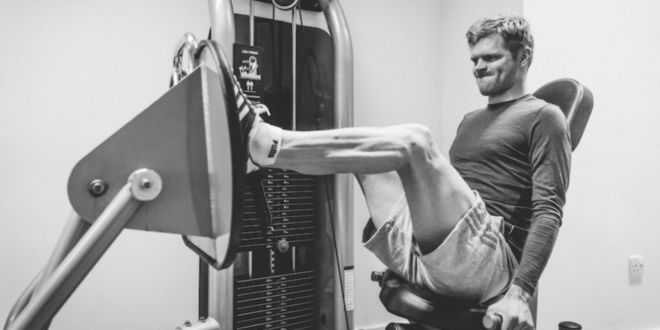
Benefits of strength training for cyclists
In cycling and endurance sports, performance mainly depends on maximal oxygen uptake (VO2Max), the % of sustainable VO2Max over time (lactate threshold), and pedaling efficiency.
Strength training directly impacts these parameters:
On VO2Max
Although strength work doesn’t improve VO2Max, it can improve MAP when training with heavy loads. This is due to the influence of anaerobic capacity, neuromuscular characteristics, and pedaling efficiency on maximal power.
On lactate threshold
Increasing type I fibers (slow and efficient) through strength training delays activation of type II fibers (fast and less efficient), which translates to a higher power at threshold and saves glycogen and ATP.

On pedaling efficiency
Increasing maximal strength allows you to maintain a muscular load longer, since at the same load you’ll work at a lower percentage of your max, boosting muscular endurance.
The table below summarizes where strength training has an impact:
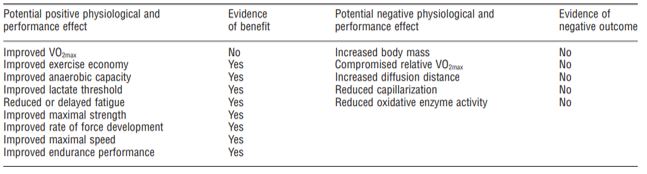
Table 1. Benefits of strength training
Gym training
Unilateral work
Strength training in the gym with heavy loads seems to improve pedaling economy and anaerobic threshold. With both legs, each leg produces less force, so it’s recommended to do exercises one leg at a time (unilateral work).
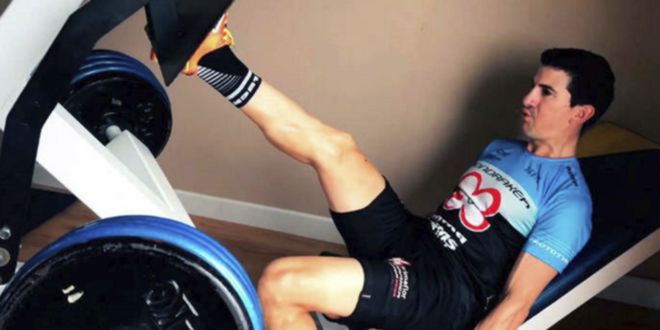
Illustration 2. One-leg inclined leg press
Exercise execution
It’s important to perform exercises at maximum speed during the concentric phase and slower during the eccentric phase, reducing muscle damage and injury risk.
Training periodization
To reap strength training benefits, it’s ideal to do it over 8 to 16 weeks, with 4 lower body exercises, 4 to 10 reps per exercise, and 2-3 sets with 2-3’ rest. Exercises should include the main muscles involved in pedaling and mimic the pedaling motion.
Load progression
Workload should progressively increase each session. It’s important to master the exercises technically before adding heavy loads. Remember, we’re cyclists, not bodybuilders, so 2 days a week is enough to benefit from strength training.
Example exercise table
The table below shows an example of how to program strength training during a cyclist’s season:
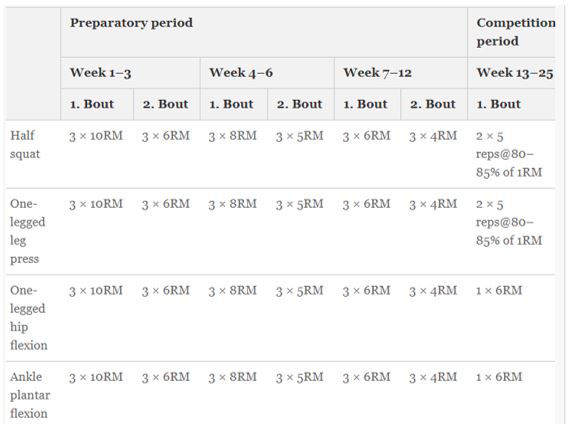
Table 2. Practical application of strength training
Training on the bike
These should be maximal strength exercises, short with long recoveries. Here are some ideas to improve maximal strength on the bike:
- Start from a standstill at max intensity, with a gear slightly higher than race gear, seated or standing, only the start, max 20-30 pedal strokes.
- Another option is to do the same but with a lower gear to reach higher speed.

Strength work should be as similar as possible to pedaling, and nothing is more specific than pedaling itself
Things to keep in mind
If you’ve decided to add or keep strength training in your program, keep these in mind:
- Don’t start a gym strength block in peak season.
- Do strength training before endurance training.
- Do strength training on lighter training days.
- If strength workload increases, reduce endurance workload.
- Weight training improves strength, but cycling needs power (strength + speed).
- Do exercises as close as possible to pedaling.
- Work with single legs.
- Don’t do exercises you can’t perform technically well.
- Work at maximum speed during the concentric phase.
- Heavy loads and low reps to maximize benefits.
Conclusions
Also, it’s important to be clear about your goal, which here is to improve strength on the bike, not to become a bodybuilder. Follow the advice above but always keep the individualization principle in mind—what works for one may not work as well for another.
References
- Rønnestad, B. R., & Mujika, I. (2014). Optimizing strength training for running and cycling endurance performance: A review. Scandinavian journal of medicine & science in sports, 24(4), 603-612.
- Rønnestad, B. R., Hansen, J., Hollan, I., & Ellefsen, S. (2015). Strength training improves performance and pedaling characteristics in elite cyclists. Scandinavian journal of medicine & science in sports, 25(1), e89-e98.
- Tanaka, H., & Swensen, T. (1998). Impact of resistance training on endurance performance. Sports medicine, 25(3), 191-200.
- Mathis, S. L., & Caputo, J. L. (2018). Resistance training is associated with higher lumbar spine and hip bone mineral density in competitive male cyclists. The Journal of Strength & Conditioning Research, 32(1), 274-279.
- Rønnestad, B. R., Hansen, E. A., & Raastad, T. (2010). In-season strength maintenance training increases well-trained cyclists’ performance. European journal of applied physiology, 110(6), 1269-1282.
- Bazyler, C. D., Abbott, H. A., Bellon, C. R., Taber, C. B., & Stone, M. H. (2015). Strength Training for Endurance Athletes: Theory to Practice. Strength & Conditioning Journal, 37(2), 1-12.
- Badillo, J. J. G., & Serna, J. R. (2002). Bases de la programación del entrenamiento de fuerza (Vol. 308). Inde.
- Sola, M. (2015). Entrenamiento de fuerza en ciclismo. Mundo entrenamiento. Recuperado de mundoentrenamiento.com/
- Zabala, M. (2019). Asignatura Especialización de Ciclismo, Universidad de Granada.
- Image 1- Lautxo (2019). Inclined leg press. Retrieved from https://www.pinterest.at/pin/446841594254459525/
- Image 2 – Iberobike (2018). One-leg inclined leg press. Retrieved from http://www.iberobike.com/video-carlos-coloma-te-ensena-ejercicios-especificos-para-ciclistas-en-gimnasio/
Related posts
- Nutrition and Supplements for Beginner Cyclists
- Cycling, the Best Supplements
- Strength Training for Runners