Fitness, Nutrition, Health and Sports Blog In the HSNstore Blog you will find tips about Fitness, sport in general, nutrition, and health – HSNstore.com

Phenylcapsaicin is a compound derived from capsaicin, the main active component that gives chilli peppers their heat. However, phenylcapsaicin has been modified to eliminate the irritating and burning sensation that capsaicin typically causes on mucous membranes, particularly in the gastrointestinal tract.
The key modification involves adding a phenylethynyl group to the acyl chain of capsaicin.
✅ Phenylcapsaicin is a capsaicin analogue, meaning it has a similar chemical structure but with a key difference: it has been altered to eliminate its ability to activate pain receptors in the nervous system, especially those responsible for the burning sensation.
✅ This change allows users to benefit from capsaicin’s effects (such as boosting metabolism and enhancing physical performance) without the associated gastrointestinal discomfort.
✅ In the fitness world, phenylcapsaicin is gaining popularity as it delivers the benefits of capsaicin, such as increased thermogenesis (calorie burning) and improved physical performance, without unpleasant side effects like stomach burning or gastrointestinal irritation that some people experience with capsaicin.
How Phenylcapsaicin Works in Your Body
Phenylcapsaicin primarily interacts with TRPV1 receptors, located in nerve cells responsible for detecting stimuli like heat and pain. These receptors, also known as capsaicin receptors, are the same ones that activate when you eat spicy foods, typically causing a burning sensation.
However, with phenylcapsaicin, the interaction with these receptors is less aggressive compared to capsaicin, as it does not trigger the same burning or discomfort.
Despite this, its activation leads to several beneficial effects:
⚡ Stimulation of Energy Metabolism: When phenylcapsaicin binds to TRPV1 receptors, it triggers processes in the body that increase thermogenesis. This means your body produces more heat by burning calories, which can help boost energy expenditure during physical activity. This metabolic stimulation is beneficial for those aiming to increase fat burning or enhance workout efficiency.
? Impact on Perceived Effort: Phenylcapsaicin may also affect how the body perceives physical effort. While the exact mechanism isn’t fully understood, it’s believed that by activating TRPV1 receptors, phenylcapsaicin may help reduce the perception of pain and fatigue during exercise. This could allow people to train longer or more intensely, improving overall performance.

Scientifically Proven Benefits of Phenylcapsaicin
Phenylcapsaicin has been the subject of several scientific studies that demonstrate its effects on the human body, particularly in terms of enhancing physical performance, regulating metabolism, and managing perceived effort during exercise.
? Aerobic Performance Studies: Studies involving active young men show that phenylcapsaicin, in both low and high doses, tends to increase fat oxidation during moderate-intensity aerobic exercise. Interestingly, the high dose also appears to reduce maximum heart rate and perceived exertion during progressive intensity tests, without affecting VO2max.
? Resistance Training Benefits: Regarding resistance training, a higher dose of phenylcapsaicin has been shown to improve squat speed, reduce speed loss during exercise, and lessen mechanical fatigue post-workout. Additionally, lower muscle effort perception and reduced muscle damage markers were observed.
? Gastrointestinal Tolerance: Importantly, the reviewed studies on aerobic and resistance performance specifically noted that no adverse effects, including gastrointestinal issues, were reported with the studied doses of phenylcapsaicin. This supports the claim that it is well-tolerated.
Some of the most important benefits backed by scientific studies are highlighted below:
Enhanced Fat Oxidation During Aerobic Exercise
Like capsaicin, phenylcapsaicin is known for its thermogenic effects. The body’s ability to use fats as an energy source during exercise is a key factor for endurance performance and weight management.
A study evaluated the effects of phenylcapsaicin on aerobic capacity, substrate oxidation (including fat), and energy metabolism in active young men. Two doses were administered, a low dose (0.625 mg) and a high dose (2.5 mg), compared with a placebo.
The exercise protocol was designed to assess substrate metabolism under relevant conditions. First, a preliminary session identified each participant’s maximum fat oxidation rate (MFO) and the exercise intensity at which it occurred (FATmax). Then, during the experimental sessions (under each supplement condition), participants performed a 60-minute steady-state exercise test at their individual FATmax intensity, immediately followed by a maximal incremental test to exhaustion. During these tests, metabolic (fat and carbohydrate oxidation via indirect calorimetry), cardiovascular (heart rate), and perceptual (RPE) variables were measured.
Results showed that both the high and low doses of phenylcapsaicin significantly increased peak fat oxidation (FATox) during the steady-state exercise test compared to the placebo. The study concluded that phenylcapsaicin may help increase aerobic capacity by improving fat oxidation. While the term ‘thermogenesis’ was not directly measured, the increase in fat oxidation is directly related to fat burning and energy metabolism.
? Reference study: https://doi.org/10.3389/fphys.2023.1190345
Improved Performance in Resistance (Strength) Exercises
Beyond its metabolic effects during aerobic exercise, phenylcapsaicin has been studied for its potential to improve performance in strength or resistance training. The research provides evidence supporting these ergogenic effects.
The exercise protocol in both cases focused on the squat (SQ). Typically, it involved performing 3 sets of 8 repetitions at 70% of one-repetition maximum (1RM), with objective monitoring of barbell lifting speed. Additionally, neuromuscular function was assessed before, immediately after, and 24 hours after the squat protocol, using tests such as the countermovement jump (CMJ), submaximal squats (60% 1RM), and isometric squats.
The results of these studies consistently indicate a beneficial effect of high-dose phenylcapsaicin on squat performance: the high dose (HD, 2.5 mg) consistently demonstrated the ability to maintain or improve lifting speed during squat sets compared to placebo and/or the low dose.
These findings suggest that acute supplementation with 2.5 mg of phenylcapsaicin can objectively improve performance during sets of resistance exercises such as squats in trained men. The main benefit observed was the ability to sustain higher lifting speed, especially in the final repetitions of a set, and potentially reduce intra-set fatigue (less speed loss).
The benefit appears to be dose-dependent, as the high dose (2.5 mg) consistently showed superior or significant effects compared to the low dose (0.625 mg) and placebo.
? Reference study: https://doi.org/10.3389/fphys.2023.1215644
Reduced Perception of Effort During Exercise
The Rate of Perceived Exertion (RPE) is a subjective measure of how hard a person feels they are working during exercise. Modulating RPE is one of the proposed mechanisms through which TRPV1 agonists like phenylcapsaicin could enhance sports performance.
Researchers discovered that phenylcapsaicin, when administered at a high dose (2.5 mg), may reduce the perception of pain and fatigue during exercise, allowing individuals to train more intensely or for longer periods. Phenylcapsaicin may act on TRPV1 receptors in the nervous system, modulating pain signalling and improving physical endurance.
The high dose (2.5 mg) shows a more consistent trend towards lowering RPE, either by reducing local perceived effort in muscles during strength training or by decreasing general perceived exertion at moderate intensities during an incremental aerobic test.

Reduced Muscle Damage and Improved Recovery
Intense exercise, particularly strength training, induces a degree of microscopic muscle damage that contributes to delayed onset muscle soreness (DOMS) and a temporary decrease in muscle function. A supplement’s ability to mitigate this damage and accelerate recovery is of great interest to athletes and active individuals. Studies on phenylcapsaicin have evaluated these aspects using biochemical and functional markers.
Blood levels of the enzyme Aspartate Aminotransferase (AST) were measured before and 24 hours after the squat protocol. AST is an enzyme found within muscle cells (among other tissues), and its elevation in the bloodstream is considered an indirect marker of muscle cell membrane damage.
The results showed that the group receiving the high dose had significantly lower AST concentrations 24 hours after exercise compared to the placebo group (p = 0.02). The low dose (0.625 mg) did not show this protective effect.
This finding suggests that acute supplementation with 2.5 mg of phenylcapsaicin may have a protective effect against muscle damage induced by a demanding squat protocol, as reflected by AST levels 24 hours post-exercise.
Phenylcapsaicin vs Capsaicin
Phenylcapsaicin and capsaicin are related compounds, derived from the capsaicinoid family (the molecules responsible for chilli heat), but with some key differences:
| Capsaicin | Phenylcapsaicin | |
| Chemical structure | N-(4-hydroxy-3-methoxybenzyl)-8-methylnon-6-enamide | N-(4-hydroxy-3-methoxybenzyl)-N-phenyl-decanamide |
| Gastrointestinal tolerance | May cause burning | Designed to minimise gastric irritation |
| Pungency | Moderate | Reduced or absent |
| Dose | Requires higher dose | Needs a lower dose |
| Half-life | Around 2 hours | 4–6 hours |
| Onset of effect | Fast (15–30 min) | Fast (20–30 min) |
| Thermal sensation | Noticeable | Mild or unnoticeable |
| Improvement in physical performance | Limited by tolerance | Proven in resistance exercise |
| Increased pain threshold | Limited by tolerance | Increases effort tolerance |
- Phenylcapsaicin has significantly higher bioavailability than capsaicin, a key factor that directly affects its efficacy, tolerance, and dosage.
- Phenylcapsaicin is a viable option for regular use, even in individuals with gastrointestinal sensitivity.
- Phenylcapsaicin can improve physical performance by modulating perceived effort and increasing pain tolerance, without the irritating effects of capsaicin.
- Phenylcapsaicin can produce ergogenic effects at very low doses, between 0.625 – 2.5 mg.
This difference means that a smaller amount of ingested phenylcapsaicin is enough to reach effective concentrations in target tissues, such as the TRPV1 receptors, which are responsible for its effects on perceived effort and thermogenesis.
As a result, exposure of the digestive tract to the active compound is also reduced, leading to better gastrointestinal tolerance and a wider safety margin in its use.
Moreover, this dose efficiency not only improves the user experience but also optimises the supplement’s performance from both an economic and functional perspective, establishing phenylcapsaicin as a superior option to capsaicin in the context of advanced sports supplementation.

How to Choose a High-Quality Phenylcapsaicin Supplement
If you’re considering adding phenylcapsaicin to your supplement stack, choosing a quality product is essential to achieve real and safe results. Here’s how to choose a good supplement and why HSN’s option is one of the best available:
- Purity and standardisation of the active ingredient: look for products that clearly indicate the amount of pure phenylcapsaicin (not mixed or disguised as ‘chilli extract’). A quality formula should contain precise microdoses, between 0.5 mg and 2.5 mg per capsule, due to its high potency.
- Certifications and quality control: It is essential that it carries quality seals such as GMP (Good Manufacturing Practices). These seals ensure that what’s on the label is what you’re actually consuming, without contaminants or unnecessary fillers.
- Format and ease of use: a vegetable capsule format is ideal, as it improves controlled release and digestive tolerance.
The Role of Microencapsulation (aXivite®)
Phenylcapsaicin marketed as aXivite® uses a patented microencapsulation technology. This process involves spraying an emulsion containing phenylcapsaicin onto fluidised microcrystalline cellulose (MCC) particles, followed by drying to create a coating.
The main purposes of this microencapsulation are:
- Control pungency: reduce or eliminate the burning sensation in the mouth and upper gastrointestinal tract.
- Ease of handling: produce a powder that is easy to work with for use in supplement manufacturing.
- Stability and bioavailability: potentially protect the active compound and enhance its stability and absorption.
? HSN offers phenylcapsaicin with GMP certification, manufactured in the European Union under strict sanitary controls:
- Uses microencapsulated phenylcapsaicin sourced from the aXivite® raw material.
- 1.25mg of phenylcapsaicin per vegetable capsule.
- Free from allergens.
- Suitable for all types of diets.
- Ideal for combining with pre-workout and thermogenic formulas to enhance their effects.
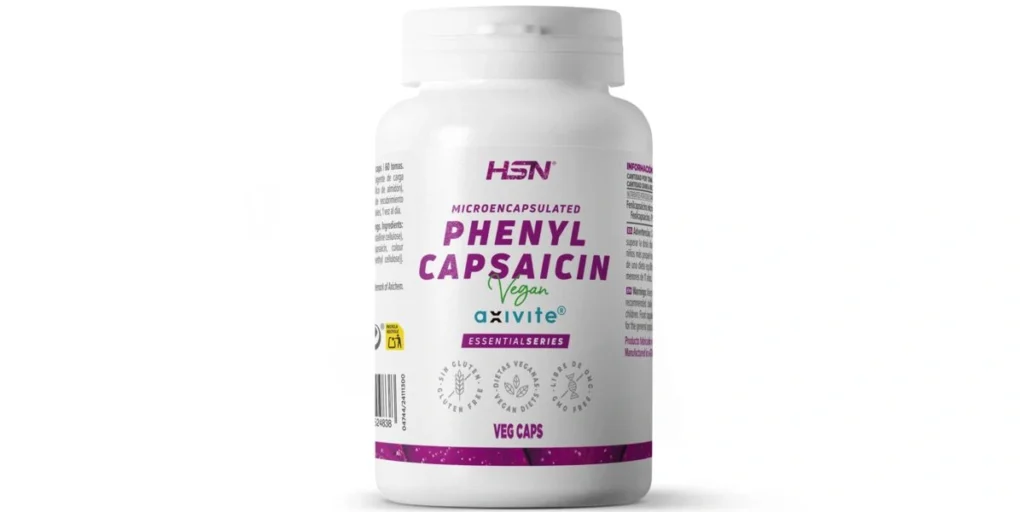
Microencapsulated Phenylcapsaicin 125mg (aXivite®) by EssentialSeries
What is the recommended dose of Phenylcapsaicin?
The dose of phenylcapsaicin used in studies showing benefits for sports performance typically ranges from 0.625 to 2.5 mg, taken acutely, usually about 45 minutes before exercise.
- The 2.5 mg dose is considered the highest recommended by the European Food Safety Authority (EFSA), and has generally shown more consistent and significant effects in studies compared to the lower dose.
Is Phenylcapsaicin Safe?
Yes, phenylcapsaicin is safe when used at the recommended doses. In fact, one of the main advantages of this compound over traditional capsaicin is its excellent safety and tolerance profile, even in individuals with some gastric sensitivity.
- Although it is well tolerated, people with high blood pressure, pregnant women, or those who are breastfeeding should consult their doctor before using it.
Related Posts
- Comparison of HSN thermogenic supplements
- Best supplements for endurance sports
- How to improve muscular endurance
- How to burn more fat during training?