Fitness, Nutrition, Health and Sports Blog In the HSNstore Blog you will find tips about Fitness, sport in general, nutrition, and health – HSNstore.com

You have surely heard of L-arginine in terms of being an amino acid involved in muscle growth. We can also tell you that it is a non-essential amino acid and, therefore, can be synthesised by your body, as it is found in a high percentage of the proteins you consume every day. By understanding the mechanism through which it is converted into nitric oxide, you will be able to assess its role in muscle hypertrophy. This way, you will have the assurance of knowing that it is the supplement you are looking for.
Why do athletes take it?
If you are a professional or amateur athlete, you will be familiar with the shared goals in the gym environment: achieving greater muscle efficiency and double vascularisation.
The purpose? Twofold:
- To guarantee the supply of nutrients and oxygen to the muscle, and
- To improve the elimination of lactic acid, the main cause of unwanted muscle fatigue
These are goals desired and shared both by athletes seeking muscle hypertrophy and by those striving to achieve speed and strength.
How is L-Arginine converted into Nitric Oxide?
The process is simple. We explain it in two steps!
- As soon as it is absorbed by the digestive tract, L-arginine travels through the blood towards the “target” tissues or organs that require its function at that precise moment
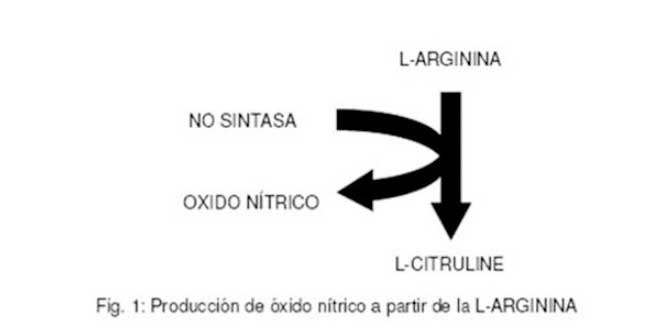
- Once internalised inside the cell and, thanks to the action of the cytoplasmic enzyme nitric oxide synthase (NO synthase), L-arginine gives rise to nitric oxide + one molecule of L-citrulline
What is Nitric Oxide?
At this point, it is time to explain what nitric oxide is: a free radical that does not act as an oxidant, damaging cells, but rather as a protector of them. Despite this, it is not stored in the body; instead, it is created exactly when it is needed. And this is where L-arginine comes into play, as supplementation with it should become your daily ally.
Based on the fact that its production requires situations triggered by strong and metabolically stressful stimuli, such as low temperatures or intense exercise, there is nothing like performing high-intensity exercise (HIT) to increase its concentration safely.
And why high intensity? Because there is no certainty that moderate exercise also has an impact on increasing its blood levels.
Discover the positive properties of this oxide
Nitric oxide can provide you with multiple positive properties at the level of the body in general.
Here are the main ones!
- It has antibacterial action, helping to combat infectious organisms, especially of bacterial origin
- It is an anti-inflammatory agent, as it inhibits some pro-inflammatory molecules
- It helps to face up to cancer cells
- It increases irrigation of the nervous system, acting as a neurotransmitter at brain level, which enhances long-term memory
- It regulates vasodilation of the circulatory system, a characteristic that becomes especially important in people with hypertension and/or heart problems. At the same time, it can act as an anticoagulant, preventing the harmful thrombi responsible for heart attacks. Its presence in the bloodstream encourages the endothelium of the blood vessels to relax, widening their diameter
- It protects the integrity of muscle fibres during exercise, particularly in movements involving an eccentric muscle contraction.
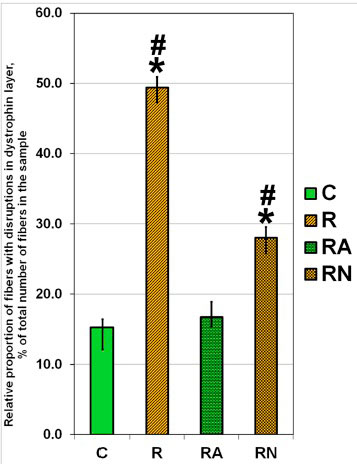
You can clearly observe this effect in a study carried out with rats, in which four groups were created: a Control C group, which remained at rest, and three other groups forced to run on a treadmill with a downward slope, simulating eccentric exercise. Of these last three groups, one took nothing (R), another took L-arginine (RA) and the last took L-arginine + another supplement (RN).
The result after measurement? The group that obtained the greatest fibre rupture was the one that took nothing, and the one that took L-arginine alone was the one that obtained the least fibre rupture, practically reaching the levels of the resting group.
- It helps muscle regeneration, as it facilitates and speeds up post-workout recovery, being a powerful stimulator of cell division. In this way, it promotes muscle hypertrophy. Nitric oxide stimulates the satellite cells of the muscle, which are responsible for dividing to generate more muscle cells
- It promotes angiogenesis, that is, the creation of new blood vessels that provide more nutrients and oxygen to the muscles, encouraging faster lactate elimination and improving performance
- It improves erectile dysfunction in a similar way to the famous Viagra, by acting on the same metabolic pathway as this medicine. Although the effects of nitric oxide are smaller, they are highly valued in the sexual sphere
- It produces an increase in the number of mitochondria, that is, mitochondrial biogenesis, improving the use of fatty acids by skeletal muscle. It also increases the amount of mitochondrial enzymes, which in turn is an element that will achieve greater ATP production. An interesting cascade of effects, if you bear in mind that the ATP molecule provides energy so that your body functions as it should.

In the image you can observe the metabolic pathway triggered by exercise and nitric oxide inside the cell. Strong muscular stimuli promote the expression of the PGC-1a gene, which in turn stimulates the transcription of various genes involved in the creation of new muscle and new mitochondria that carry out the respiratory chain, creating more ATP, as well as genes involved in the use of fatty acids as an energy source, known as beta-oxidation.
L-Arginine supplements provide you with more Nitric Oxide
We have already mentioned that nitric oxide cannot be stored in the body. For this reason, you should divide the dose of the L-arginine supplement into several daily intakes or, at least, take it once a day. Follow this protocol and you will see the amount of nitric oxide in your body increase by up to 46%! This is what numerous studies indicate.
Even so, and given that it is a molecule that can be synthesised by the body, you should encourage the need for the latter to generate its own nitric oxide by itself, if you do not want to see its production decrease.
And remember that your body is a perfect machine that only synthesises what it needs!
For this reason, if it always had enough of this oxide, it would not need to produce it. Along these lines, it is advisable to do supplement cycles, for example every two or three months, followed by a break of another two or three months, which you could use to take a different supplement.
Buy L-Norvaline capsules at HSN
Do not miss the conclusions
L-arginine can be your star supplement for achieving your sporting goals, especially if you have stalled along the way. Take it properly and your gym partners will soon be asking you for the secret behind your extraordinary progress.
Sources
- Bentley R, Gray SR, Schwarzbauer C, Dawson D, Frenneaux M, He J. Dietary nitrate reduces skeletal muscle oxygenation response to physical exercise: a quantitative muscle functional MRI study. Physiol Rep. 2014;2(7).
- Lomonosova YN, Shenkman BS, Kalamkarov GR, Kostrominova TY, Nemirovskaya TL. L-arginine supplementation protects exercise performance and structural integrity of muscle fibers after a single bout of eccentric exercise in rats. PLoS One. 2014;9(4):e94448.
- Morales RC, Bahnson ES, Havelka GE, Cantu-Medellin N, Kelley EE, Kibbe MR. Sex-based differential regulation of oxidative stress in the vasculature by nitric oxide. Redox Biol. 2015;4:226-33.
- Pearson SJ, Hussain SR. A review on the mechanisms of blood-flow restriction resistance training-induced muscle hypertrophy. Sports Med. 2015;45(2):187-200.
- Rybalkin SD, Yan C, Bornfeldt KE, Beavo JA. Cyclic GMP phosphodiesterases and regulation of smooth muscle function. Circ Res. 2003;93(4):280-91.