Fitness, Nutrition, Health and Sports Blog In the HSNstore Blog you will find tips about Fitness, sport in general, nutrition, and health – HSNstore.com

Muscle fatigue occurs with intense and heavy training, but we can optimise our performance with the following advice
As many of you will know, I recently released a questionnaire related to diet and training in people doing CrossFit, where almost 1000 people gave their opinion. Part of the data that caught my attention was that 2 out of 3 people said that they weren’t recovering or that they got tired during training. This confirmed one of my beliefs: people do not recover well.
In my opinion, many people try to base their performance on the day to day, they don’t focus on long term planning, which is what will really allow you to get a record or improve your marks. If you try to go 100% every day, it’ll catch up with you sooner or later (ailments, joints, injuries, strains, muscle overload…etc).
Actually, there’s not much information available about muscle fatigue in strength athletes. Most existing studies speak of muscular fatigue in endurance-training athletes, such as marathons or cycling. Muscle fatigue in these people, however, is somewhat difficult to achieve in comparison with strength sports.
In endurance sports, muscle contraction is intermittent, as well as having a lower load than a person performing weights or powerlifting training, where the muscle load is much greater.
When does muscular fatigue occur?
Leaving this factor aside, we have to take into account that muscle fatigue varies throughout the training:
The fatigue that occurs in the first sets of a training session will be different to that in the 4th sets of the second or third exercise of a muscle group.
This is a point of vital importance, as a person with a poor diet/supplementation, can get the same results in a squat set as someone with a good diet/supplementation.
However, as the number of sets (and therefore repetitions) increases, the performance threshold varies greatly, or, in other words, where we will really see if a diet/supplementation works is with a high training load.
An example of this can be seen when we compare the effects of doing a set at 80% arm curl, compared to 3 sets.
Looking at the following1:
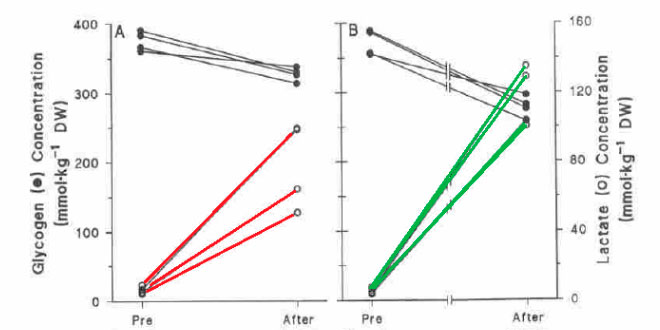
What we see here are lactate levels produced during the test
As you can see, the group doing 3 sets of bicep curls (green lines) are producing up to 30 times more lactate.
Substrate during high intensity training
Knowing which substrate the muscle uses during the contraction becomes of vital importance if we want to improve our training.
As this will translate into greater muscle gain
During a high intensity exercise, more than 80% of the energy used is produced through glycolysis4.
High Intensity Training when fasting
Now many will ask: If at high intensity we basically use carbohydrates, how come some people train at high intensity on an empty stomach?
There are several reasons. The main reason is that the carbohydrates we eat are stored mainly at a muscular level and at a hepatic level (liver). During the night, or even a 16h fast, the body degrades glycogen to keep our blood glucose levels stable.
However, the enzyme responsible for making this happen is only found in the liver, not in the muscle
As such, our reserves are reduced in the liver, but on a muscular level we have them intact. This fact allows the person to do a short but very intense training, even if they are fasting.
Obviously, sedentary people or those with little experience in this type of training have a lower metabolic flexibility if we compare them with a regular sportsperson, which means a much faster use of glucose and therefore the feeling of “flying” in the person.
How to combat muscle fatigue
To avoid muscle fatigue, we can focus on two ways:
- On the one hand, improve the supply of substrate to the cell, which will translate into a greater facility to produce energy, directly improving our performance.
- On the other hand, improving the cellular environment. Or in other words, by eliminating the waste products that are produced with the training and that will obviously have a negative influence on our training.
Carbohydrates during training
In the first case, the answer is simple. If 80% of the energy we use during high intensity comes from glycogen, carbohydrate intake during training will facilitate the use of this as an energy source.
When there is intense muscle contraction, the entry of glucose into the cell is much greater (hence a weighting routine is always recommended for a diabetic or obese person).
In people with a very low carbohydrate diet, the use of glucose is reduced and the use of fatty acids is better
Intense training
In a short workout, the body is able to manage to maintain performance without the presence of glucose, but when we talk about a 23-32 sets workout, things change completely.
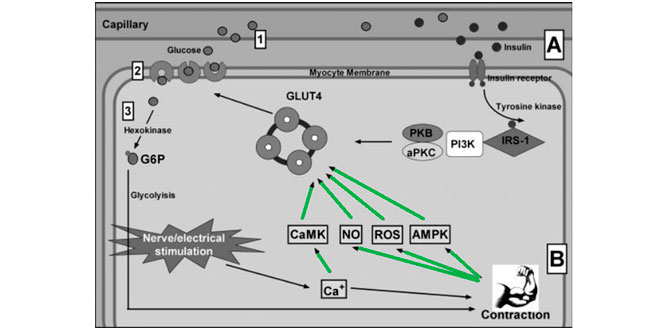
Muscle contraction facilitates the entry of glucose, where one of the mechanisms is free radicals (FDR), therefore avoiding the intake of antioxidants when training
With a low carbohydrate intake (about 2-3g carbohydrate/kg body weight) our glycogen stores can maintain that glucose requirement during high intensity training.
Creatine as a fundamental performance aid
At this point, you’ll agree that the ideal would be to look for a tool for those days when we want to train with low glycogen reserves. And the solution is very simple (and cheap): CREATINE
All sportspeople wanting to train at a high intensity or submit their muscle to a lot of work would benefit from this supplement. I won’t go into exactly what creatine is here, as we’ve looked at it before in a multitude of How to Take Creatine.
What we should know, however, is that this substance helps to provide energy in situations where the requirements are triggered, allowing us to train with greater intensity.
Some studies 6show that creatine supplementation can increase our bench press record by 6%, or even allow us to increase the number of repetitions by more than 30%.
Another detail to take into account is the water retention produced by creatine. Many athletes reject this supplement in definition as they argue that it “covers”.
Lactate Buffer
As I mentioned above, the other way we can avoid muscle fatigue is by eliminating the waste products that appear during training. For this, we can use supplements such as citrulline malate, or through our diet.
It is on this last point that more research has been done, with it being observed that during high intensity training the environment becomes more acidic (thanks to lactate).
Our body has a series of “buffers” that help to regulate the physiological pH through our organs (hence alkaline diets have no evidence), however, many researchers have wanted to see the impact of alkalising substances during training.
Sodium bicarbonate
In my opinion, this protocol with bicarbonate would make sense if we want to do long term training with a very high demand.
In situations where the duration is very short, the body can “clean” the medium without any problem, avoiding a slight acidification
Conclusions
In summary, we can see how not adjusting carbohydrates as we increase exercise intensity or duration can reduce performance in both the short term (fatigue) and the long term (recovery).
In any case, the introduction of creatine into our supplementation can play a rather interesting role, having a synergistic effect on di- tri-peptides in people performing strength routines.
However, this doesn’t mean we increase our daily carbohydrate intake. Training with low reserves in short training sessions can have a beneficial role on glycogen maintenance.
Sources
- Muscle substrate utilisation and lactate production. MacDougall JD1, Ray S, Sale DG, McCartney N, Lee P, Garner S.
- Fitts R. H.Cellular, molecular, and metabolic basis of muscle fatigue
- Lactate inhibits Ca2+-activated Ca2+-channel activity from skeletal muscle sarcoplasmic reticulum.Favero T. G., Zable A. C., Colter D., Abramson
- Anaerobic energy release in working muscle during 30 s to 3 min of exhausting bicycling. Medbo JI, Tabata I.
- Critical Review Skeletal Muscle Glucose Uptake During Exercise: A Focus on Reactive Oxygen Species and Nitric Oxide Signaling.Troy L. Merry and Glenn K. McConell
- The effect of creatine monohydrate ingestion on anaerobic power indices,muscular strength and body composition. Earnest CP, Snell PG, Rodriguez R, et al.
- Acid-base balance during repeated bouts of exercise: influence of HCO3. Costill DL, Verstappen F, Kuipers H, et al.
- Effect of sodium bicarbonate ingestion on exhaustive resistance exercise performance.WebsterMJ,WebsterMN, Crawford RE, et al.
Related Entries
- CrossFit Training Methodology
- No Brain, No Gain
- Intermittent Fasting