Fitness, Nutrition, Health and Sports Blog In the HSNstore Blog you will find tips about Fitness, sport in general, nutrition, and health – HSNstore.com

Let’s begin the HSN guide to Lose Fat Without Losing Performance
Since I started writing articles, I always had the dream of writing a protocol to achieve almost impossible body fat percentages. Unfortunately, I never had the time (and in my opinion the necessary knowledge) to write it.
Today, with more confidence and greater knowledge, the time has come.
Clarification before starting the protocol
The first thing I want to make clear is that I am not one of those who think that diet is 70% of success
For this reason and many others, even if you take care of your diet, you will never see optimal results if you do not train properly. Therefore, this protocol is aimed at people who train with a high workload.
In sedentary individuals, the outcome may be completely different, and they may even gain fat.
The second thing I want to clarify is that this protocol is not based on a linear diet, meaning that calorie and macronutrient intake will vary throughout the week. At times we will be close to a typical ketogenic distribution, while on other days we may even consume more calories than we need.
As we will see below, the expression of certain genes will vary depending on fat or carbohydrate intake, or even training, and this is something we must understand.
Our biological system is dynamic and adapts depending on what we do and how we do it
What does the HSN Protocol for Fat Loss consist of?
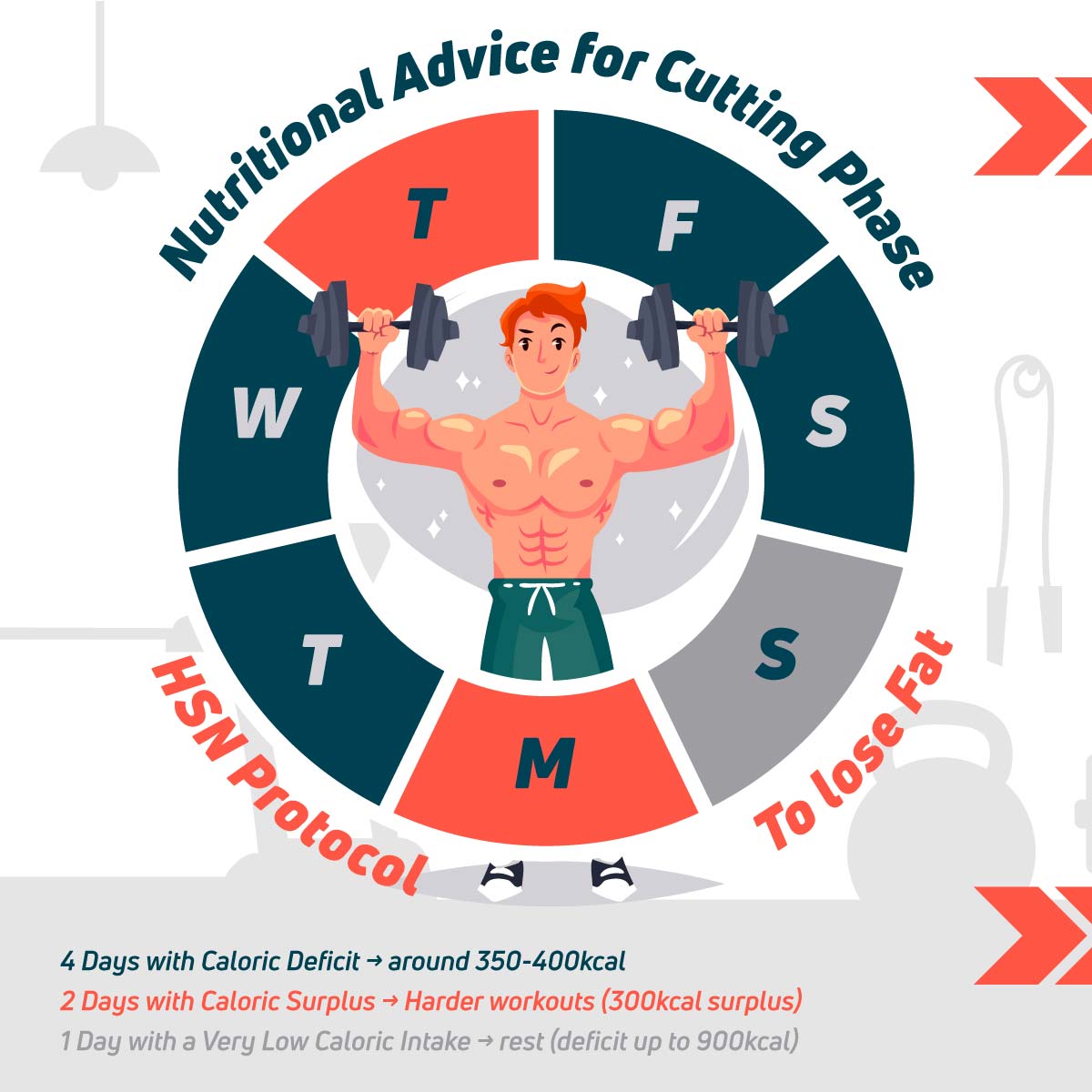
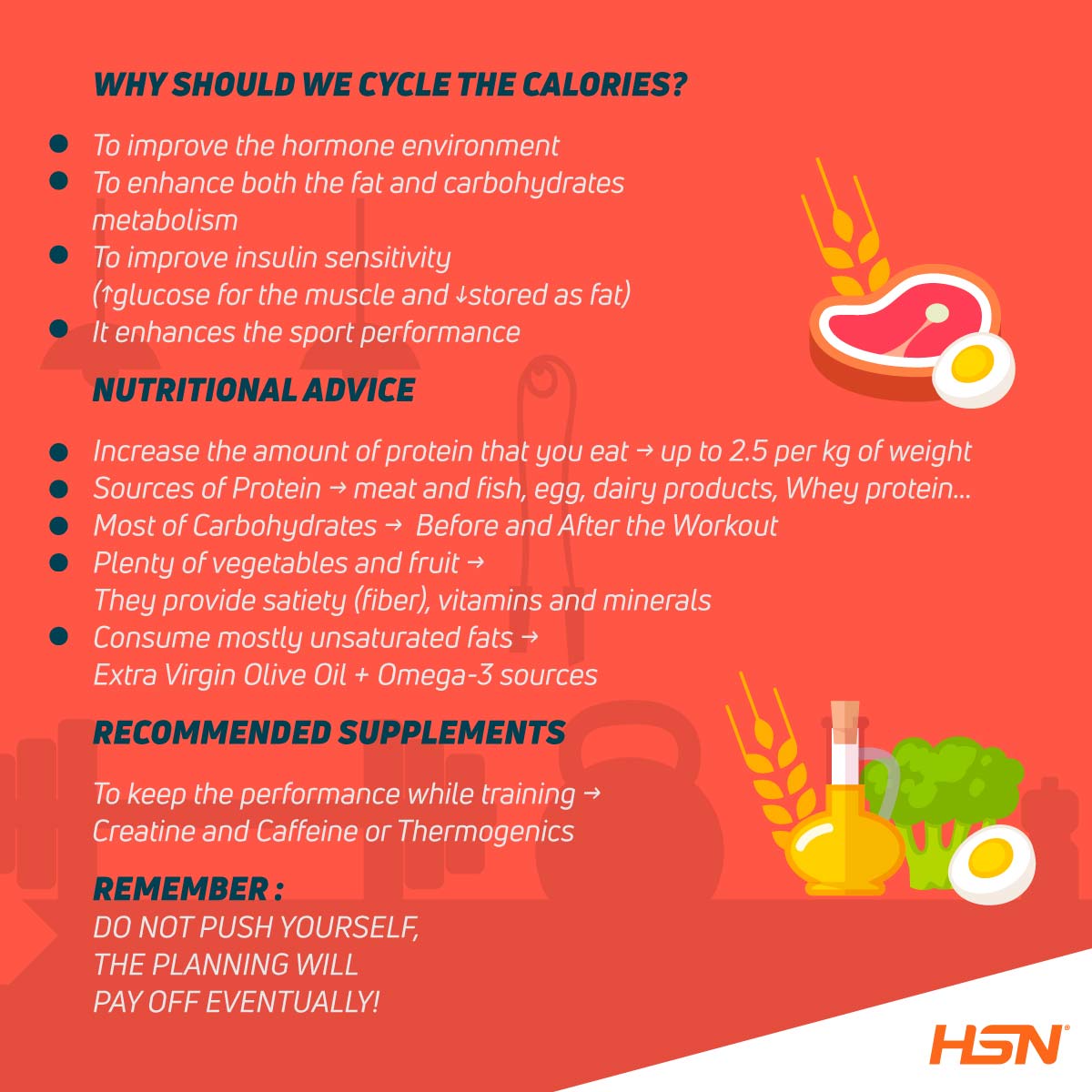
Restricting calories
When we talk about fat loss, the first thing that comes to mind is:
I must consume fewer calories than I need
following the first law of thermodynamics:
Energy is neither created nor destroyed, only transformed
This law can be represented as follows:

▲E (Change in energy quantity) is the difference between calories consumed and calories expended
Thus, if you burn more calories than you consume, the result is negative, meaning you will lose weight. This is nothing new for most people; however, our body is not simple enough to be reduced to this law.
We find that with the same calorie deficit we can lose fat, muscle, or a combination of both. A calorie from protein behaves very differently from a calorie from carbohydrates or fats, and, for example, with a high-protein diet we can consume more calories than we expend without gaining fat1.
In hypocaloric diets, the body not only fails to oxidise fat during the day, but also synthesises it20. In fact, fat synthesis and storage were five times higher in calorie-restricted mice than in those fed ad libitum, likely due to increased expression of fat-synthesising enzymes.
When we are in a hypocaloric diet, meaning we consume fewer calories than we expend, the body prepares to regain lost weight in the future. In other words, a long-term hypocaloric diet is not only ineffective but can even be harmful.
This explains why many individuals regain their initial weight easily2,3,4,5,6.
Fat loss and hormonal environment
Chronic exposure to a calorie deficit leads to:
- a decrease in metabolic rate,
- a drop in body temperature, and
- neuroendocrine changes that alter hunger perception.
An important fact that few people know is that many of these changes occur due to the calorie deficit, not the fat loss. This means we can lose fat without harming metabolism. Sounds good, right?
AGrP Peptide
Hormones such as ghrelin and leptin regulate hunger, but AGrP is a key peptide that regulates metabolic rate independently of food intake8.
Why is it so important to keep AGrP levels low?
In summary, it prevents:
- Fatty acid synthesis in the liver and fat storage in adipose tissue
- Reduced glucose sensitivity in muscle
- Increased glucose uptake by adipose tissue
These factors promote fat retention and future fat gain.
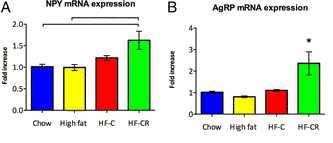
AGrP levels increase during hypocaloric diets10
Ghrelin
Regarding ghrelin:
Weight loss with calorie restriction increased ghrelin levels more than weight loss without restriction
Foods allowed: IIFYM
Any food can be consumed if quantities are controlled.
The body treats glucose the same regardless of source
Fats differ, as saturated and unsaturated fats are metabolised differently.
IIFYM Study
Groups:
- GROUP A: Fast food meal
- GROUP B: Organic meal
- GROUP C: Balanced meal
Increase unsaturated fats
Prioritise mono- and polyunsaturated fats, especially omega-3.
Using fats to maintain muscle mass
In lean individuals, muscle loss may occur.
A high-fat diet may help prevent this.
Sources
- The effects of consuming a high protein diet(4.4 g/kg/d) on body composition inresistance-trained individuals. Jose Antonio, Corey A Peacock, Anya Ellerbroek, Brandon Fromhoff and Tobin Silver
- Contribution of different mechanisms to compensation for energy restriction in the mouse. Hambly C1, Speakman JR.
- One-year behavioral treatment of obesity: Comparison of moderate and severe caloric restriction and the effects of weight maintenance therapy. Wadden, Thomas A.; Foster, Gary D.; Letizia, Kathleen A.
- Leibel RL, Rosenbaum M, Hirsch J. Changes in energy expenditure resulting from altered body weight. N Engl J Med 1995;332:621–Bennett WA. Beyond overeating. N Engl J Med 1995;332:673–4.
- Ravussin E, Lillioja S, Knowler WC, et al. Reduced rate of energy expenditure as a risk factor for body-weight gain. N Engl J Med
- Mild calorie restriction induces fat accumulation in female C57BL/6J mice. Li X1, Cope MB, Johnson MS, Smith DL Jr, Nagy TR.
- Reducing hypothalamic AGRP by RNA interference increases metabolic rate and decreases body weight without influencing food intake. Hideo Makimura12, Tooru M Mizuno12, Jason W Mastaitis12, Reuven Agami3 and Charles V Mobbs12*
- The central melanocortin system directly controls peripheral lipid metabolism. Nogueiras R1, Wiedmer P, Perez-Tilve D, Veyrat-Durebex C, Keogh JM, Sutton GM, Pfluger PT, Castaneda TR, Neschen S, Hofmann SM, Howles PN, Morgan DA, Benoit
- Calorie-restricted weight loss reverses high-fat diet-induced ghrelin resistance, which contributes to rebound weight gain in a ghrelin-dependent manner. Briggs DI1, Lockie SH, Wu Q
- Effects of high-protein diets on fat-free mass and muscle protein synthesis following weight loss: a randomized controlled trial. Pasiakos.
- Hormonal Responses to a Fast-Food Meal Compared with Nutritionally Comparable Meals of Different Composition. Ann Nutr Metab.
- Overfeeding Polyunsaturated and Saturated Fat Causes Distinct Effects on Liver and Visceral Fat Accumulation in Humans. Rosqvist
- Prior exercise increases dietary oleate, but not palmitate oxidation. Votruba SB1, Atkinson RL, Schoeller DA.
- Relation of serum testosterone levels to high density lipoprotein cholesterol and other characteristics in men. Freedman DS1
- Cholesterol-rich membrane microdomains mediate cell cycle arrest induced by Actinobacillus actinomycetemcomitans cytolethal-distending toxin. Boesze-Battaglia K1
- Distribution of peroxisome proliferator-activated receptors (PPARs) in human skeletal muscle and adipose tissue: relation to insulin action. M. Loviscach
- Increased expression of PPARgamma in high fat diet-induced liver steatosis in mice. Inoue M1
- Hepatic amino acid-degrading enzyme expression is downregulated by natural and synthetic ligands of PPARα in rats. Alemán G
- Calorie restriction increases fatty acid synthesis and whole body fat oxidation rates.Bruss MD1, Khambatta CF, Ruby MA, Aggarwal I, Hellerstein MK.
Related Posts
- Part 2
- Part 3
- Part 4
- Part 5