 Fitness, Nutrition, Health and Sports Blog In the HSNstore Blog you will find tips about Fitness, sport in general, nutrition, and health – HSNstore.com

The burpee is undoubtedly one of the most popular exercises of recent years. One of the main reasons is that it’s a full body exercise that works the largest muscle groups, such as the pectorals, back and lower limbs, and smaller ones too, such as the triceps and shoulders.
The truth is that nowadays, due to the demand and efficiency of the exercise, it’s rare not to find it in training sessions involving high oxygen consumption. Today, we’re going to tell you where burpees come from, how they improve our physical condition, and how to perform them with correct technique to optimise their benefits.
The origin of burpees
Burpees weren’t originally created for the purpose they’ve not adopted. It was the American physiologist Royal Huddleston Burpee who, in 1939, presented a Fitness Test within his doctoral thesis that incorporated the predecessor to the burpee we know today: the Squat Thrust.
Unlike the current burpee technique, the Squat Thrust consisted of only four steps:
- Squat down with both hands on the ground, in front of your feet.
- Jump back to a prone plank.
- Jump forward to a squatting position.
- Return to your vertical position.

The test proposed by Royal Huddleston Burpee consisted of only four repetitions, in which heart rate was measured before and after the exercise
As you can see, the technique and procedure differed markedly from that of today’s burpee, where we generally include a complete push-up, keeping the body straight and bringing the chest to a few inches from the ground.
Burpee variations over time
In 1942, Squat Thrusts, as they were then known, were incorporated as a fundamental part of training for the U.S. Armed Forces, as a physical fitness evaluator for those enlisted to World War II. This was also when the original exercise created by the physiologist underwent its first modifications and was included in a Test where people were asked to perform as many burpees as possible in 20 seconds.
Despite the physiologist’s criticisms, who considered the exercise unsuitable for so many repetitions, the US Army and Marines also added the push-up step that we perform today as a fundamental part of the burpee, turning it into an eight-step exercise.

Steps for performing a burpee
Burpee effects
As we mention, burpees are one of the most complete exercises for working the whole body, from cardiovascular endurance and coordination to power.
A simple exercise of functional movements, but at the same time of high intensity, which translates into an increase in muscle endurance, working chest, arms, gluteus, quadriceps, shoulders and abdominals at the same time.
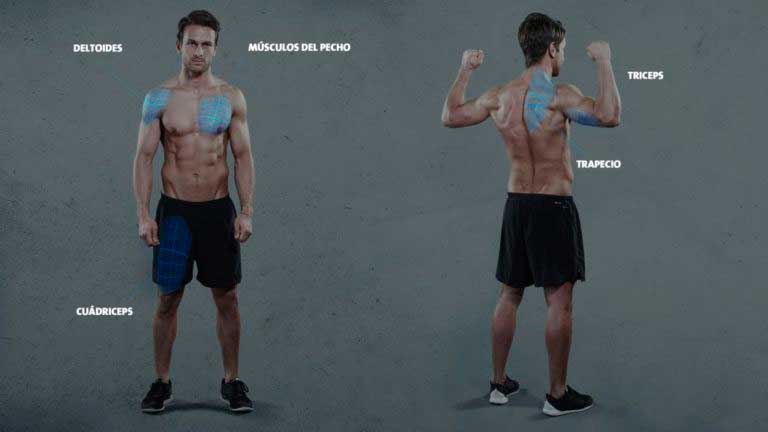
Burpees are an excellent exercise to improve endurance and help you lose fat.
Fat burning effect
As a cardiovascular exercise involving so much muscle range, the heart rate soars, resulting in a high demand for energy and calorie burning.
In fact, this kind of intense exercise generates excess oxygen consumption after exercise (known as EPOC), increasing metabolism and fat burning for several hours after completing physical activity.
Anaerobic capacity
Short, high-intensity interval training (such as HIIT training) not only builds muscular endurance, but pulmonary and cardiovascular endurance too.
When carrying out an intense burpee session, muscles are worked more aerobically than in other exercises, which is why breathing and blood circulation work at full capacity to compensate for the oxygen demand coming from the muscles.
How to correctly execute a burpee
There are many different types of burpees, especially in the realm of elite crossfit.
But the one we’re talking about today is the classic burpee in which we lower ourselves into a squat, moving to a horizontal plank, performing a push-up, and then returning to the starting position with jump and clap.
Although at first glance it seems a very simple exercise, it can be strenuous, and it’s important to use the correct technique, without forgetting to maintain a good amount tension and proper positioning at each stage of the exercise, without falling into common mistakes.

Starting position
We start standing up in a vertical position and then drop to the squat position, resting on the tips of our feet and with our hands on the ground, at slightly over shoulder width apart.
Ideally, this lowering sequence should be performed as if it were a deadlift, holding an imaginary weight, keeping our arms close to the body with the necessary bend ready for the next step.
Jump to plank position
From the squat position, we’ll kick the legs backwards, without taking our hands off the ground, so that we end up in a plank position with our legs fully extended and our arms stretched out, maintaining tension in the core throughout the movement.
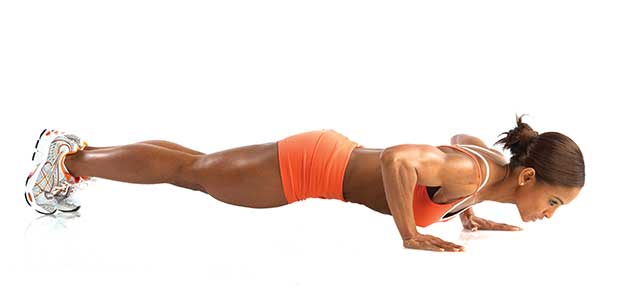
Full push-up
At this point we’ll perform a full push-up, keeping the body straight and our back horizontal, taking our chest to a few centimetres from the ground.
Jump to squat position
Keeping our arms supported and fully extended, we’ll jump forward with our legs together, without taking our hands off the ground, to return to the starting squat position.
During this stage of the ascent, it’s essential we maintain core tension and correct hip posture, which is where the force of the movement must start in order to push the feet forward.
It’s important that we land the jump with correct foot positioning, neither too close together nor too far apart, to avoid losing time in repositioning ourselves in the vertical position and, at the same time, to make it easier to transition to the rest of the movements.
Vertical jump
Once we’re in the upright position, we’ll jump as high as possible, extending the arms, shoulders, hip and knees, and squeezing the abdomen and glutes to the hollow position; then we’ll clap and drop again, bending the knees, to the initial starting point, if we’re going to be doing more repetitions.
During the jumping air squat process, your toes should be pointing forwards or slightly outwards; this way, you’ll be able to align your knees at the same time, preparing them for an optimal jumping and ascent phase.
Conclusions
Burpees are one of the oldest and most complete bodyweight exercises that we can incorporate into our training programmes.
The benefits are clear and it’s impressively effective.
100 Burpee Challenge
I’ll leave you with the video of my colleague Javier Colomer performing the #HSNChallenge:
Related Posts
- Start Beatman Performance Training (BPT)
- HIIT, improve your performance while burning fat
- All about Tabata Training