Fitness, Nutrition, Health and Sports Blog In the HSNstore Blog you will find tips about Fitness, sport in general, nutrition, and health – HSNstore.com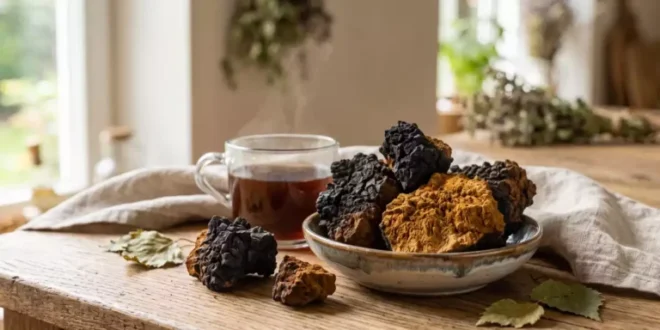

If you haven’t heard of Chaga yet, get ready: this rather unassuming-looking mushroom —a kind of dark growth that forms on birch trees— is one of the ingredients generating the most interest in the world of herbal medicine, and for good reason.
Its phytochemical profile, rich in polysaccharides and phenolic compounds, has made it a subject of study among researchers interested in cellular health.
Let’s take a closer look at it, with the scientific rigour it deserves and without going beyond what the available evidence allows us to claim.
What is Chaga mushroom and what are its active compounds?
Chaga (Inonotus obliquus) is a parasitic fungus that grows mainly on birch trees in cold boreal regions such as Siberia, northern Europe and Canada.
This harsh environment is precisely what accounts for its unique phytochemical profile: to survive extreme conditions for years —sometimes even decades— the fungus develops a very high concentration of secondary metabolites, including phytonutrients and polysaccharides, which have attracted considerable interest within the wellness sector.
Betulinic acid, beta-glucans and polyphenols: biological synergy
What makes Chaga interesting is not a single compound, but rather the combination of several compounds working together:
- Betulinic acid: a triterpene that the fungus absorbs directly from the bark of its host birch tree and accumulates within its structure.
- Beta-glucans: soluble polysaccharides that have been widely studied in the field of cellular physiology and are also found in other medicinal mushrooms.
- Polyphenols: compounds capable of interacting with oxidative processes in the body.
The combination of betulinic acid and soluble beta-glucans has been linked by research to processes involving metabolic modulation and protection against external agents, making Chaga a particularly interesting extract within the family of so-called “adaptogens” —a term commonly used in herbal medicine to refer to plants and mushrooms that help the body manage stress, although it is not a category officially recognised under European food regulations—.
What are the main health benefits of Chaga mushroom?
Research into Chaga has focused primarily on two main areas: its role in modulating the immune system and its antioxidant capacity. Let’s look at them separately.
Modulation of the immune system and inflammatory response
The polysaccharides found in Chaga, particularly beta-glucans, interact directly with receptors on immune system cells, such as dendritic cells and macrophages. This interaction is key to supporting a balanced immune response, stimulating normal immune function so that the body can respond to everyday challenges.
Antioxidant capacity and cellular protection against oxidative stress
Chaga is known for having one of the highest ORAC (oxygen radical absorbance capacity) values among foods. Its powerful antioxidants, such as polyphenols, help mitigate the damage caused by oxidative stress, which is a key factor in cellular ageing. By neutralising free radicals, Chaga contributes to the protection of cells and the maintenance of their normal function.

How should you take Chaga mushroom and what is the recommended dose?
Traditionally, Chaga has been consumed as an infusion, by grating or chopping the dried mushroom and leaving it to steep in hot water for an extended period.
It is a simple method with centuries of use in the traditional medicine of Siberia and northern Europe, although it has one drawback: the concentration of active compounds is difficult to standardise from one preparation to another.
Chaga extract in capsules or powder: standardisation criteria
For this reason, modern extracts in capsule or powder form are often preferred by those looking for a more consistent intake. The doses commonly used in studies are generally around 1,000 mg of concentrated extract per day, although the exact amount should always follow the manufacturer’s instructions on the product label.
One key aspect to consider when choosing an extract is the concentration ratio (for example, 10:1), which indicates how much raw material was required to produce the final extract and can be a useful indicator of the product’s potency and consistency.
- The Chaga extract (10:1) 500mg provides an extract that is 10 times more concentrated and is standardised to 40% polysaccharides and 30% beta-glucans.
How do you choose a high-quality Chaga supplement?
Not all Chaga supplements are the same, so there are several important details worth checking before buying:
- Traceability: a reputable manufacturer should be able to provide information about the origin of the mushroom and its production process.
- Fruiting body vs. mycelium: prioritise extracts made from the fruiting body of the fungus (the part that grows visibly on the tree), as it generally provides a more consistent concentration of active compounds than products based on mycelium grown on grain.
- Third-party testing: look for brands that subject their batches to independent laboratory testing, particularly to rule out the presence of heavy metals. This is especially relevant for wild-growing mushrooms, which can accumulate elements from their environment.
Are there any contraindications or side effects associated with Chaga?
As with any supplement, caution is advisable. Chaga naturally contains oxalates, compounds that should be monitored in people with a history of kidney stones or kidney health problems. In these cases, it is advisable to consult a healthcare professional before adding it to your routine.
If you are taking any medication, are pregnant or breastfeeding, or have any medical condition, always consult your doctor before taking Chaga. Remember that food supplements should not be used as a substitute for a varied and balanced diet or a healthy lifestyle.
References
- Lu Y, Jia Y, Xue Z, Li N, Liu J, Chen H. Recent Developments in Inonotus obliquus (Chaga mushroom) Polysaccharides: Isolation, Structural Characteristics, Biological Activities and Application. Polymers (Basel). 2021 Apr 29;13(9):1441. doi: 10.3390/polym13091441. PMID: 33947037; PMCID: PMC8124789.
- Glamočlija J, Ćirić A, Nikolić M, Fernandes Â, Barros L, Calhelha RC, Ferreira IC, Soković M, van Griensven LJ. Chemical characterization and biological activity of Chaga (Inonotus obliquus), a medicinal “mushroom”. J Ethnopharmacol. 2015 Mar 13;162:323–32. doi: 10.1016/j.jep.2014.12.069. Epub 2015 Jan 7. PMID: 25576897.
- Fan L, Ding S, Ai L, Deng K. Antitumor and immunomodulatory activity of water-soluble polysaccharide from Inonotus obliquus. Carbohydr Polym. 2012 Oct 1;90(2):870–4. doi: 10.1016/j.carbpol.2012.06.013. Epub 2012 Jun 22. PMID: 22840014.
- Diao BZ, Jin WR, Yu XJ. Protective Effect of Polysaccharides from Inonotus obliquus on Streptozotocin-Induced Diabetic Symptoms and Their Potential Mechanisms in Rats. Evid Based Complement Alternat Med. 2014;2014:841496. doi: 10.1155/2014/841496. Epub 2014 Jun 30. PMID: 25093030; PMCID: PMC4100277.
Related Posts
- Benefits and properties of Maitake mushroom
- Antioxidant properties of Reishi mushroom
- Properties and contraindications of Shiitake mushroom
- Nutritional benefits of Lion's Mane mushroom