Fitness, Nutrition, Health and Sports Blog In the HSNstore Blog you will find tips about Fitness, sport in general, nutrition, and health – HSNstore.com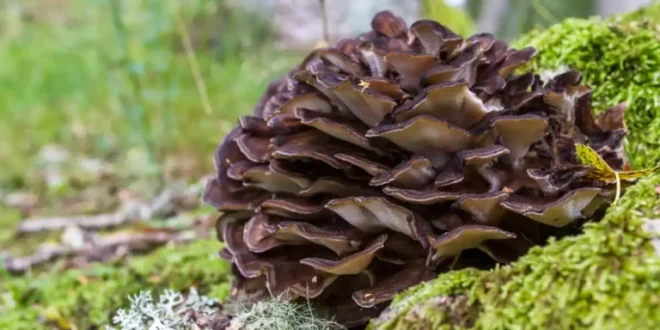

Maitake (Grifola frondosa) is one of the functional mushrooms most extensively studied by science due to its high concentration of beta-glucans, bioactive polysaccharides that are the subject of numerous current lines of research. Used for centuries in traditional Japanese and Chinese medicine, it is now included in numerous supplementation protocols as part of a varied diet and healthy lifestyle.
In this article, we review what the research says about Maitake, its main characteristics, how it is commonly taken, and what aspects should be considered when choosing a quality supplement.
What is Maitake?
Maitake is a basidiomycete mushroom belonging to the Meripilaceae family. It grows wild at the base of oak, beech, and other hardwood trees, forming large clusters that can weigh several kilograms.
Its Japanese name literally means “dancing mushroom”, a name associated with the great value historically attributed to it.
Currently, scientific interest in Maitake focuses primarily on its polysaccharides, particularly beta-1,3 and beta-1,6 glucans.
Although it is commonly included within the group of so-called adaptogens, an important clarification should be made:
Adaptogens are natural substances that, according to various research hypotheses, may be related to the body’s ability to adapt to certain physiological situations. In the case of Maitake, this classification is mainly associated with ongoing research into its polysaccharides.
Nutritional composition: the value of beta-glucans and D-Fraction
One of the aspects that distinguishes Maitake from other mushrooms is its richness in structural polysaccharides.
Beta-glucans: the most extensively studied compounds
The beta-glucans found in Maitake are polysaccharides primarily composed of β-(1→3) linkages with β-(1→6) branches.
This structural configuration is particularly relevant because laboratory studies have shown interactions with various cellular receptors, including Dectin-1, CR3, and TLR-2.
Not all beta-glucans have the same composition: chain length, degree of branching, and extraction method determine their characteristics.
D-Fraction: the best-known Maitake extract
The so-called D-Fraction is a highly purified beta-glucan complex obtained through aqueous extraction. It has been one of the most extensively researched Maitake compounds, mainly in in vitro and preclinical studies, where interactions with different cell populations (macrophages, dendritic cells, NK cells, and T lymphocytes) have been observed.
What does the research say about Maitake?
Scientific research on Maitake continues to evolve, with several lines of study currently underway.
Immune system
The immune system is a complex system that maintains a delicate internal balance.
Maitake beta-glucans are among the most extensively studied compounds in relation to this balance: laboratory studies have observed their interaction with macrophages, NK cells, and certain cellular markers.
Glucose metabolism
One field of research that has developed in recent years is the study of beta-glucan-rich extracts in relation to carbohydrate metabolism. This is a preliminary line of research, with results varying according to the type of extract and methodology used, and it does not currently allow conclusions to be drawn that can be applied to consumption through supplementation.
Other bioactive compounds
In addition to beta-glucans, Maitake contains other compounds of nutritional interest, such as natural antioxidants, which are also part of current lines of research into this mushroom.
How to take Maitake
The dosage mainly depends on the type of extract used and its beta-glucan concentration. Standardized supplements commonly provide a daily intake of between 500 and 1000 mg of extract, depending on the manufacturer’s instructions and the concentration of the product. Continued use for several weeks is generally recommended and, if in doubt, you should consult a healthcare professional.
Criteria for choosing a quality Maitake supplement
The composition of a supplement largely depends on the source of its raw material.
Fruiting body vs. mycelium grown on grain
One of the most important aspects is knowing the source of the extract. Supplements made from the fruiting body generally have a higher concentration of beta-glucans.
In contrast, many products made with mycelium grown on rice or oats contain high amounts of starch from the cultivation substrate, reducing the actual concentration of beta-glucans relative to the total weight of the extract.
Therefore, it is advisable to check the label for the actual percentage of beta-glucans and the source of the extract (fruiting body or mycelium).
Standardization percentage of active compounds
Standardization makes it easier to determine the actual composition of the product. A supplement should clearly state the following on its label:
- Percentage of beta-glucans.
- Extraction method.
- Extract-to-raw-material ratio.
- Botanical identification (Grifola frondosa).
Frequently asked questions about Maitake (FAQ)
How long is it recommended to take it?
It depends on the purpose of supplementation and the individual. In the available studies on immunity and metabolism, the periods analyzed generally range from 4 to 12 weeks of continuous use. As with other functional mushrooms, consistency in supplementation is recommended.
Can it be combined with Reishi?
Yes. In fact, the combination of Maitake and Reishi is one of the most common in mycotherapy.
While Maitake stands out for its beta-glucan content, Reishi provides triterpenes and other compounds of interest within the context of research into general well-being.
Does it have any side effects and/or contraindications?
Maitake has a favorable safety profile when consumed at the recommended doses. However, caution and prior medical consultation are recommended for people who:
- Take antidiabetic medication, due to possible interactions.
- Are receiving anticoagulant or antiplatelet treatment.
- Are due to undergo surgery in the near future.
- Are pregnant or breastfeeding, due to insufficient evidence.
Conclusion
Maitake (Grifola frondosa) has become one of the functional mushrooms of greatest scientific interest, thanks to its high concentration of beta-glucans and other bioactive compounds.
Available research continues to explore its role in different areas, particularly when incorporated as part of a balanced diet and healthy lifestyle.
To obtain a quality product, it is essential to choose supplements made from the fruiting body, properly standardized for beta-glucans, and subject to quality controls that ensure their purity.
Related Posts
- Benefits and properties of Lion's Mane mushroom
- All the properties of Reishi mushroom
- Support your immune system with Shiitake mushroom