Fitness, Nutrition, Health and Sports Blog In the HSNstore Blog you will find tips about Fitness, sport in general, nutrition, and health – HSNstore.com

Let’s go over some tips to avoid stalling your training progress
You might have seen a big change in your body, both physically and in strength gains, during your first steps in the weight room, and you probably thought it would always be like that… but now you’ve hit a point where you just can’t keep moving forward.
If you’re in this situation, check out the following points and see if you’re making these 10 mistakes that hold back your progress
1.-Not knowing yourself

And I’m not talking about recognizing yourself in the mirror, but these points:
- What your somatotype is
- How many calories you need
- How much protein you need
- If you need supplementation
- What RM you can lift
Depending on your genetic biotype, although we’re always a mix of several, you should focus your corresponding plan. If you don’t know how many calories you consume daily, how is that thermogenic going to work if you actually need to be in a calorie deficit? If you’re aiming to cut, you’ll have to increase protein intake, didn’t you know that? If you get tired of eating many meals, adding an extra shake might help you avoid burnout at the end of the day.
Want to improve your weight gains but haven’t been able to lift more for a year? You’ll probably need to measure your RM on the basics and act accordingly. Of course, I assume you know what that is…
2.-Not knowing your goal

This ties into the previous point, and I’m talking about how after spending 2 years doing chest on Mondays and biceps and triceps on Fridays, maybe it’s time to stick to a more thorough plan.
Also, it seems like you move according to the seasons: as summer approaches, you change your method, and since you’ve heard that “to cut you have to do supersets and cardio,” you switch your system completely, and there you are doing a gazillion flyes combined with cable crossovers, plus your 60 min of treadmill cardio chatting with the grandma next to you…
I don’t think that’s going to get you far, and every year you’ll have a new Déjà vu…
If you want to cut to show off a 6-pack at the pool, we can do things right, and at the start of the season, coinciding with the start of the football league… set up mesocycles, which basically means assigning a chunk of time about 4-6 weeks long to a specific goal (increase strength, increase size, cut…).
All this to program each phase and improve training progress, so you don’t have to resort at the last minute to basing your diet on lettuce + chicken + extra cardio hours in May…
3.-Not knowing the technique
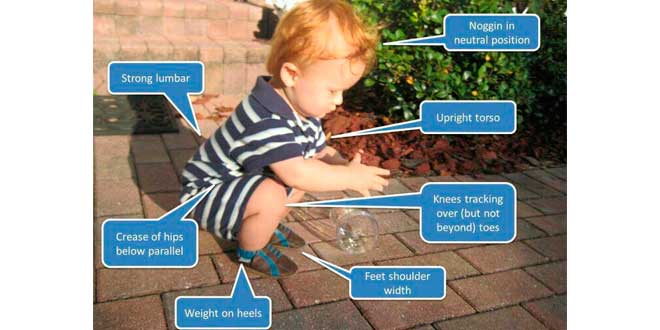
To avoid injury risk, and since almost nobody does it, you stopped doing deadlifts because you think it will definitely hurt your back.
Well, you just cut out a basic tool for training progress and strength, with the added bonus of working about 90% of your muscles, directly and indirectly, plus a crazy hormonal cascade… wouldn’t it be better to learn how to do it right before ditching an exercise?
Of course, this applies to free weights in squats… And if you have doubts, when you do squats, don’t stop at 45º! Go all the way down, and if your knees go past your toes, don’t listen to the coach next to you nagging…
But buddy, to do these moves, you need some prerequisites before jumping in:
- Flexibility: if you have limited ankle dorsiflexion, don’t expect miracles just by reading the previous paragraph, you won’t do a perfect squat without the “butt wink” showing. You need to work on your joint, tendon, and muscle system so it knows these new positions require high flexibility. Oh, but I guess you’re already working on that, right?…
- Neural connection: basic moves require a strong mind-muscle connection, since you’ll recruit many motor units. Your brain will register this, so if you’ve never trained this way before, you’ll need adaptation time. You won’t squat 2xBW (body weight) in the first week, even if your ego thinks otherwise…
- Conviction and decision: it’s never the same to stand under the Smith machine to do squats, going up and down with your hands on your quads… than to psych yourself up, put a weight on your shoulders, take two steps back, and now it’s you alone against the weight of the world. The situation changes drastically. You’ll need the certainty that you can start with it.
4.-Not training hard
Training hard hurts, I won’t deny it, maybe that’s a bit extreme.
But those who try it, step out of their comfort zone, and spend most of their training time building real strength, end up happy, and the later quad or back soreness when getting up – caused by inflammation from the tough session, not bad technique – fades into the background as results show up.
And this is tied to a much more motivational factor:
I’m happy every time I can lift more weight than last time
Obviously, this focus relates to the training system we use. I’ll always go for one where the cornerstone is training the basics intensely (mentioned in the next point), leaving “finishers” or secondary exercises that support from another auxiliary perspective or help “shape” you. All to keep moving forward in training progress.
5.-Not applying intensity

“…Now I’m serious, and training really hard…” A very common phrase, and almost everyone has heard someone say it. Intensity relates to the % of the load compared to your max lift.
In other words, you’ll train “harder” or your training will be more intense the closer the weights you lift are to your max potential.
An example: 30x bodyweight squats VS 1x squat with 180 kg, which is more intense…?
Sometimes people confuse this with training density, which also relates to total session volume and how many muscle groups you hit with different exercises. So if you think you’re training intense, first do the theoretical calculations regarding your RM (there it is again, must be important…)
6.-Not respecting rest periods

Gyms usually have wall clocks, even digital ones with a visible second hand. If not, you can always use a wristwatch or your phone. I put “phone” in quotes because resting means exactly that, not replying to messages, checking Instagram, or posting your current status on Facebook…
Use rest time to lower your heart rate, catch your breath, relax your muscles, drink some water – or intra-workout drink – and of course, don’t lose your “focus.”
Want to know how to tell if you’re not losing concentration? Spend your rest thinking about the next sets, visualizing yourself doing the movement, and making sure your technique is spot on without mistakes.
On the other hand, if we want to keep training density, it’s obvious you can’t rest 60” on one set and 2.5 min on another… Better just watch the clock and keep the same rest pattern.
7.-Not tracking your plan

“Planning” covers your training routine as well as your nutritional balance, both pillars for training progress. Nowadays, apps and gadgets can help a lot here. Since you won’t leave your phone even for water, it’s even easier.
You can monitor your heart rate (external chest sensor connected via Bluetooth to your phone) during training to later see how your heart rate evolved, calories burned (approx.); then note the routine you did, if the weights matched your plan, and rest times (check the timer).
Later, with your daily activity tracker on your wrist, you can see if you hit your step goal…
Calorie control is key if you want real results, or you’ll keep guessing and eating whatever you feel like. People tend to overconsume protein, cut carbs, stop eating them at a certain time, and not get enough fatty acids…
All this would be easier if you use, as I said before, software apps that are widely available. I’m not going to make your plan, you’ll have to figure out calorie cycling, learn about nutrition, and not demonize foods…
8.-Not consulting a professional

This point fits perfectly with the last one. If all the above seems confusing, and you don’t even know where to start or what routine suits your goal, or if you need a proper assessment… I mean a tailored sports plan, not copying Arnold’s routine from the internet and applying it yourself…
If you go to a health professional when you’re sick, or to a specialist for software setup (not the fruit vendor, even if he might know something…), why not go to a real professional if you have no clue how to plan your training?
Maybe this gets overlooked and you try to figure it out on your own, not realizing what’s really at stake—it’s no small matter, we’re talking about your health.
Back to the summer example, when the season of showing off comes, everyone rushes, and like self-proclaimed nutrition experts and accredited sports pros, they convince themselves that eating chicken and greens will get results. What I see here is basically doing harakiri without realizing it. They don’t understand the impact of cutting essential foods and nutrients lightly… and as for training, as we said before, many hours of cardio, exercises at full speed without much sense…
9.-Not doing other activities

Sometimes, the level of commitment to achieving our training progress goals becomes an obsession, with strange, almost unhealthy behaviors. And it’s understandable—I myself had a phase where I didn’t realize these habits, and later understood I couldn’t keep that pace. It wasn’t worth the demand.
I can say this has probably happened to you or at least you’ve come close. It’s not your fault, it’s basically everything around you: so many stereotypes, idolizing magazine covers, competition… There’s a strong psychological component, and when you’re caught in it, you act very differently from others.
I’m not talking about bringing a tupperware with rice and chicken to the beach, but other behaviors that make you stop doing everyday activities like walking, biking, running… because you’re “afraid” they’re “catabolic” and will reverse your muscle gains.
If you like the fitness world, that’s cool, but going to incomprehensible extremes isn’t, and cutting your social life, old habits, or spending more time with weights than with family and friends… I don’t see that as healthy. A different story would be professionals in this field who live that lifestyle, but unless you plan to follow the same path, it’s probably not the best idea.
10.-Not accepting your limits

Linking to the last part, some practical ideas to keep in mind for your training progress: you have to be able to recognize that you’ll never lift the weight of that guy who’s been training 15 years when you’ve only done 3, or that you won’t get below 10% body fat, not because you can’t, but because your circumstances don’t allow it.
Do you sleep little or not rest enough? Work shifts? Have responsibilities? These are negative factors for training progress and don’t help you be at 100%. It usually takes a toll. Don’t obsess over achieving something that might make you lose way more than you gain and, above all, is less important.
You have to know yourself well to realize that if you didn’t get it before, you won’t now, and instead of creating a negative vibe, let’s look at it from another angle.
Related Posts