 Fitness, Nutrition, Health and Sports Blog In the HSNstore Blog you will find tips about Fitness, sport in general, nutrition, and health – HSNstore.com



The final magnitude of hypertrophic adaptations as a result of weight training is based on the proper prescription of program variables (volume, intensity, rest intervals, and training frequency). Most bodybuilders believe that high training frequencies (more training days per week) are necessary to maximize muscle development.
The average training frequency among 127 competitive bodybuilders surveyed by Hackett et al. in 2013 (cited by Ribeiro et al., 2015) was 5 or 6 days a week, using a split routine to facilitate these high frequencies, with each muscle group worked either once or twice per week.
The topic of frequency is somewhat controversial because current research limitations make it hard to draw conclusions about whether a dose-response relationship exists between training frequency and lean tissue mass gains.
Possibly, piling too much exercise into a single session would cause peripheral and central fatigue that would reduce the quality of work done on subsequent days. Therefore, the potential benefit of higher training frequencies is speculated to allow total training volume to be spread over more sessions per week, preserving high intensity and training quality and improving results.
Although it may seem surprising given how often and interestingly this topic is discussed, until the study we’re about to analyze, no other had specifically compared the effects of training frequency while keeping weekly volume per muscle group constant in highly trained subjects.
Conducted by Ribeiro and colleagues (including Brad Schoenfeld), the study aimed to evaluate the effects of two weight training protocols equating volume in split routines; either 4 days or 6 days a week, in elite bodybuilders.
In both splits, each muscle group was worked twice per week, since the hypertrophic response seems to stabilize at this frequency as a hypothesis prior to the results obtained.
Of course, there were conditions participants had to meet (10 Brazilian bodybuilders with competition experience over the last three years):
- Not having used anabolic steroids for at least 6 months before the study (starting from a point that, even after stopping use, they still have an advantage over subjects who have never used them).
- Being non-smokers
- Not consuming alcoholic beverages.
- Being in their off-season period aiming to increase muscle hypertrophy
The training
- For all exercises, 4 pyramid sets were performed (12/10/8/6 RM), except for the triceps surae (calves and soleus; max 15-20 RM) and abdomen (150 to 300 reps per session). According to the authors, the higher rep volume for calves and abs is justified by the premise that these muscles have a higher total amount of type I fibers (endurance) and need more time under tension to maximize muscle development.
- The load increased by 2-4 kg each set for upper body exercises, and 3-6 kg for lower body exercises.
- Subjects were instructed to perform each rep with a concentric-eccentric phase ratio of 1:2, respectively.
- Rest periods between sets lasted 1-2 minutes, with 2-3 minutes rest between exercises.
- Each training session for those training 4 times a week lasted approximately 90 to 100 minutes; while those training 6 times a week lasted about 60 to 70 minutes.

Diet
The diet consisted of 66 kcal / kg of body mass (around 5800 kcal on average), distributed as follows:
- Proteins: 1,8 g / kg body weight.
- Carbohydrates: 13 g / kg body weight (up to 1113 g of carbs per day!!), making up 76% of total energy intake
- Lipids: 0,9 g/kg body weight (13% of total caloric intake).

Results
After hypothesizing that increasing training frequency with lower volume per session would lead to greater improvements in body composition, results indicate this is not the case, and when a twice-per-week split per muscle group with equated volume is performed, training frequency does not influence body composition results, at least in the short to medium term (the 4-week training program duration).
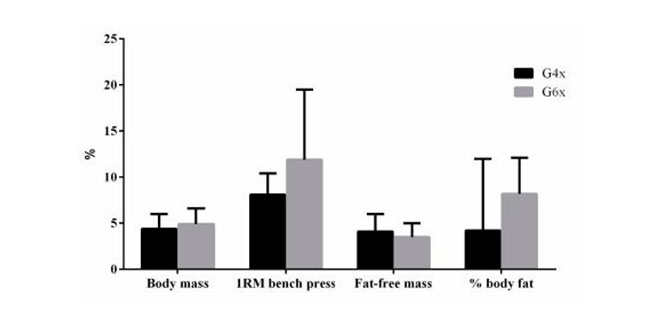
On the other hand, as shown in the graph above, increasing training frequency does show significant results in strength improvement.
Based on the results, it can be concluded that both double and triple split routines are effective strategies to increase lean mass and muscular strength in professional bodybuilders.
Would this be extrapolatable to the general population? Well, the previous note about steroid use should be kept in mind, since the body has “memory” and results could be enhanced even after a 6-month abstinence period as in this protocol.
Also, it’s worth noting that the higher intra-session volume in the 4-day routine compared to the 6-day one may impair performance in some people due to accumulated general fatigue. Alternatively, the 6-day per week routine might not allow enough recovery between training sessions, which could speed up the onset of overtraining.
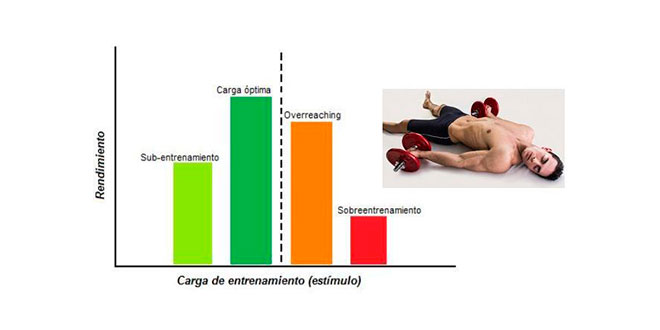
Not being black (4 days a week) or white (6 days a week), the possibility that higher training frequency could be beneficial cannot be ruled out, since in this specific case the limiting factor was the volume per session in the 4-day routine. Generally, total volume in 6 days of training is higher than in 4, with the possible concomitant increase in results as long as individual training capacity is not exceeded.
Sources
- Ribeiro, A., Schoenfeld, B., Silva, D., Pina, F., Guariglia, D., Porto, M., Maestá, N., Burini, R., and Cyrino, E. (2015). Effect of Two- Versus Three-Way Split Resistance Training Routines on Body Composition and Muscular Strength in Bodybuilders: A Pilot Study. International Journal of Sport Nutrition and Exercise Metabolism. Epub ahead of print