 Fitness, Nutrition, Health and Sports Blog In the HSNstore Blog you will find tips about Fitness, sport in general, nutrition, and health – HSNstore.com



Training to muscle failure is one of the most common and frequent methods used in all kinds of strength routines
But at the same time, it’s one of the practices that sparks the most debate about its effectiveness on our muscle performance. If we look at different opinions, we find trainers and pros who praise it, and others who criticize it and are totally against doing it.
Two completely different views on this deeply rooted training style, where the “questionable” effectiveness of muscle failure is debated if you’re aiming for strength or power, versus those who back the clear benefits gained through experience. Should you always train to failure?
To better define the pros and cons that have come up about this type of training and understand the seemingly opposite stances (though we’ll see they’re not that different), let’s analyze, through various studies, the real effectiveness of muscle failure.

We need to open our minds and be aware that in the fitness world, just like in real life, not everything is black or white, good or bad, but it depends on our goals
Analysis of muscle failure
When we talk about whether muscle failure is necessary or not, we mean if it will benefit our muscle results. But results related to hypertrophy? Strength? Power? Muscular endurance?
As I mentioned before, effectiveness depends on the goal set
If we focus only on hypertrophy, training to failure is a pattern where the metabolic component is maximized, clearly benefiting the hypertrophy process.
Izquierdo Study.M (2006)
Eleven weeks of training were evaluated in a group training to failure (HF) and another not training to failure (LF), regarding strength, power, and muscular endurance. Results showed both groups improved strength and concentric power (bench press and squat at 65% of 1RM) in a very similar way:
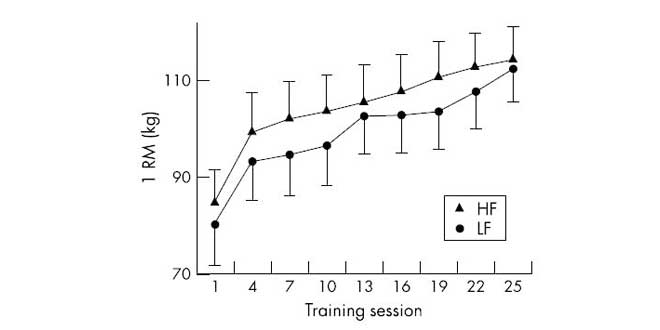
But on the flip side, muscle performance during bench press at 75% of 1RM was slightly better in the group not training to failure. As we see, the study concludes that effectiveness varies depending on our goal.
Drinkwater Study (2005)
This study analyzed the effect of training to failure and not to failure in two groups of athletes over six weeks, using 6RM bench press and bench throw. Results showed a greater short-term gain in muscle power after training to failure.
Review by Willardson et al. (2008)
The reality is that some studies don’t show a clear benefit of training to failure, but as we’ve seen, in these cases there is at least similar performance and rarely a conclusion of performance deficit.
So, whether to use failure or not will largely depend on the goal, being mostly justified in routines purely focused on hypertrophy. In other words, it’s a training pattern more suitable for people who only want muscle gain over strength, power, or endurance gains. dumbbell
The review by Willardson et al. precisely suggests how to integrate training to failure into a solid hypertrophy routine in a non-continuous way, alternating six-week cycles to maximize benefits without compromising technique and doing it safely to avoid injuries.

Conclusions
It’s been proven that training to failure (or close to it) is one of the most effective paths for hypertrophy, although we always talk about a beneficial method but never mandatory, and as we said, this can vary depending on the training goal.
If your goal is something else, like muscle power, evidence seems to indicate it’s not so advisable since other training patterns or techniques like cadence or repetition speed gain more importance (study).
However, if what you’re after is strength development, combinations of training patterns closer to muscle failure are recommended, of course, always in a controlled way.
Sources
- ncbi | Is Resistance Training to Muscular Failure Necessary? | Sanmy R. Nóbrega and Cleiton A. Libardi | Jan 2016
- Drinkwater EJ, Lawton TW, McKenna MJ, Lindsell RP, Hunt PH, and Pyne DB.| Increased number of forced repetitions does not enhance strength development with resistance training.| J Strength Cond Res 21: 841–847, 2007.
- American College of Sports Medicine. | Position stand on progression models in resistance training for healthy adults.| Med Sci Sports Exerc 41: 687–708, 2009
- ncbi | Muscular Adaptations in Response to Three Different Resistance-Training Regimens: Specificity of Repetition Maximum Training Zones |GE Campos et al. Eur J Appl Physiol 88 (1-2), 50-60. 2002 Aug 15
Related Posts
- HSN Protocol: Gain Muscle Mass with Barely Any Fat
- Can You Gain Muscle Mass and Lose Fat at the Same Time?
- How Much Protein to Take Every Day?