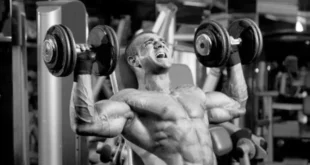
 Fitness, Nutrition, Health and Sports Blog In the HSNstore Blog you will find tips about Fitness, sport in general, nutrition, and health – HSNstore.com
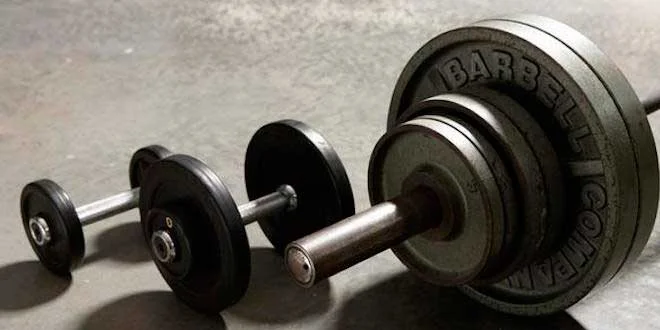


From the perspective of the weight lifted, you can’t compare barbell work to dumbbell work
If you can move 100 kg on flat bench press with a barbell, you won’t be able to lift 100 kg with dumbbells (2 x 50 kg) for the same number of reps.
One of the most common and accepted explanations is the need for a higher degree of stabilization in dumbbell exercises. However, although balance/stability is an obvious limiting factor for beginners, a more experienced athlete generally shouldn’t have major stability issues performing the exercise.
Difference between Barbell Vs Dumbbell Exercise
To understand the main kinetic difference between an exercise done with a barbell and dumbbells, it’s necessary to grasp the mechanical difference between the two, shown in the following table:
Open kinetic chain: dumbbells
OPEN KINETIC CHAIN: exercises where the end of the main joint involved in the movement (hand or foot) moves freely.
- Examples: dumbbell exercises, leg extensions, leg curls…
In an open kinetic chain situation, external forces transmitted through the hands point directly downward due to gravity and lack of friction. That’s why it’s advised not to bring the dumbbells together at the peak contraction of a movement, since mechanical tension in the muscles is lost. It’s a way to rest.
The vertical forces create an external extension moment/torque at the elbow (biceps activity needed) and a large moment/torque at the shoulder joint.

Closed kinetic chain: barbell
CLOSED KINETIC CHAIN: exercises where the end of the main joint involved in the movement (hand or foot) can’t move freely. There’s a “bond” preventing it (usually a barbell). Closed chain exercises tend to offer more athletic benefits.
- Examples: barbell exercises (bench press, squats, 90º rows…), leg press…
In this case, forces usually also have a medio-lateral component due to friction and the bar itself, especially with a wide grip. These medio-lateral forces make up about 25% of the vertical forces throughout the range of motion.
That’s why, as you can see in the table above, the external force is more medial (oblique toward the chest) creating an external flexion moment/torque at the elbow (triceps activity needed) and a smaller moment arm for the shoulder.

Conclusion
In the bench press example, triceps will be more involved when using the barbell, and the moment arm at the shoulder joint will be reduced compared to the same exercise done with dumbbells. The extra help provided by accessory agonist muscles makes it easier to move more weight with a barbell than with dumbbells, plus the lower stabilization demand. To give a few examples:
- Triceps help more in military press or bench press done with barbells than with dumbbells.
- Biceps help more in rows done with barbells than with dumbbells.
Sources
- Cotterman, M. L., Darby, L. A., & Skelly, W. A. (2005). Comparison of muscle force production using the Smith machine and free weights for bench press and squat exercises. The Journal of Strength & Conditioning Research, 19(1), 169-176.
- Krosshaug, T. (2012). Revealing “secrets” of strength training exercises with kinetic analysis. 8th International Conference on Strength Training. Oslo, Norway.
- Saeterbakken, A. H., van den Tillaar, R., & Fimland, M. S. (2011). A comparison of muscle activity and 1-RM strength of three chest-press exercises with different stability requirements. Journal of Sports Sciences, 29(5), 533-538.
- Santana, J. C., Vera-Garcia, F. J., & McGill, S. M. (2007). A kinetic and electromyographic comparison of the standing cable press and bench press. The Journal of Strength & Conditioning Research, 21(4), 1271-1277.
- Schick, E. E., Coburn, J. W., Brown, L. E., Judelson, D. A., Khamoui, A. V., Tran, T. T., & Uribe, B. P. (2010). A comparison of muscle activation between a Smith machine and free weight bench press. The Journal of Strength & Conditioning Research, 24(3), 779-784.