Fitness, Nutrition, Health and Sports Blog In the HSNstore Blog you will find tips about Fitness, sport in general, nutrition, and health – HSNstore.com

Teenagers are a group of people who not only can train, but absolutely should!
- Physical exercise is health at any age, including kids and teens, we just need to keep in mind some particularities to develop the body more safely.
We’ll explain how to train them and the best ab exercises.
1 Isometric plank for abs

?️♂️Execution: Rest the entire surface of the forearms and the tips of the toes on the floor.
?Tip: Keep a straight line (head-hips-feet) by contracting the abs.
?Reps and sets: 3 sets of 20 seconds.
2 Ab crunch

?️♂️Execution: Lying on a mat on your back (supine), the teen contracts the abs to flex the spine up to about 40º between the floor and the dorsal spine area.
?HSN tip: It’s important not to go higher to keep the spine healthy.
?Reps and sets: 4 sets of 15 reps.
3 Lying leg raise

?️♂️Execution: Lying on a mat on your back (supine), the teen raises the legs until they form a 90º angle with the torso.
?HSN tip: Pay attention during the movement to avoid lumbar hyperextension.
?Reps and sets: 3 sets of 8-10 reps.
4 Side plank with fitball support
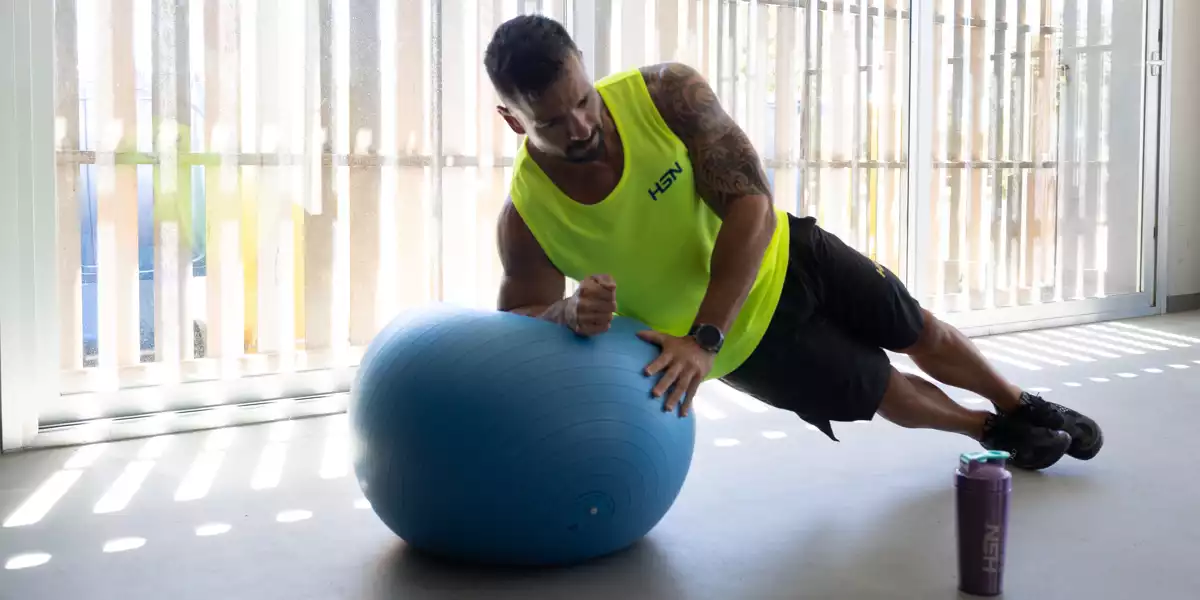
?️♂️Execution: Lying on one side, resting the forearm on the fitball, and supporting with the opposite hand, hold the side plank position.
?HSN tip: If possible, remove the hand support to increase intensity.
?Reps and sets: 3 sets of 30″ per side.
5 Hollow Hold

?️♂️Execution: Lying on a mat on your back (supine), the teen flexes hips and knees at 90º.
?HSN tip: Hold this tucked position.
?Reps and sets: 5 sets of 30″.
Exercises at home
It’s easy to meet the recommendation of core muscle work by doing an ab routine for teens without equipment.

Cardiovascular exercises
Cardio exercise is aimed at improving cardiorespiratory capacity, and can be measured by factors like:
- Lower resting HR.
- Higher HR reserve.
- Increased maximal oxygen consumption (VO2Max).
- Higher MAP and MAV.
- Peripheral angiogenesis.
- Improved metabolic efficiency (substrate oxidation).
- Better technique and increased motor efficiency.
According to WHO recommendations, kids and teens should do at least 60 minutes of physical activity daily at moderate (5-6 out of 10) or vigorous (7-8 out of 10) intensity, preferably through games and playful activities.
Activities that are so rare nowadays are the best way to meet these guidelines, such as:
- Playing a football match with friends;
- Playing cops and robbers; or
- Going out on a bike ride through the mountains.
Strength training
The NSCA’s specific recommendations for training teens are:
- Start with relatively light loads and always focus on correct exercise technique.
- Do 1 to 3 sets of 6 to 15 reps of a variety of upper and lower body strength exercises.
- Include specific exercises to improve the core.
- Focus on symmetrical muscle development and proper balance of muscles acting on joints.
- Do 1 to 3 sets of 3 to 6 reps of a variety of power exercises for upper and lower body.
- Progress gradually based on needs, goals, and skills.
- Increase load gradually (5-10%) as strength improves.
- Start strength training 2 or 3 times a week, on non-consecutive days.
WHO recommends focusing on developing major muscle groups, including the trunk.

Preferably by doing global (multi-joint) exercises.
General recommendations for exercising
Teens don’t have to train very differently from adults, since their muscles are the same. In 2009, the NSCA published its position on this. Their general exercise recommendations are summarized as:
- Give teens instructions and supervision by a qualified professional.
- Ensure a safe, risk-free training environment.
- Start each session with a 5 to 10-minute dynamic warm-up.
- Cool down with less intense calisthenics and static stretches.
- Address individual needs and session-specific characteristics.
- Use individual training logs to track progress.
- Update the training program and set challenges by systematically varying it.
- Optimize performance and recovery with healthy nutrition, proper hydration, and adequate rest.
- Supporting and praising the teen (coach and parents) helps keep motivation high.
References
- Faigenbaum, A. D., Kraemer, W. J., Blimkie, C. J. R., Jeffreys, I., Micheli, L. J., Nitka, M., & Rowland, T. W. (2009). Youth resistance training: updated position statement paper from the national strength and conditioning association. Journal of Strength and Conditioning Research / National Strength & Conditioning Association, 23(5 Suppl), S60-79.
- World Health Organization. (2010). Global recommendations on physical activity for health. Retrieved from https://apps.who.int/iris/rest/bitstreams/52834/retrieve.
Related Posts