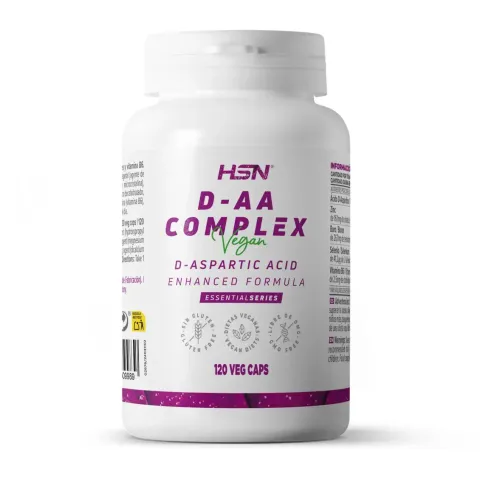
What is D-AA (D-aspartic acid) 1000 mg Complex?
D-AA (D-aspartic acid) 1000 mg Complex from EssentialSeries is our D-aspartic acid food supplement with zinc, boron, selenium and vitamin B6. We’ve brought these ingredients together in vegetable capsules to give you a convenient combination that’s easy to fit into your daily routine.
D-aspartic acid, also known as D-AA or DAA, is one form of the amino acid aspartic acid. It occurs naturally in the body and has its own distinct identity, different from the L-form commonly found in food proteins.
In this Complex, we use the amino acid in its free form. Our team has used it to develop a formula with additional ingredients, while keeping the convenience of a format that’s ready to take with water.
An amino acid with several decades of history
The scientific history of D-AA began long before it appeared in sports nutrition catalogues. For a long time, amino acid research focused mainly on L-forms, which are known for being part of proteins.
In 1977, researchers D’Aniello and Giuditta published one of the classic studies on the natural occurrence of D-aspartic acid. This study helped spark interest in D-amino acids and their presence in living organisms.
As analytical techniques advanced, researchers were better able to identify and study D-AA, including in human tissues. Today, several decades of publications help us understand its structure, its distribution in the body and how it differs from other amino acids.
Free-form D-AA and D-AA salts: what’s the difference?
When you look for D-aspartic acid, you may come across different forms of the ingredient. One is the free form, which we’ve chosen for this Complex. Others are its salts, in which aspartate is bound to a mineral, as with calcium D-aspartate.
The difference becomes clearer when you look at their composition. In a calcium salt, the ingredient’s weight includes both the amino acid and the calcium. Some forms also contain water in their crystal structure, as is the case with hydrated forms.
That’s why the total weight of a D-AA salt and the amount of D-aspartic acid it provides are two different figures. Two raw materials with the same weight can provide different amounts of the amino acid, depending on their composition.
For our Complex, we choose free-form D-AA and select the accompanying minerals separately. This lets us define the combination of ingredients and list the amount of amino acid and each mineral individually.
A formula that pays attention to detail
D-aspartic acid is the main ingredient in the formula. We’ve combined it with zinc, boron, selenium and vitamin B6 for anyone who prefers to get these ingredients together in one food supplement.
For the zinc, we’ve selected zinc citrate, a compound that combines this mineral with citric acid. It’s a source of zinc whose absorption has been studied, and it’s one of the raw materials we’ve chosen for this product.
Zinc, selenium and vitamin B6 each bring their own nutritional functions to the formula:
- Zinc contributes to the maintenance of normal testosterone levels.
- Vitamin B6 helps to reduce tiredness and fatigue.
- Selenium contributes to the protection of cells from oxidative damage.
We also take care with the information provided about the product. Our clean label lists the ingredients and the amounts they provide, distinguishing between the amount of a mineral and the amount of the compound used to supply it.
That detail is especially useful for ingredients such as zinc citrate: it shows how much zinc the formula actually provides, as well as identifying its source within the formula.
HSN quality: from ingredient to finished product
Quality starts with the selection of raw materials. At HSN, we assess our suppliers and work with ingredients backed by certificates of analysis and checks designed to verify their composition, purity and quality.
During manufacturing, we carry out process and weight checks and record information associated with each batch. We also check the finished product before approving it for release. This monitoring lets us maintain traceability and review the different stages of production.
Our team is involved in developing the formula, choosing the ingredients and overseeing the manufacturing process. That involvement shapes specific decisions: which form of D-AA we use, how we add the minerals and what information we make available to you.
You can learn more about our work on the HSN quality guarantee page.
Who is it for and how do you take it?
We’ve developed it for adults looking for D-aspartic acid who prefer a combined formula in capsules. It may be a particularly good fit if you’re already familiar with this ingredient and like the convenience of having it alongside minerals and vitamin B6.
The capsules make it easy to use at home, at work or while travelling. You take them with water, with next to no preparation needed—handy when you want to keep your routine simple.
To fit it into your day, follow the directions on the packaging and choose a time that works for you. Our formula and the vegetable capsule shell are suitable for people following a vegetarian or vegan diet.
Other D-aspartic acid options at HSN
The format and the ingredients paired with D-AA may influence your choice. As well as this Complex, you’ll find the amino acid on its own or in a different combination with minerals in our range.
D-aspartic acid powder from RawSeries
Our D-aspartic acid powder from RawSeries contains just one ingredient: free-form D-AA, 100 % pure and with no additives.
It’s an option for anyone who prefers to take the amino acid separately and choose the rest of their nutritional supplements independently. The powder can be mixed with water or your usual drink.
It contains no flavourings or sweeteners and retains the ingredient’s naturally acidic taste. If you prefer a ready-made combination with minerals and vitamin B6, D-AA Complex capsules offer that format.
EvoZMA: D-AA with magnesium, zinc and vitamin B6
EvoZMA from SportSeries is another of our formulas with D-aspartic acid. Here, we combine it with magnesium, zinc and vitamin B6 in vegetable capsules.
For this combination, we use magnesium as citrate and zinc as chelated bisglycinate. It may appeal to you if you’re looking for a formula that includes magnesium alongside D-AA, zinc and vitamin B6.
D-AA Complex, D-AA powder and EvoZMA give you options based on the ingredients and format you prefer: a formula with zinc, boron, selenium and B6; the amino acid on its own; or a combination with magnesium.
What can you combine with D-AA Complex?
If you train and want to add other products to your sports nutrition shop, you could choose Evowhey Protein. It’s a practical way to add protein to meals through shakes or recipes such as yoghurt, porridge and pancakes.
Another option is our creatine monohydrate powder from RawSeries if you want to include creatine in your sports nutrition plan. Its unflavoured format makes it easy to add to water or your usual shake.
Frequently asked questions
What does the D in D-aspartic acid mean?
The letter D identifies the orientation of its structure. The D- and L-forms have the same components but a different arrangement, much like a hand and its mirror image. That difference makes them distinct forms of the same amino acid.
Is the aspartic acid in food the same as D-AA?
The aspartic acid found in food proteins is usually in its L-form. Our product specifically contains the D-form, known as D-aspartic acid.
Are zinc citrate and zinc the same thing?
Zinc citrate is the compound we use to provide the mineral. Its weight includes both the zinc and the rest of the compound. That’s why we distinguish between the two and list the amount of zinc the formula provides.
Why choose capsules instead of powder?
Capsules offer a ready-made combination that you can take with water. RawSeries powder lets you choose D-aspartic acid as a single ingredient and mix it with a drink. You can pick whichever best suits your routine.
Choose D-AA Complex if you’re looking for free-form D-aspartic acid, selected minerals and vitamin B6 in a convenient format. A vegan-friendly combination developed by HSN and backed by our work in ingredient selection, manufacturing and quality control.
References
- D’Aniello, A. and Giuditta, A. (1977). Identification of D-aspartic acid in the brain of Octopus vulgaris Lam. Journal of Neurochemistry, 29(6), 1053–1057. DOI: 10.1111/j.1471-4159.1977.tb06508.x.
- Kiriyama, Y. and Nochi, H. (2016). D-Amino Acids in the Nervous and Endocrine Systems. Scientifica, 2016, 6494621. DOI: 10.1155/2016/6494621.
- Maeda, M. and colleagues (1990). Complex formation of calcium(II) with amino acids under physiological conditions. Journal of the Chemical Society, Dalton Transactions. DOI: 10.1039/DT9900002337.
- Wegmüller, R. and colleagues (2014). Zinc Absorption by Young Adults from Supplemental Zinc Citrate Is Comparable with That from Zinc Gluconate and Higher than from Zinc Oxide. The Journal of Nutrition, 144(2), 132–136. DOI: 10.3945/jn.113.181487.