Fitness, Nutrition, Health and Sports Blog In the HSNstore Blog you will find tips about Fitness, sport in general, nutrition, and health – HSNstore.com

Hypertrophy-Specific Training, or HST Routine, is a training system aimed at achieving hypertrophy.
Origin
HST was created by Bryan Haycock and emerged from research that analysed both the stimuli and the mechanisms for muscle cell hypertrophy.
Hypertrophy-Specific Training (HST) is based on the physiological principles of hypertrophy first discovered in the laboratory.
These principles are organised into a «method» of mechanical load on the muscle to induce hypertrophy (figure 1).

Figure 1. HST Routine (10 repetitions). Source: Haycock (2002).
Principles of HST
Mechanical load
A mechanical load is necessary to induce muscle hypertrophy.
This mechanism involves, but is not limited to, MAPk/ERK, satellite cells, growth factors, calcium and other factors that are well understood.
High frequency training
For the load to result in significant hypertrophy, the stimulus must be applied with sufficient frequency to create a new «environment».
This is as opposed to apparently random and acute attacks on the tissue’s mechanical integrity.
In terms of the stimulus frequency of the training, a disadvantage is having to introduce a weeks rest every time a muscle is worked, as many of the acute responses to training, such as increased protein synthesis, prostaglandins, IGF-1 levels and mRNA levels, return to normal in approximately 36 hours.
So, the author notes that:
“…you spend 2 days growing and half a week in a semi-cantiatabolic state…”.
Progressive load
With time, the tissue will adapt and become more resistant to the damaging effects of the mechanical load.
This adaption (resistance to stimulus) can happen in just 48 hours (Repeated Bout Effect or Rapid Training Effect).
Strategic de-conditioning
This concept refers to reducing the degree of load conditioning. The muscle is sensitive not only to the absolute load, but also to the change in load (up or down).
Because of this, a hypertrophic effect can be obtained by increasing the load from a previous load, even if the absolute load is not maximum, assuming conditioning (resistance to exercise induced micro-damage) is not to extensive.

There is a limit on the number of increments that can be made when increasing the load.
HST Methodology
Using lactic acid as a stimulus for tendon repair/health
HST involves higher repetitions to prepare the muscles and tendons for future weight loads.
This serves as «regular maintenance». Without it, you increase your risk of chronic injuries and pain. The metabolically-demanding reps improve the healing of strained tendons.
Compound exercises
Compound exercises are suggested to maximise the effects of the load.
Nevertheless, the optimal ratio between global and isolated exercises is: 70% and 30% (figure 2).
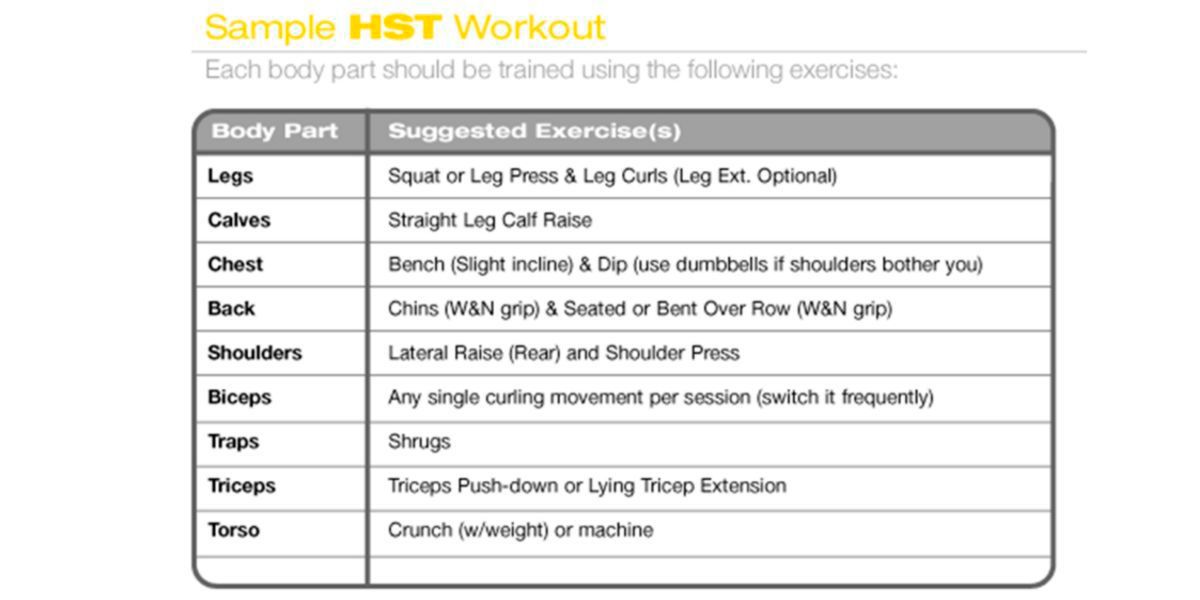
Figure 2. Suggested exercises for each muscle group Fuente: Haycock (2002).
Progressive adjusting of repetitions to accommodate progressive loads
The use of 2-week blocks for every set of repetitions is recommended.
This suggestion has nothing to do with adaptation, it’s simply a way of accommodating the load.
Low volume per exercise
There’s a limit in the number of sets per exercise and per training (1 or 2).
This is based on evidence that sets beyond the first «effective» set do little more than burn calories.
The number of sets start low to accommodate the necessary frequency to create and effective and consistent environment to stimulate hypertrophy.
Eccentric workouts
As for the load variety principle, HST uses eccentric workouts for 2 consecutive weeks.
Practical points of HST
Load to use
- Find your 15RM, 10RM and 5RM for each exercise to use.
- Increase the load after every mesocycle (2.5-5kg).
Determine the weights for each workout.
- Start repetition schemes with loads less than the maximum lifts.
- Systematically progress towards maximum weights.
Repetition range
Repetitions will decrease every 2 weeks in the following order:
- 15 repetitions for 2 weeks.
- 10 repetitions for 2 weeks.
- 5 repetitions for 2 weeks.

Load variation
Reduced repetition accommodates the increased load:
- The high-repetition workouts play an important role.
- The anaerobic work of greater volume benefits the muscle by increasing resistance to injury and increasing functional capacity.
Training frequency
Each muscle group should be loaded 3 times a week (medium-high frequency; full-body routine).
- Frequency Principle.
- A stimulus for muscular hypertrophy should be sufficiently frequent enough to create a consistent «environment» for the muscle to adapt.
Importance of rest
- During rest days (for example, Tuesday, Thursday, Saturday and Sunday) light cardiovascular exercise (20-40 mins) should be done.
- The slant running belt (fast walking) should be the first choice.
- Adequate and regular rest is important for injury prevention and stress management..
Complete every workout
- Even if your muscles are slightly sore from the previous workout, finish it with the designated kilos.
- It’s important to recognise the difference between and injury and common muscle pain.
- The warm-up is important.
Strategic De-conditioning
After every 6-8 week cycle, take some time off from training. This time should be used for recovery and to allow minor injuries from overworking to heal.
Bibliographic Sources
- Haycock, B. (2002). Hypertrophy-Specific Training.
Related Entries
- What are the Principles of Training?
- «Rest-Pause» is an advanced method for achieving hypertrophy. If you want to know more about it, click here.