 Fitness, Nutrition, Health and Sports Blog In the HSNstore Blog you will find tips about Fitness, sport in general, nutrition, and health – HSNstore.com
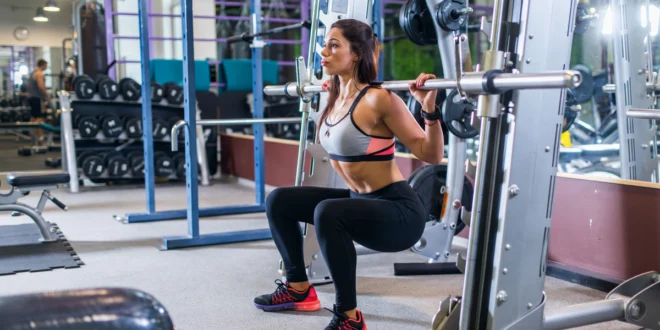


The Smith machine squat, also known as a multipower squat or guided squat, is a multi-joint lower-body exercise that primarily targets the quadriceps, glutes and adductors. Its main feature is that the bar moves along guide rails, reducing balance demands throughout the movement.
This feature allows both beginners and experienced athletes to focus on exercise execution and manage their training load.
Below, we explain how to perform Smith machine squats correctly, which muscles are involved, how to position your feet and the main differences compared with free-weight squats.
How to perform Smith machine squats correctly
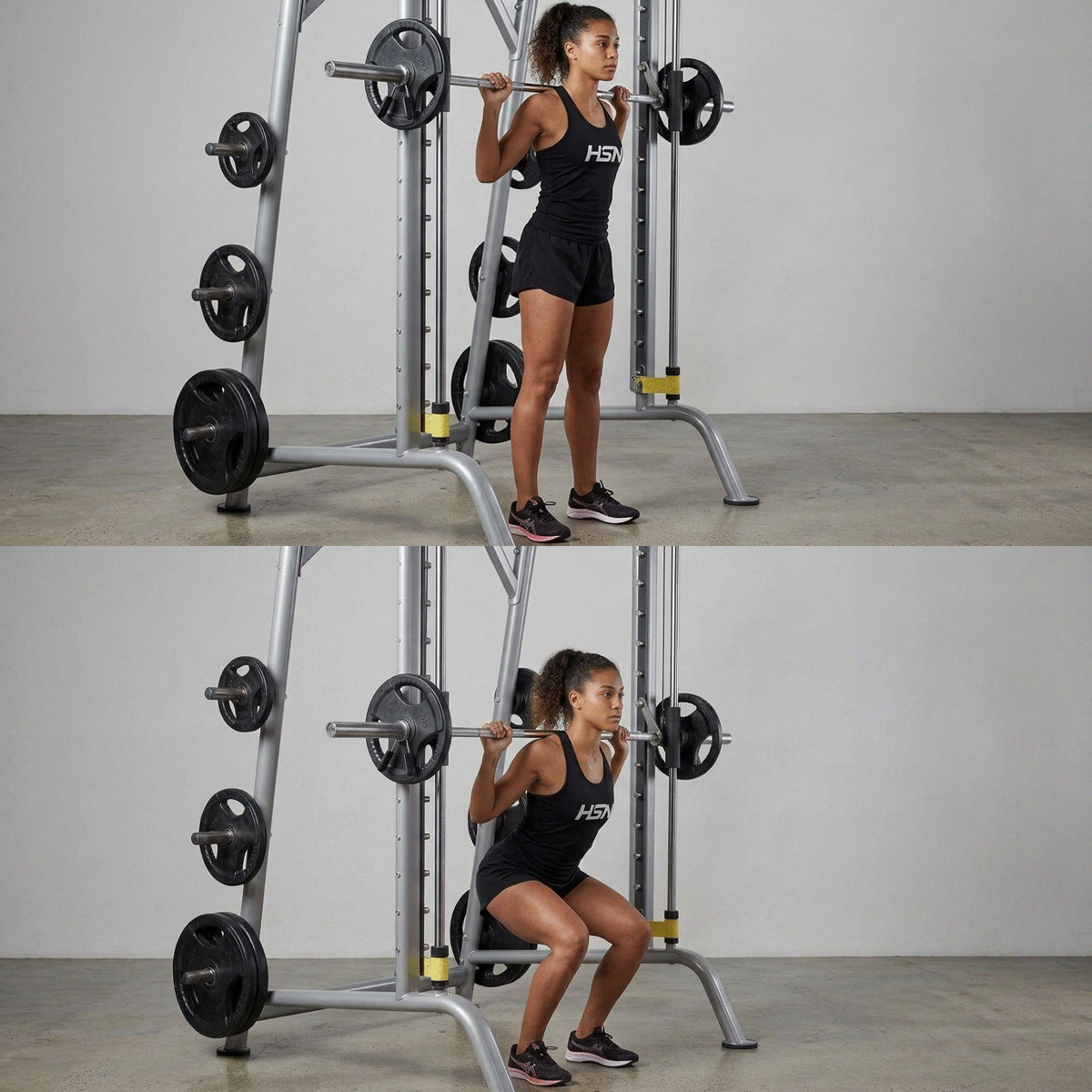
- Adjust the machine: position the bar slightly below shoulder height, adjust the safety stops and select a load appropriate for your training level.
- Position the bar: stand underneath it and rest it across the muscles of your upper back, avoiding direct pressure on the cervical vertebrae.
- Adopt the starting position: place your feet approximately shoulder-width apart, with your toes pointing slightly outwards. Adjust their position according to your anatomy and the machine’s bar path.
- Engage your core: inhale, create abdominal tension and unlock the bar while maintaining a stable position.
- Perform the descent: bend your knees and hips simultaneously, keeping your entire feet flat on the floor and your knees aligned with the direction of your toes.
- Control your depth: descend until you reach a range of motion that you can control without losing stability or excessively altering the position of your spine.
- Return to the starting position: push against the floor through your entire feet and extend your knees and hips in a controlled manner, gradually exhaling as you rise.
What muscles do Smith machine squats work?
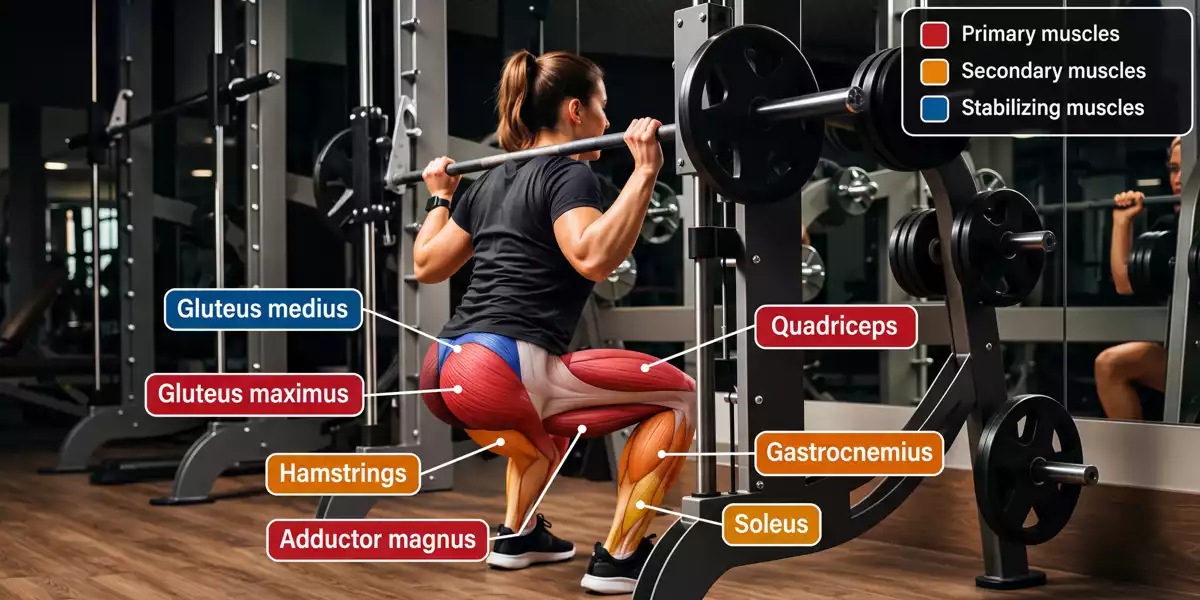
The Smith machine squat involves different lower-body muscle groups, whose contribution may vary depending on squat depth, foot placement and torso inclination.
| Muscle group | Involvement | Function during the exercise |
|---|---|---|
| Quadriceps | Primary | Knee extension during the upward phase. |
| Gluteus maximus | Primary | Hip extension. |
| Adductor magnus | Primary and assisting | Contributes to hip extension, particularly in positions involving greater hip flexion. |
| Hamstrings | Secondary | Assist with hip extension and joint stability. |
| Core and spinal erectors | Stabilising | Help maintain torso posture. |
| Calves | Secondary | Contribute to ankle control and stability. |
Benefits of Smith machine squats
The guided bar path offers several features that may be useful when programming strength and hypertrophy training.
- Reduced balance demands: allows you to perform the exercise without having to control the horizontal movement of the bar, as you would during a free-weight squat.
- Lower-body muscle development: allows you to apply significant mechanical tension to the quadriceps, glutes and adductors.
- Ease of load progression: allows you to gradually increase the weight, repetitions or training volume.
- Versatility: accommodates different foot positions, ranges of motion and lifting tempos.
- Availability of safety stops: allows you to limit the bar’s range of motion when they are correctly adjusted.
- Complements other leg exercises: can be combined with free-weight squats, leg presses, lunges and other lower-body movements.
How to position your feet during Smith machine squats
One of the distinctive features of the Smith machine squat is the ability to modify foot placement relative to the bar path. This can alter the mechanical demands placed on the knees and hips.
Conventional foot placement
Place your feet approximately shoulder-width apart and in a position that allows you to bend your knees and hips in a coordinated manner.
This variation is suitable for training the quadriceps and glutes together.
Feet positioned slightly forwards
Moving your feet moderately forwards relative to the bar can change how the demands are distributed between the hips and knees.
Depending on the execution, this position may increase the involvement of the hip extensors, although the quadriceps continue to play an important role.
Wide-stance or sumo Smith machine squat
This variation is performed with your feet wider than shoulder-width apart and your toes pointing outwards.
This variation changes the position of the hips and may increase the demands placed on certain muscles in the gluteal region and the adductors.
There is no universal foot position that is optimal for everyone. Limb length, joint mobility and the machine’s vertical or angled bar path all influence exercise execution.
Sets and repetitions according to your training level
Smith machine squat programming should be adapted to your experience, goals, recovery capacity and the other exercises included in your leg workout routine.
| Level | Sets | Repetitions | Alfredo’s tip |
|---|---|---|---|
| Beginner | 2-3 | 10-15 | Prioritise learning the correct technique and use loads that allow you to leave 3 to 4 repetitions in reserve. |
| Intermediate | 3-4 | 8-12 | Apply progressive overload and generally train with 1-3 repetitions in reserve. |
| Advanced | 3-5 | 6-15 | Adjust intensity and volume according to your training programme. You can occasionally incorporate pauses, tempo variations or advanced training techniques. |
These ranges are provided as a guide and refer to working sets of the exercise, excluding ramp-up or warm-up sets.
Smith machine squat variations
The Smith machine allows you to perform different squat variations by modifying the bar position, foot placement or lower-limb support. These changes allow you to adjust the mechanical demands of the exercise and the involvement of different muscle groups.
Cross-arm Smith machine squat
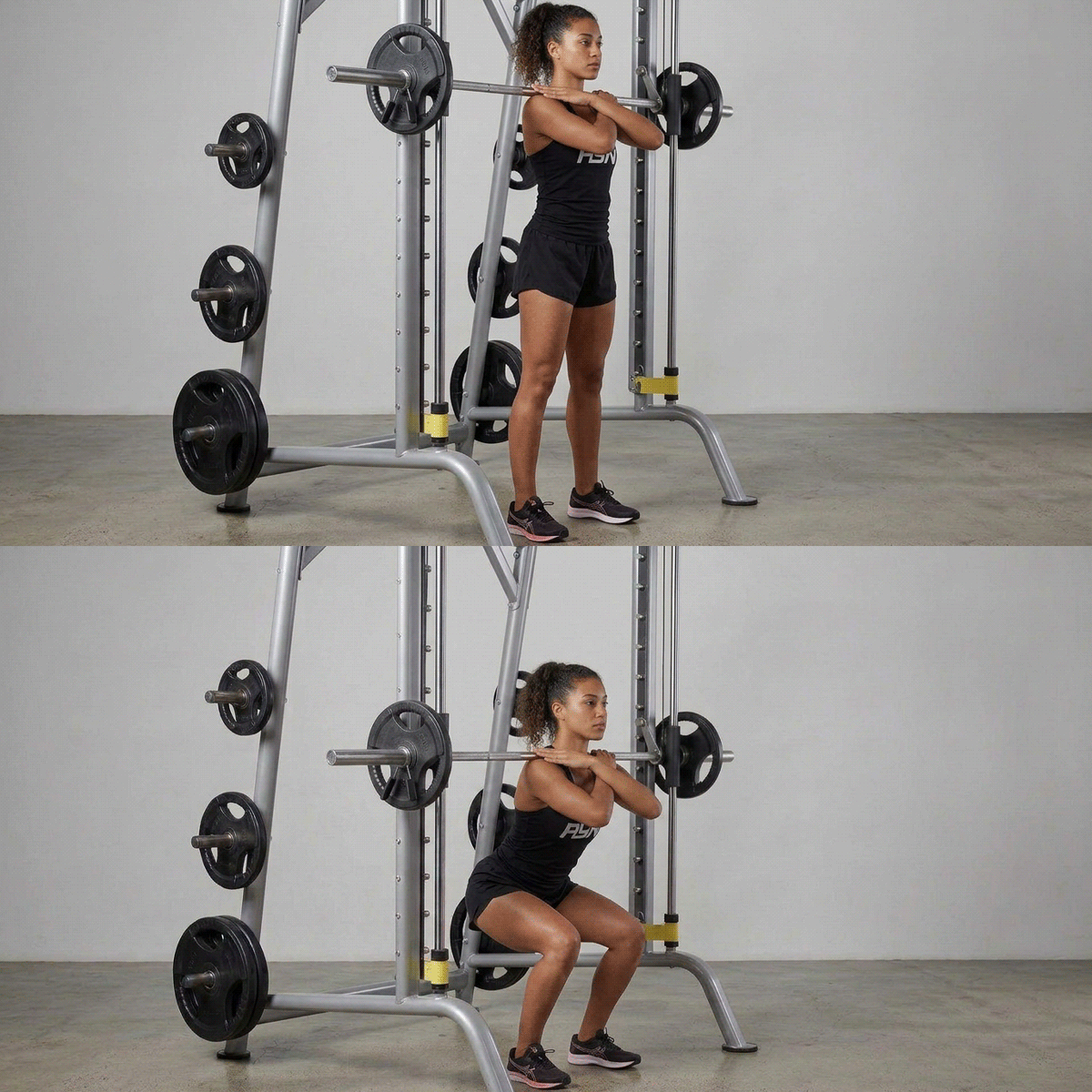
Also known as the Smith machine front squat, this variation is performed by placing the bar across the front of the shoulders and crossing the arms in front of the chest to hold it in position.
This variation encourages a more upright torso position and may increase the demands on the quadriceps relative to the hip extensors.
- Place the bar across your anterior deltoids and cross your arms over it.
- Keep your elbows elevated and your feet approximately shoulder-width apart.
- Bend your knees and hips while keeping your torso upright.
- Extend your legs in a controlled manner until you return to the starting position.
Key muscles worked: quadriceps, gluteus maximus and torso stabilising muscles.
Smith machine sumo squat
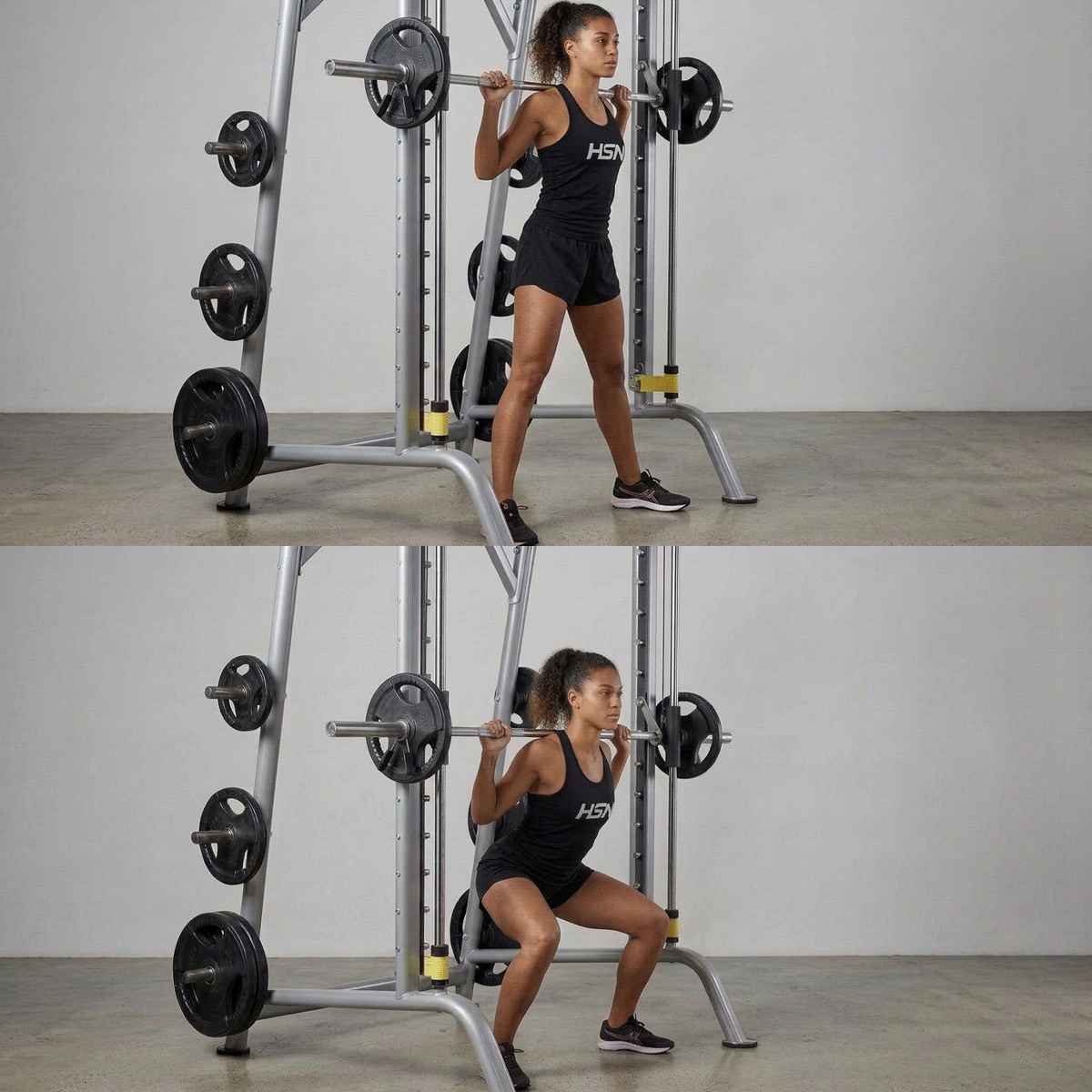
The sumo squat is characterised by a foot placement wider than shoulder-width, with the toes pointing outwards.
This position alters the mechanical demands on the hips and may increase the involvement of the adductors while continuing to work the quadriceps and glutes.
- Place the bar across the muscles of your upper back.
- Position your feet wider than shoulder-width apart and point your toes outwards.
- Descend in a controlled manner, ensuring that your knees follow the direction of your toes.
- Push against the floor through your entire feet until you return to the starting position.
Key muscles worked: adductors, gluteus maximus and quadriceps.
Smith machine Bulgarian split squat
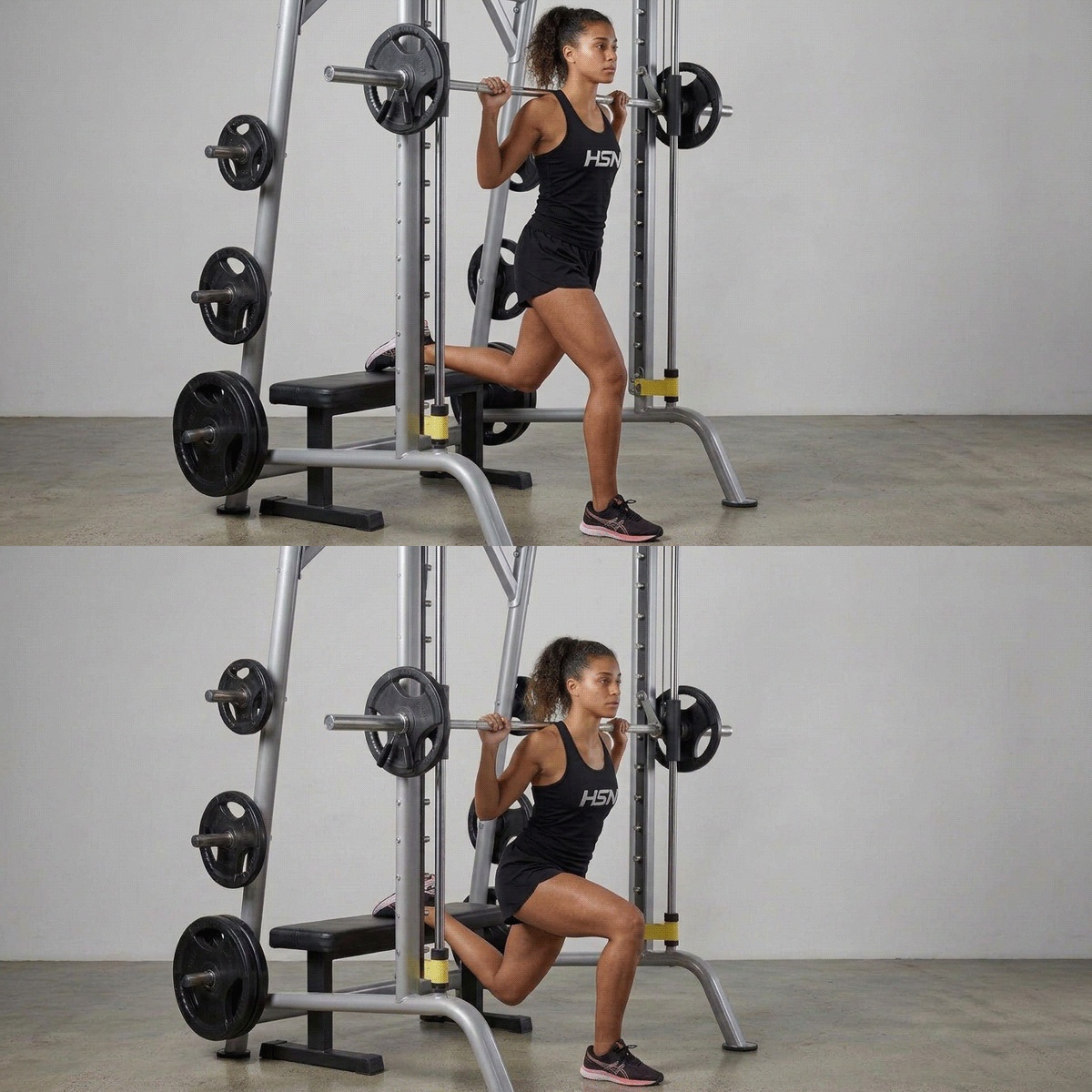
The Smith machine Bulgarian split squat is a unilateral lower-body training exercise in which the foot of the rear leg remains elevated on a bench.
The guided bar path reduces balance demands compared with the free-weight variation, allowing you to focus the effort on the front leg.
- Place a bench behind you and adjust the bar height and safety stops.
- Rest the bar across your upper back and place the top of your rear foot on the bench.
- Bend the knee and hip of your front leg, descending in a controlled manner.
- Push against the floor with your front foot until you return to the starting position.
- Complete the planned repetitions and switch legs.
Key muscles worked: quadriceps, gluteus maximus, adductor magnus and gluteus medius as a stabiliser.
Common Smith machine squat mistakes and how to avoid them
Although the bar path is guided, it is important to pay attention to your technique to make the most of the exercise’s characteristics.
- Placing the bar on your cervical spine: rest it across the muscles of your upper back and avoid direct pressure on the vertebrae.
- Positioning your feet too far forwards: find a position that allows you to maintain balance and perform the movement without adopting forced postures.
- Lifting your heels during the descent: maintain stable contact between your entire feet and the floor, and adapt your foot placement or squat depth to your mobility.
- Allowing your knees to collapse inwards: ensure that they follow a path consistent with the direction of your toes.
- Descending without control: avoid dropping down or using excessive bounce at the bottom of the movement.
- Hyperextending your knees at the end of the movement: complete leg extension in a controlled manner without forcing the joint beyond its natural position.
- Losing abdominal tension: stabilise your torso before starting each repetition and maintain control throughout the entire range of motion.
- Using excessive weight: select a load that allows you to maintain consistent technique throughout all repetitions.
- Failing to adjust the safety stops: position them slightly below the lowest point of your range of motion before starting your sets.
Differences between free-weight squats and Smith machine squats
Both variations allow you to train the lower-body muscles, but they differ in terms of load path, stabilisation demands and freedom of movement.
| Feature | Free-weight squat | Smith machine squat |
|---|---|---|
| Bar path | Unrestricted. | Guided, vertical or angled. |
| Balance | Greater demands. | Lower demands. |
| Muscular stabilisation | Generally greater. | Partially facilitated by the guide rails. |
| Freedom of movement | Greater ability to adapt the movement path. | Determined by the machine’s design. |
| Learning the technique | Greater coordination demands. | Lower balance demands. |
| Muscle hypertrophy | Suitable. | Suitable. |
| Strength development | Specific to the free-weight movement. | Specific to the guided movement. |
| Safety | Depends on technique, load and the available safety systems. | Depends on technique, load and the adjustment of the safety stops. |
Free-weight squats and Smith machine squats are not mutually exclusive exercises. Both can form part of the same strength and hypertrophy training programme.
Frequently asked questions about Smith machine squats
Do Smith machine squats work the glutes or quadriceps more?
They work both muscle groups. Their relative involvement depends on factors such as foot placement, squat depth, torso inclination and the individual characteristics of the athlete.
Are Smith machine squats better than free-weight squats?
There is no universally superior variation. Free-weight squats place greater demands on balance and coordination, whereas the Smith machine allows you to perform the movement along a guided path. Both are valid options for developing strength and muscle mass.
Are Smith machine squats bad for your knees?
Not necessarily. The fixed bar path influences the mechanics of the movement, so it is important to adapt foot placement, load and range of motion to your individual characteristics. If you experience pain or have a previous injury, consult a healthcare professional.
How much does a Smith machine bar weigh?
The effective weight of the bar depends on the manufacturer, the model and whether it features a counterbalance system. Not all Smith machine bars have the same starting resistance, so it is advisable to check the machine’s specifications.
Can you build muscle with Smith machine squats?
Yes. Smith machine squats allow you to generate mechanical tension in the lower-body muscles. To promote hypertrophy, it is important to combine appropriate training programming, progressive overload, adequate nutrition and recovery that matches the demands of your training.
Conclusion
The Smith machine squat is an effective alternative to incorporate into your leg training, whether you are new to strength training or already have experience.
Its guided bar path reduces balance demands and offers different execution possibilities. The key is to adapt your body position, select an appropriate load and progress in a structured manner.
Related posts
- Differences between Bulgarian split squats and traditional squats
- When to use knee wraps for squats and how to use them correctly