Fitness, Nutrition, Health and Sports Blog In the HSNstore Blog you will find tips about Fitness, sport in general, nutrition, and health – HSNstore.com

Last updated: October 2026
We want to speak to you with the same transparency as always. If you’re here, it’s because you’ve noticed that the prices of some of our products have changed, or because you’ve followed the link from the transparency information displayed on our product pages. Either way, this page is here to give you all the facts.
We’re not going to give you vague answers. We’re going to put the numbers on the table.
October 2026: We’ve reduced the price of our whey proteins
Over the past few months, we’ve been transparent about the exceptional situation in the whey protein market and why we had to increase the prices of some of our products. We also made you a promise: if costs went down, we would lower our prices.
Today, we can say that we’ve kept that promise. Since 14 October, all flavours of our Evowhey Protein are available at the same price, with a 20% reduction. This also applies to the No Sweeteners version and the RawSeries version.
This reflects our commitment to passing on improvements in costs to you, so you can continue enjoying HSN quality at the best possible price.
What’s changed in the market?
According to Vesper’s data from 7 October 2026, the European benchmark price for whey protein concentrate (instant WPC80) stands at around €21,000 per tonne, compared to the peaks reached this summer of nearly €28,000 per tonne. This represents a correction of more than 20% and the first clear reversal in the trend for a long time.
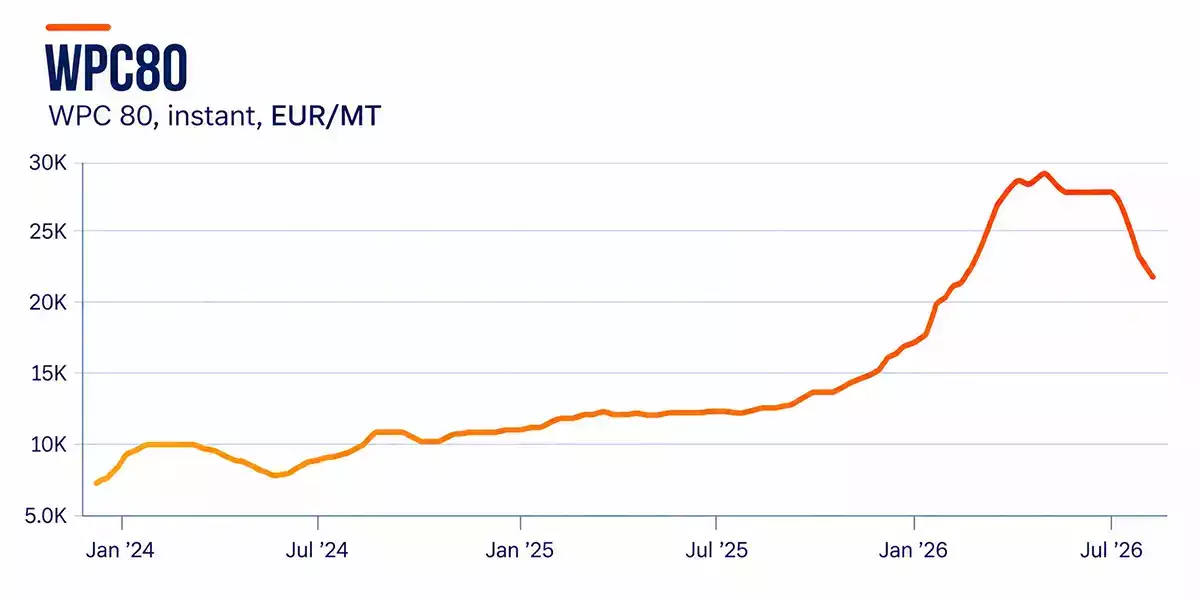
Source: Vesper · Instant WPC80, EU, EUR/tonne · Data as of 07/10/2026.
Why now?
When prices increased, we introduced the changes gradually, batch by batch. This time, we’ve chosen not to wait: as soon as we saw the market changing direction, we decided to pass those savings on to you immediately.
Will prices fall further?
That depends on how the market develops. WPC80 prices are still above their 2024 and 2025 levels, and no one can say for certain how far this correction will go. What we can assure you is that we’ll continue to keep you informed here and, if the trend continues, we’ll keep reviewing our prices.
This update concerns whey protein. Creapure® and omega-3 are following different market trends, which we’ll explain below.
Transparency works both ways
When costs rise, we explain why. When they fall, we tell you and pass the savings on to you. Because our commitment isn’t about justifying prices, but about always offering the highest quality at a fair price.
Our goal has never been to be the cheapest, but to offer the highest quality at a fair price. Today, that fair price is lower. Our formulas, raw materials and quality controls remain exactly the same.
Source: Vesper, instant WPC80 benchmark, European market (EUR/MT), updated 7 October 2026.
October 2026: The latest on Creapure® and omega-3
Alongside the good news about whey protein, we also want to update you on the other two raw materials we’ve discussed in this article, as their situations are very different.
Creapure®: The situation remains unchanged
Global demand for Creapure®, the creatine monohydrate manufactured by Alzchem in Germany, continues to exceed its production capacity. As of today, nothing has changed: the situation remains the same as we explained in July, and availability continues to be limited.
If you’re looking for an alternative, our Creatine Monohydrate undergoes the same purity and safety controls that we apply to Creapure®. It’s also available in an ultrafine 500-mesh version and in flavoured versions. You’ll find the links in the “Smart Alternatives” section of this article.
Fish oil omega-3: The situation continues to worsen
For omega-3 derived from fish oil, the trend is exactly the opposite of what we’re seeing with whey protein. Fishing restrictions in Peru, home to some of the world’s main fishing grounds for sourcing this raw material, continue to reduce its availability, and the situation has steadily worsened over recent months.
We maintain our quality standards across all our omega-3 products and will continue to monitor market developments closely, updating this page as the situation changes.
Some background: What’s happening with raw materials?
This is not a general logistics issue or a one-off excuse. It is a genuine availability crisis affecting key ingredients:
- Whey protein: the market cost of WPC80 has increased by 60% in just four months. The price of the raw material has almost quadrupled over the past three years. The data is public and can be verified at vespertool.com, the industry’s leading reference platform. Most European manufacturers are reported to be fully sold out, with buyers securing volumes for the entire year.
- Omega-3: fishing restrictions in Peru, the world’s leading producer of fish oil, have drastically reduced the availability of raw material, driving up costs at source.
- Creapure®: global demand for this creatine monohydrate from Alzchem (Germany) has exceeded the company’s production capacity. There is not enough Creapure® to supply the global market.
Why is the price of protein increasing? The real cause: supply and demand
It is true that international conflicts — such as the situation in Iran or tensions in the Strait of Hormuz — have a real impact and a human cost that we do not wish to minimise in any way. These factors may affect logistics and energy costs. However, in the specific case of protein, the main reason is different, and we want to be honest: the underlying problem is supply and demand.
1. Protein is no longer just “a gym thing”
Today, protein can be found in yoghurts, ice creams, snacks, tortillas, crisps and mass-market ready meals. Major food corporations are now competing for the same raw material, but production facilities have not expanded at the same pace as this global demand.
2. GLP-1 medicines (such as Ozempic) are driving up demand
Doctors are widely recommending whey protein shakes to patients taking these medicines in order to prevent muscle mass loss. In markets such as the United States, this has created an enormous and entirely new level of demand, which is putting upward pressure on prices.
3. The price of the raw material has almost quadrupled
The market cost of WPC80 (Whey Protein Concentrate 80% Instant) has almost quadrupled over the past three years, according to data from Vesper. On top of this base ingredient, premium flavourings, sweeteners, natural colourings, packaging, labelling, transport, processing and the quality controls carried out under IFS Food standards for every batch must also be taken into account.
4. This is a global situation
Leading international sports nutrition brands are already openly communicating price increases and their causes to consumers. According to Vesper, European brands have publicly reported increases of 42% in raw material costs in just six months. Nobody is increasing prices because they want to: the market leaves no other option.
Forecasts for the coming months show no signs of improvement. We do not want to alarm you, but we would rather you heard it from us before hearing it anywhere else.
What are we doing at HSN?
We have not stood idly by. We have introduced three lines of action to protect our customers:
- Absorbing costs. For months, we have been sacrificing a very significant part of our margin to reduce the impact on your budget. The raw material increases by 60%; the price for the customer does not increase by 60%. We absorb the difference. We are operating with the tightest margins we have ever had.
- Direct negotiation and bulk purchasing. We optimise logistics and purchase large volumes to limit the impact from suppliers as much as possible.
- Gradual price increases by batch, not all at once. The price of each flavour and format only changes when it is restocked with a new batch manufactured at the updated cost. While stock from the previous batch remains available, that product keeps its previous price.
This means that, at the moment, you may find some flavours at one price and others at a different price within the same product. This is not an error: each price reflects the actual cost of the raw material used to manufacture that batch. We prefer to do it this way because, if a batch was manufactured using raw material purchased at a lower cost, we do not believe it is fair for you to pay the price of the next batch.
October 2026: Promise kept. Read the update
The real cost per serving: putting it into perspective
We know that seeing a higher price can be frustrating. But we want to put the situation into context:
A 2 kg format provides approximately 66 servings of 30 grams. At the current price and with the usual promotions, the cost per serving ranges between €0.82 and €0.95. Less than one euro per serving.
How much do the same 24 grams of protein cost with other options?
| SOURCE | FOR ~24 G OF PROTEIN | APPROXIMATE COST |
| Evowhey HSN | 1 serving (30 g) | €0.82 – €0.95 |
| Chicken breast | ~130 g raw | €0.95 – €1.10 |
| Eggs | 4 units | €0.80 – €1.00 |
| Tinned tuna | ~1.5 tins | €1.50 – €2.00 |
| Rib steak / beef | ~130 g raw | €2.00 – €3.25 |
| High-protein yoghurt | 2 units | €2.50 – €3.50 |
| Protein bar | 1 unit | €2.00 – €3.50 |
| RTD protein shake | 1 bottle | €2.50 – €4.00 |
| Coffee (0 g of protein) | 1 cup | €1.30 – €1.80 |
Even at the current price, Evowhey matches or improves on the cost per gram of protein provided by chicken breast and is significantly cheaper than any other alternative. And that is without taking into account three advantages that whole foods cannot replicate:
- Superior bioavailability. Whey protein has a DIAAS score of 1.09 (FAO standard), compared with 0.91 for chicken and 0.92 for beef. Your body makes use of more protein from each serving.
- Higher leucine content (~2.5-2.7 g per serving), the key amino acid that activates muscle protein synthesis.
- Convenience. 30 seconds to prepare, easy to carry, with no cooking or cleaning required. Whey covers moments of the day when whole foods are not practical.
Whey does not replace whole foods — it complements them. However, for the additional grams of protein you need each day, it remains the most efficient option.
Quality and safety: our red line
We could lower prices by using lower-quality raw materials, removing controls or disguising information on labels. But that would not be HSN.
Our factory holds IFS (International Featured Standards), GMP and HACCP certifications. Every batch is analysed and traceable. We work with high-quality raw materials and internationally recognised suppliers.
We have not changed a single detail of our formulations. We have not replaced any raw material with a cheaper alternative. The only thing that has changed is the cost of what we purchase.
At current market prices, when you see a whey protein format priced significantly below these ranges, it is worth asking: what raw material is being used? What is its actual concentration? What quality controls are applied?
We will not compete by lowering standards when your health is at stake.
Smart alternatives for optimising your budget
Whey does not have to be the only option. If you are looking for effective alternatives with more stable prices:
- Plant-based proteins, egg protein or meat protein. Nutritionally excellent sources with more stable prices in the current context and the same HSN quality guarantee.
- Creatine Monohydrate. The same purity and safety controls that we apply to Creapure®, at a much more affordable price and with greater availability. Also available in different flavours. New: Ultra-Fine 500 mesh version.
In summary
If you are looking for quality, transparency, in-house manufacturing, certifications and an honest price, HSN remains your best option.For us, a fair price does not mean always being the cheapest. It means offering the greatest possible real value for every euro you spend. And we remain firmly committed to that principle.
We will continue to update this page as the situation develops. Just as we tell you about every price increase, we will also tell you about every price reduction.
Thank you for your trust.
The HSN Team
Sources used:
- Vesper, vespertool.com