 Fitness, Nutrition, Health and Sports Blog In the HSNstore Blog you will find tips about Fitness, sport in general, nutrition, and health – HSNstore.com
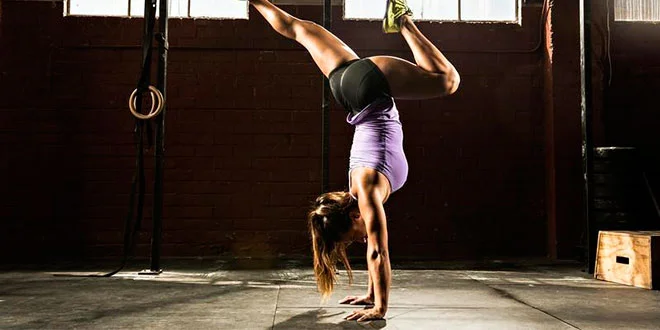

We keep moving forward in our mission to gather the basics of the CrossFit methodology, which we already started to explore in previous posts, showing the bodyweight movements and the Olympic movements. Now, let’s dive into the importance and direct connection that gymnastics has with any other fitness facet and how it affects performance and even health.
One of the most overlooked disciplines by casual gym-goers in any fitness center is gymnastics elements. Luckily, this is one of the many barriers being broken down with the rise and boom of CrossFit as a training system for the masses.
Let’s explain why having solid gymnastics fundamentals is so important before moving on to resistance training, but first, let’s define what we mean when we talk about gymnastics elements.
What is Gymnastics?
According to the RAE, gymnastics is:
- The art of developing, strengthening, and giving flexibility to the body through certain exercises.
- The set of these exercises.
- Practice or exercise that trains any activity or function.
The definition of gymnastics according to the CrossFit methodology is more specific, referring to exercises, movements, or elements where the resistance is our own bodyweight, that is, “bodyweight” work.
Therefore, any element that requires overcoming an external resistance, like bars, dumbbells, medicine balls, kettlebells, etc., falls outside this definition.
Is gymnastics trained in the gym?
As we said at the start, the regular gym-goer, regardless of their goal (sports transfer, general fitness, rehab, body recomposition…), usually focuses on two types of work:
- Resistance training: dumbbells, bars, cables…
- “Cardio”: running, swimming, elliptical, spinning…
Mostly ignoring gymnastics work and reducing it to what you “see” around the gym or what’s on the workout board, basically:
- Push-ups on the floor,
- Dips on parallel bars,
- Pull-ups, or
- Crunches.
Is that enough? In my opinion, no. Gymnastics fundamentals should be priority, especially before high-intensity strength training and when someone is new to it.
The importance of gymnastics elements will be clear through the following concepts:
Proprioception
Working on gymnastics fundamentals helps us develop great body awareness. Stabilizer muscles get a boost when we train properly, helping us spot and correct imbalances that might go unnoticed in similar exercises with external loads.
Here’s a concrete example
One of my favorite upper body strength exercises is the strict handstand push-up against the wall, which is also very scalable. We don’t have to start with a full range of motion; we can add plates or discs under our hands to add deficit and increase the lever difficulty, the time under tension, and thus the applied force, just like a classic load progression by increasing movement intensity.
Its “equivalent” in weighted training would be the strict military press with a barbell. Here, we face an open kinetic chain movement like all gymnastics elements (dips) vs. a closed kinetic chain movement (military press). The work and muscles involved are very similar but not identical, with a greater need for muscle recruitment, especially stabilizers, in gymnastics.
In the barbell exercise (military press), if we don’t apply equal force with both arms, we tend to overcompensate dangerously or even cause injury. This is more obvious when working unilaterally with dumbbells, noticeable even to an untrained eye. However, in gymnastics, if the force applied by both arms is very different, we probably just won’t be able to push up or will fall toward the weaker side, so we know exactly what’s going on without dangerous compensations.
Here’s an example from weightlifting athlete Dimitry Klokov, performing vertical pushing gymnastics work -> handstand push-ups, horizontal pushing -> dips on the floor, and barbell work -> strict military press. You can see the similarity between the first and third exercises in this redundant yet spectacular strength work.
Core strength
Closely related to the previous point, closed kinetic chain exercises (where the force application point stays fixed) demand strong activation of our “core” — abdominal muscles, lower back, etc.
To stabilize properly during these exercises, doing specific gymnastics moves where the limiting factor is the core helps us transfer that strength to exercises requiring massive midline engagement.
For example, the handstand push-ups we mentioned earlier can lead to dangerous lumbar arching without proper core activation, which can also happen in military presses or pull-ups.
Who hasn’t lost control of a movement, swinging wildly because their midline wasn’t properly engaged, or had to cross and bend their legs? This contrasts with pull-ups done by an athlete consciously engaging this musculature:
Range of motion
Doing gymnastics exercises usually forces us to seek or have the maximum joint range for effective and efficient movement execution. Using the earlier example, to do a strict handstand push-up against the wall correctly, one requirement is maximum shoulder flexion (180 degrees) without compensating with lumbar hyperlordosis. That means keeping arms fully extended above the head, aligned with ears, hips, and heels, with a neutral pelvis position, even forcing pelvic retroversion.
If we can’t do this, for example, due to limited shoulder flexion, we won’t be able to balance on our hands and will likely be “pushed out” when trying.

This position can even help coaches prescribe workouts to their clients, as it raises the question: if we challenge different structures in these movements and they “collapse” (midline instability, bilateral strength imbalance, lack of range of motion…), should we really be adding load intensity in resistance exercises, or should priorities be different?
Unfortunately, this often goes unnoticed in most gyms, where we see military presses with a range of motion where the load is in front of the base of support and balance, which is dangerous for our shoulder.
Force application and core power
As we know, CrossFit methodology is a system of core strength and conditioning. When we talk about core strength, we mean all movements where force application starts from our “core” and transfers to our limbs — basically all functional exercises. After establishing midline stability — a strong, compact, and voluntarily recruited core — the next step is applying power through it.

In other words: to project power through the midline, it needs to be strong and stable, progressing from isometric exercises (planks) to isometric and dynamic movements (hollow rocks), and finally to joint power application (legs/hips) with proper core function for effective power transfer, no matter the task.
Here’s a perfect example where a world-class gymnast applies power with hip flexion-extension properly transferred through a stable and powerful midline:
They get us out of a “jam”…
Besides everything mentioned, one advantage of regularly integrating gymnastics elements into training is the minimal equipment needed. Sometimes, they can even get us out of a jam.
When we’re away from home or our usual training spot, how about swapping a bench press for another horizontal push, like dips on parallel bars or on the floor?
For vertical pushes, you probably already guessed 😉 and there’s always a bar nearby to pull on, air squats for the lower body, or one-legged squats if you want more intensity, plus dozens of variations to work the midline.
So, add gymnastics to your life!
What better way to illustrate this last point than with a Beatman’s Outdoors Training!