Fitness, Nutrition, Health and Sports Blog In the HSNstore Blog you will find tips about Fitness, sport in general, nutrition, and health – HSNstore.com

Let’s go over the main exercises and movements using just your own body weight that we do in CrossFit
In this part, I’ll focus on those exercises where you only need your own body weight, without using any extra equipment like bars or dumbbells. I think this can be a good step, following the recommendations from the previous article, as a way to test your capacity. If you’re a fan of outdoor workouts and you get to a park or a spot with pull-up bars and parallel bars, for example, you can practice the whole list; on the other hand, you can even do it in your living room (just make sure to shield all the furniture…)
Air squat
This is about doing a squat without the bar load, just using your own body weight. Place your feet shoulder-width apart, with toes pointing outwards. When you go down, go as low as possible (no stopping at parallel), where your hips should be lower than your knees. During this movement, you’ll take a deep breath so you can push it out as you come back up.
Push up
The classic push-ups we all know. Just get parallel to the floor, supporting yourself on your toes and hands, with hands about shoulder-width apart (you can vary this distance depending on the muscle you want to target).
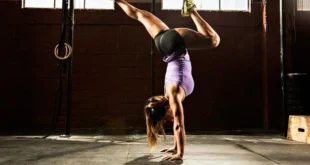
HSPU (Handstand Push Up)
Handstand push-ups, or simply push-ups while doing a handstand. Another move widely used in many wods. It combines strength, endurance, and balance. You’ll need a wall to help support your feet (heels).
Burpee
A CrossFit classic, used in some wods as a penalty if you don’t complete the required reps in time, or as a punishment from your coaches 😉 It’s a combo of a push-up, frog squat, jump, with full hip extension, and respecting the ROM (Range Of Movement), bringing your hands above your head.
Dips
These are the typical dips, either chest dips or triceps dips, depending on how wide you open your arms (wider means more focus on the lower chest). You just need parallel bars. To do a dip, lower yourself until your elbow forms a 90º angle with your arm. It’s best to keep your legs parallel, not crossed, to stabilize your core more easily.
Pull up
The pull-ups we all know, which you can do in two ways: strict (no swinging) for strength work with added weight, or with swinging or kipping, which is the better option during a wod when you need to crank out reps.
Even with swinging, the rule is the same: arms fully extended at the bottom, and chin over the bar.
Muscle Up
This could roughly be defined as a combo of a pull-up and a dip, done in two parts. If you can do a muscle up, you’re definitely closer to the community ;)…
Toes to bar
A pretty straightforward name for what you have to do: hanging from the pull-up bar, bring your toes up to touch the bar. Easy? One rep, yes, but when you need to string together several, it gets tricky and heavily involves your abs and hip-shoulder coordination, which is key to nailing your reps.
Box Jump
Jumping onto a box, bench, hurdle, or elevated platform… Facing the object, feet on the ground, you push off with your legs and hips to land on the elevated surface, fully extending your hips and standing up straight.
Lunge
The backward lunge usually found in leg routines. An important tip is to let the knee of the back leg touch the floor. In a wod, lactate buildup in the leg can be why you don’t finish your reps.
Related Posts