Fitness, Nutrition, Health and Sports Blog In the HSNstore Blog you will find tips about Fitness, sport in general, nutrition, and health – HSNstore.com

Hill series work offers different adaptations to improve your strength and endurance.
This type of hill training is considered specific strength training with the aim of improving the athlete’s momentum and thus improving his efficiency in each stride, his power and, of course, improving his running pace.
For runners, strength work is necessary for the enhancement of other capacities: maintenance of technique levels.
Hill series running training has many benefits:
- Improved thrust force.
- Improved muscular endurance.
- Improved cadence (work on downhill slopes).
- Development of the neuromuscular conditions necessary to achieve greater impulsion and, consequently, an improvement in speed.
- Create conditions for improving running technique even in a high state of fatigue.
- Improved mechanical efficiency.
Running technique on a hill
Any type of terrain that requires a higher intensity than would be required for the same performance on normal terrain can meet the strength gain objectives.
Taking advantage of the characteristics of the terrain offers the possibility to vary training and improve certain physical capacities in order to run better.
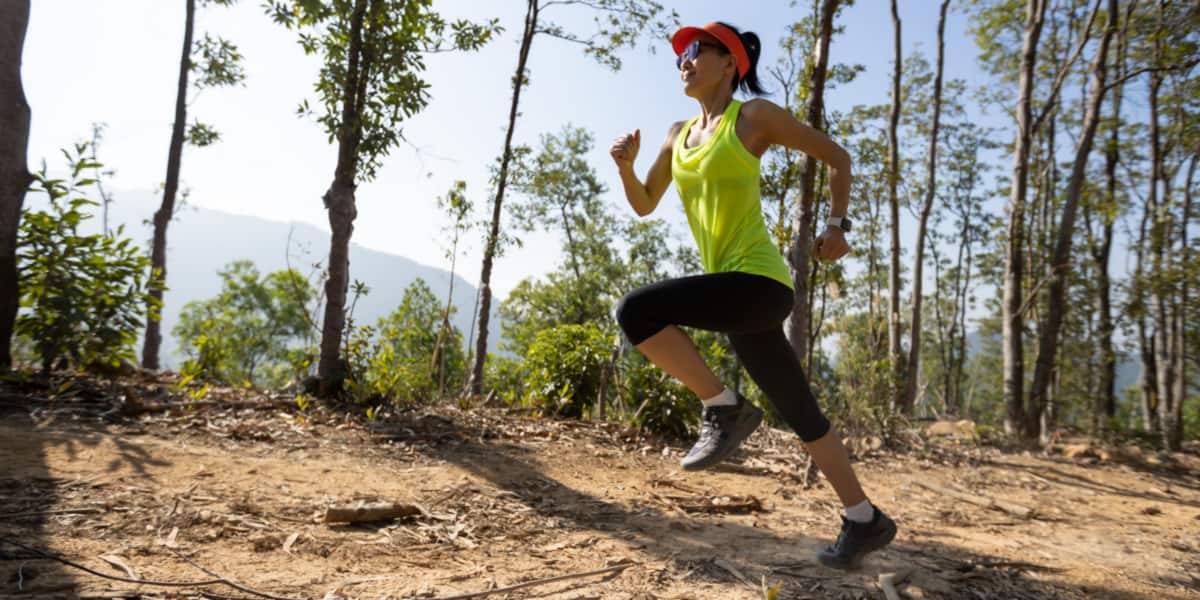
This type of work on inclined terrain, we will have the variables of intensity and duration depending on the objectives pursued with the training.
How to run uphill
In this case, there is a greater incidence of the agonist muscles involved in the impulsion, offering concentric work.
The trunk should remain slightly inclined forward, as the centre of gravity is altered. The foot is supported more naturally from the forefoot, taking slightly shorter steps (as if we were climbing stairs), avoiding lengthening the stride because this will cause greater muscle fatigue.
How to run downhill
In this case, the greatest impact is on the quadriceps, with an eccentric character (this type of work is very necessary for mountain runners), which develops strength to a greater extent.
However, due to an incorrect trunk position (the body tends to lean backwards instead of forwards in favour of the force of gravity), a bad support technique is produced, increasing excessively the braking forces.
Therefore, the body must lean in favour of the slope, taking advantage of the inertia and this will cause an increase in the cadence per minute and also the speed.
Types of hills for series training
Depending on the specific objective we want to work on, also at a metabolic level, we can use long slopes (longer work intervals) or short stretches of slope, as well as their degree of incline (between 5-10 %):
- Short distance hills (50-100 metres) with high gradients between 7-10%: they allow aerobic power work, improvement of pushing strength. Between 100 and 200 metres, approximately 1’ of intense work, is also very interesting for high intensity work.
- Medium and long distance slopes (200-500 metres), but with a lower gradient (4-6%): they allow the development of resistance to fatigue.

Series routine for hill training
When doing hill series training, a good warm-up period is required: gentle jogging at a very aerobic pace for 20-25 minutes.
On a slope with a gradient between 6-10%, we will do sets of several repetitions depending on the fitness level and experience of the participant:
Beginner level:
- 1 set of 5 repetitions of 30-60 seconds at a strong pace on the way up, recovering on the way down with a very gentle jog + 30 seconds of recovery before enunciating the next repetition.
Intermediate level:
- 2 sets of 5 repetitions of 1 minute hard on the way up + recovery of approximately 90 seconds of gentle jogging on the way down.
- Continuous running on regular terrain for 5-7 minutes.
- Repeat a 2nd set of 5 repetitions.
Recovery
Like the series training sessions, this type of hill training session involves a high energy and muscle expenditure. The intensity is very high and the recovery period between sessions must be respected.
Above all, if the series and repetitions have been performed at high intensity focused on downhill-descents, as there is greater muscle damage and, therefore, recovery is more than necessary.

At the level of training but also at the level of nutrition, which must focus on repairing the muscle damage suffered as quickly as possible.
The day after an intense session of uphill series you can do:
- Non-impact cardiovascular training: swimming, cycling, long walks…
- Very low intensity running training on soft and preferably flat terrain.
- Carry out a complementary injury prevention training session, trunk and core strength work.
What equipment do you need for running?
We recommend the following HSN garments that will surely be very useful for you:

HSN technical T-shirt for quick perspiration and wicking away sweat.

HSN Sports Beanie for the coldest days.
References
- “Entrenamiento de la Resistencia”, Mariano García Verdugo; Xavier Leibar, Gymnos Editorial, 1997.
- “La Preparación del Corredor de montaña”, Octavio Pérez, Formación Alcalá, 2014. Pags.176-185.
Related Entries
- Improve endurance and speed with series training.
- Do you know the most important supplements for runners? Find out about them in this Post.
- All about Trail Running read now
- The best way to get started in the world of running is to follow these steps.