Fitness, Nutrition, Health and Sports Blog In the HSNstore Blog you will find tips about Fitness, sport in general, nutrition, and health – HSNstore.com

We tell you the whole truth about ecdysterone and the situation in the dietary supplement market related to it, with all the details including the key measurement method that a company must ensure to be able to confirm that their ecdysterone is not underdosed.
Ecdysterone, Where We Can Find It
Ecdysterone (20-hydroxy-beta-ecdysone, or beta-ecdysterone) is a type of hormone present in insects and a phyto steroid extracted from specific plants.
Ecdysterone is marketed as a dietary supplement from plant extracts rich in this compound, because, thanks to the most recent scientific research, it is attributed possible significant anabolic mechanisms for humans, which would be a competitive advantage in sports performance, and a positive effect for increasing muscle mass in athletes interested in aesthetics.
The most common sources from which ecdysterone is obtained are:
- Cyanotis arachnoidea C.B. Clarke Commelinaceae.
- Rhaponticum carthamoides (Willd.) Iljin Asteraceae.
- Ajuga turkestanica (Regel) Briq. Lamiaceae.
In addition to other less used sources, but which also naturally contain ecdysterone:
- Achyranthes bidentata Blume Amaranthaceae.
- Ajuga multiflora Bunge. Lamiaceae.
- Ajuga reptans L. Lamiaceae.
- Chenopodium album L. Chenopodiaceae.
- Polypodium vulgare L. Polypodiaceae.
- Pteridium aquilinum L. Kuhn Pteridaceae.
- Trianthema portulacastrum L. Aizoaceae.
- Vitex glabrata R.Br. Lamiaceae.
Why the Source of Ecdysterone Is Not a Relevant Factor?
A common debate among athletes, sports doctors, and users of ecdysterone dietary supplements is which of all the plant sources it is obtained from is better.
However, this debate is incredibly empty and denotes a lack of control of basic concepts of plant extracts, but at HSN we are going to explain why with a simple example:
What is more effective, the caffeine in coffee or in tea?
And if the answer to this question is that tea does not have caffeine, but it has theine, I will tell you it’s the same substance: 1,3,7-Trimethylxanthine; it’s just called differently depending on the source that contains it, but both are caffeine/theine.
You might naturally respond that the caffeine from coffee is more effective than that of tea; just as there are people who justify that ecdysterone from one plant is more effective than from another, however, this is a mistake.
In relation to the effects of the compound, it is the same compound that has the properties attributed to it.
The difference in sources lies in which plant may be naturally more concentrated in the compound of interest; this occurs with plants that contain ecdysterone, some are more concentrated than others in ecdysteroids, but…
You don’t take the plant as is, right? The capsules of your dietary supplement are not plant powder, right? They are standardized.
When two extracts, from two different plants, have equivalent standardization:
- For example, 95% ecdysterone, the reasoning of concentration no longer applies.
Quantification of Ecdysterone Content: HPLC vs UV. Differences
One of the big problems with ecdysterone is that its effectiveness has been questioned numerous times, but the reason for this questioning is the low quality of many of the dietary supplements that are marketed, especially when they are products of extra-European manufacture.
Studies such as those carried out by Isenmann et al. (2019) show that the ecdysterone content of market products is much lower than actually indicated, in fact in the sample used for their study it was observed that each capsule was underdosed by 94% regarding the ecdysterone content it claimed to have (100mg) vs 6mg real. This is a downright deception.
The reason this happens is because of the measurement method, that is, the ecdysterone content of a product is determined using laboratory methods that allow knowing its content, this content can be the natural one of the plant or that of any extract.
Normally the ecdysterone contribution that is sought to standardize is 90-95%.
However, one of the methods most used to determine it is an inadequate method, which is ultraviolet-visible spectroscopy (UV). This analysis method consists of the application of magnetic radiation that, depending on the absorption ratio that the sample has, allows quantifying and determining the content of molecules and functional compounds.
While this measurement method serves and is indicative for many substances, it is also very imprecise in the case of ecdysterone, since since these plants contain many other ecdysteroids with absorbances at wavelengths equivalent to ecdysterone, the amount of radiation that the sample absorbs is much greater “falsely”, which means that a very high ecdysterone content can be standardized when actually its contribution is very low, as we could see with the study of Insenmann;
This is because other ecdysteroids “camouflage” as if they were ecdysterone in the UV analysis, and this is not at all precise, giving unreal inflated results of the active.
In other words: HPLC is the method that must be used and the only one that guarantees the declared amount, it is something you can and should ask to know for sure that what you are using is legitimately ecdysterone, and the ecdysterone content is authentically indicated on the label.
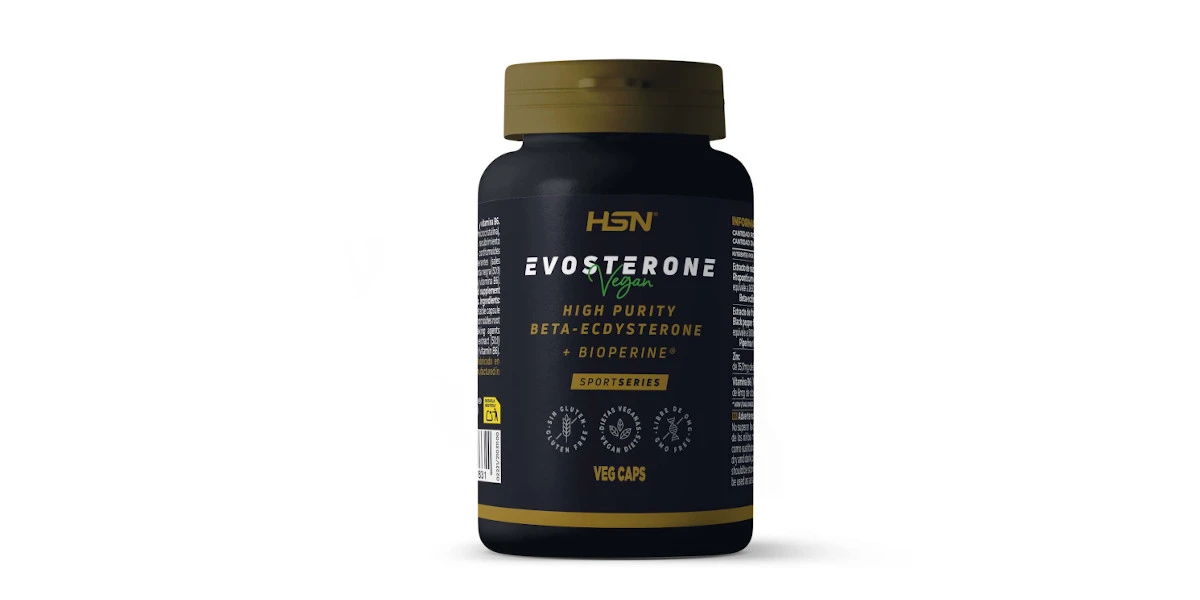
Evosterone (95% by HPLC) by SportSeries
Cost of Raw Materials – Don’t Be Deceived
You might naturally ask yourself after reading all this, which is…
Then why aren’t all extracts standardized in ecdysterone measured by HPLC?
Because the price is much more expensive, but much, much more.
Being a more specific detection method, which requires more tools and more technical knowledge to perform correctly, the raw materials whose ecdysterone content is determined by HPLC are much more expensive.
If determination by HPLC were not necessary, because other analyses like spectrophotometry or gasometries, which are cheaper, were effective, it would not be necessary to carry out such expensive analyses as HPLC, but it is necessary in this case because no cheaper determination method is effective.
Companies that use methods like UV are “confusing” their consumers:
- Either deliberately because they know this;
- Or unconsciously because they do not even know that the UV measurement method is ineffective to determine its content in ecdysterone (as a separate compound from other ecdysteroids).
In any case, the extracts standardized in ecdysterone by UV are not reliable since their ecdysterone content can be from 0 to an unknown value, but always (much) lower than declared.
When we talk about the cost of raw materials, we are talking about that 1kg of a plant extract, whether Cyanotis arachnoidea or Rhaponticum carthamoides, presents a 2.5 to 9 times greater cost difference, between HPLC and UV measurement.
That’s why many companies use UV extracts, because their production cost is much lower, but unfortunately, this conditions their effectiveness, so in our case we prefer, as always, to opt for quality, and pay the cost of a raw material that really guarantees the content that is declared.

Market Products and Realities, What Is and What Is Not Possible?
Most of the dietary supplements on the market, sell ecdysterone analyzed by UV, almost all of the products you are going to find use cheap raw materials standardized following spectrophotometry analysis methods, which has the associated problems we have been discussing above.
When evaluating the manufacturing cost of a dietary supplement we have to analyze not only the cost of the raw material as such, but also that of the other ingredients (the additives, the fillers, the capsules, etc.), the materials for the containers, the laboratory that manufactures the supplement (since unlike HSN, most companies in Spain do not have their own factory), the transport companies that distribute the
product in its different stages of the production process, other intermediaries in the process and the retail outlets; in addition to the margin for the brand…
But in any case, and without going into such evaluations, simply think about the cost of the raw material for a certain X amount of extract, analyzed by HPLC, in a specific number of capsules, there are product prices offered on the market that do not correspond with the cost they should have, which generates doubts about the quality of the raw material and/or the manufacturing process of the product.
Bibliographic References
- Zimmer, A. R., Bruxel, F., Bassani, V. L., & Gosmann, G. (2006). HPLC method for the determination of ecdysterone in extractive solution from Pfaffia glomerata. Journal of pharmaceutical and biomedical analysis, 40(2), 450–453. https://doi.org/10.1016/j.jpba.2005.07.016
- Todorova, V., Ivanov, K., Karcheva-Bahchevanska, D., & Ivanova, S. (2023). Development and Validation of High-Performance Liquid Chromatography for Identification and Quantification of Phytoecdysteroids Ecdysterone and Turkesterone in Dietary Supplements. Processes, 11(6). https://doi.org/10.3390/pr11061786
- Isenmann, E., Ambrosio, G., Joseph, J. F., Mazzarino, M., de la Torre, X., Zimmer, P., … Parr, M. K. (2019). Ecdysteroids as non-conventional anabolic agent: performance enhancement by ecdysterone supplementation in humans. Archives of Toxicology, 93(7), 1807–1816. https://doi.org/10.1007/s00204-019-02490-x
Related Posts