 Fitness, Nutrition, Health and Sports Blog In the HSNstore Blog you will find tips about Fitness, sport in general, nutrition, and health – HSNstore.com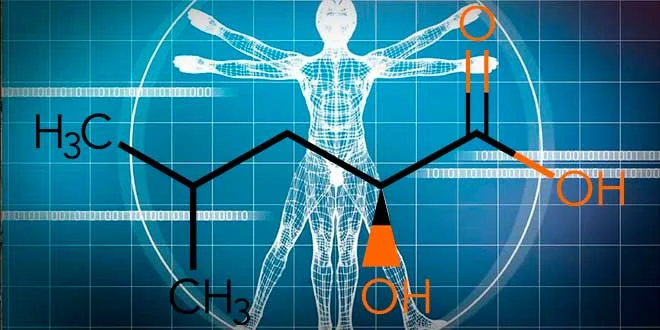

Today we’re checking out a supplement known as HICA (Leucic Acid), which is actually a metabolite of the amino acid Leucine
Most people know that leucine, one of the 3 branched-chain amino acids, has a powerful effect stimulating muscle protein synthesis. This is crucial when we talk about training adaptations, which is why athletes can really benefit from taking it.
Importance of Leucine
We can get it from high biological value protein sources, but probably the best example due to its high digestibility and leucine content is whey protein.
Likewise, many studies suggest that not only does leucine act as a muscle-building booster or help preserve it during tougher times (calorie deficit, high training volume, or even illness), but some of its metabolites might trigger a similar or even stronger effect.

What is HICA (DL-α-hydroxy-isocaproic acid or alpha-hydroxy-isocaproic acid)?
HICA (also called Leucic Acid) is another leucine metabolite that, according to some research, could play an anticatabolic and anabolic role, meaning:
Prevent muscle loss and improve its synthesis

This substance is mainly produced in muscle and connective tissue after leucine’s full metabolic processing
Study on Leucic Acid HICA
The main issue when talking about this substance is the scarce literature available, as there’s only one published study where it was used as a nutritional supplement in humans (Mero et al., 2010).
Study methodology and design
They followed a double-blind, randomized, placebo-controlled design, with 15 subjects split into 2 groups taking either HICA or maltodextrin (placebo).
Study done on football players taking HICA (alpha-hydroxy-isocaproic acid)
The intervention group took 583 mg of HICA sodium salt (500 mg of HICA) combined with juice or water, while the control group took 650 mg of maltodextrin also combined with water or juice. These supplements were taken 3 times a day, totaling 1500 mg of HICA daily in the experimental group.
Training and nutrition
Subjects did between 5 and 7 training sessions per week, including 3-4 football sessions and 1-2 strength training sessions (max strength and power). Diet wasn’t controlled, just recorded. This estimated an average protein intake of between 1.6 and 1.7 g/kg body weight per day.
Measurements: Blood parameters, body composition, and performance were assessed before and after the 4-week intervention.
Results
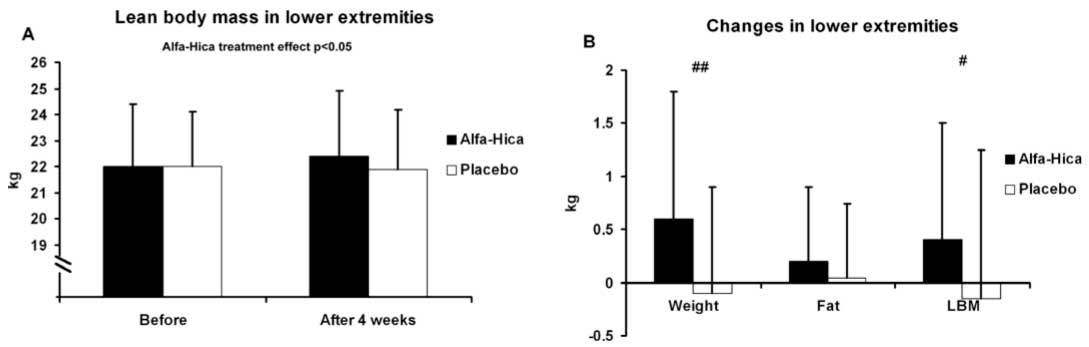
According to the study authors, participants in the experimental group gained a total of 400 g of lean mass in the lower limbs, while those in the placebo group lost 150 g of lean mass (Charts A and B).
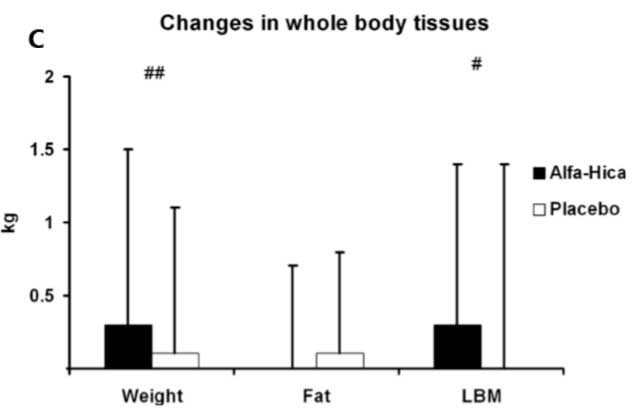
This meant a significant increase in total lean body mass in the supplemented group compared to placebo (Chart C).
Despite these body composition improvements, no performance gains were seen, although it seems DOMS symptoms were lower in the HICA group.
Discussion and conclusions
Looking at these results, we might think HICA is an effective supplement to promote muscle growth. However, there are serious limitations to confidently say it’s truly functional.
First, as mentioned at the start, scientific literature backing its effectiveness is very limited, since besides the study described here, there’s only one other by the same authors that hasn’t been published.
In that study, HICA only improved DOMS in a group of wrestlers. The mechanisms behind this effect are still unknown.
Focusing on this research, the training protocol wasn’t optimal to see muscle mass gains, as the average strength training sessions were just 4 over the 28 days.
Also, a 28-day period is too short to extrapolate long-term results, so more studies are needed.
Another point is that the study distinguishes between lean and fat mass, but we can’t know which exact lean mass fraction mostly caused the increase. The weight gain could be from more glycogen, muscle tissue, or even fluids.
Recent Studies
In fact, a recent study (Naviaux et al., 2016) performing a metabolomic analysis in patients with chronic fatigue syndrome (CFS) compared to healthy individuals found that HICA levels were decreased in the sick subjects.
Whether supplementing with this metabolite could improve symptoms linked to this condition should be the focus of future research.

How to take Leucic Acid HICA?
If you decide to take it, you could follow the doses used in studies so far, that is, 1500 mg split into 3 doses of 500 mg, since this amount has proven safe in humans.
Conclusions
Sources
- Ojala et al., α-hydroxy-isocaproic acid (HICA). Effects on Body Composition, Muscle Soreness and Athletic Performance. Nutrition and Enhanced Sports Performance. Muscle building, Endurance and Strength.
- Mero et al., 2010. Effects of alfa-hydroxy-isocaproic acid on body composition, DOMS and performance in athletes.
- Naviaux et al., 2016. Metaboic features of Chronic Fatigue Syndrome.
- Leucic Acid
- HICA, The next big thing?
Related Posts
- BCAAs or Branched-Chain Amino Acids – Effects, Contraindications and How to Take Them
- Amino Acid Dosages: How and When to Take Them