 Fitness, Nutrition, Health and Sports Blog In the HSNstore Blog you will find tips about Fitness, sport in general, nutrition, and health – HSNstore.com

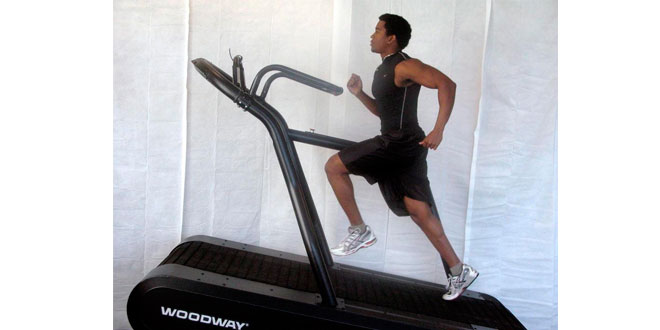
Training on an inclined treadmill has been used for a while as a key interval training tactic for runners. Naturally, at the same speed, the higher the incline, the greater the calorie burn and energy demand.
One of the most common questions might be exactly what speed to run on an inclined treadmill to match the energy expenditure, time to fatigue, and lactate buildup of running on flat ground.
To set that comparable speed, you’d need to know the maximum oxygen consumption (VO2max) from one of the usual flat-ground tests, always under a professional’s supervision. From those results, you can find the max running speed on flat ground during VO2max, which can be maintained for a max time (Tmax).
When running on a treadmill with a fixed incline (10%, for example), a certain running speed can be kept for a max time before fatigue forces you to slow down. Well, according to the data, when comparing speeds at 65, 70, 75, 80, and 85% of the max running speed on flat ground during VO2max, the one that correlated best was V inclined = 68% V max at VO2max.
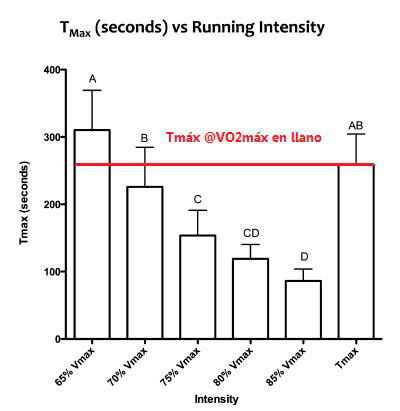
This means that on a treadmill with a 10% incline, running at 65-70% of the max speed recorded on flat ground during VO2max would have similar effects on the overall physiological response.
Practical use through heart rate
Lack of access, mostly due to lack of knowledge and/or financial reasons, to quality medical check-ups can limit the practical use of these considerations for most people (though it would definitely be a good investment). However, what’s also important from the above is that heart rate turned out to be a reliable variable to focus on.
During exercise at VO2max intensity, several criteria are used to end the test and establish VO2max. One is the flattening of the VO2-time curve by at least 300 ml/min or no increase in VO2 with increased load. Usually, this comes with a plateau in heart rate and a sharp drop, as you can see in the table below:
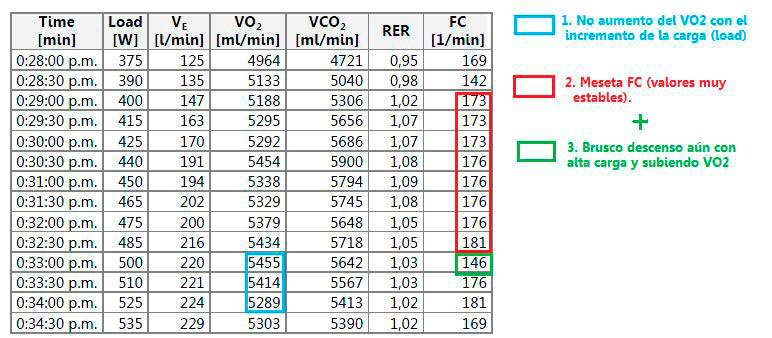
Knowing this heart rate condition, you could use a heart rate monitor to check that the running speed on an inclined treadmill has similar effects to flat ground on the overall physiological response, if the time to reach a heart rate equal to the plateau HR is the same as on flat ground.
Although training monitoring and evaluation should be done through several indicators, just analyzing HR is a “good” marker (not the best) of health status, and can be very useful for controlling and tracking training adaptation. It’s better than nothing, but remember its variability depends on the person’s training status and its interpretation has important limits, for example, when relating it to the combined activity of the sympathetic and parasympathetic systems.
Practical example
Assuming on flat ground:
- Including warm-up, it takes 29 min to reach the HR plateau (175-176 bpm) with a 4-5 minute maintenance followed by a sharp drop (this should be the reference point if you only have a heart rate monitor).
- At that moment (VO2max would have been reached), the max speed on flat ground was 20 km/h.
To match the effects of those 4-5 minutes at VO2max on a 10% inclined treadmill, the speed should be about 68% of the max flat ground speed, that is, 13.6 km/h.
Sources
- Ferley, D. D., & Vukovich, M. D. (2015). Time-to-fatigue During Incline Treadmill Running: Implications for Individualized Training Prescription. Journal of Strength and Conditioning Research, 29(7): 1855–1862.
Related posts