Fitness, Nutrition, Health and Sports Blog In the HSNstore Blog you will find tips about Fitness, sport in general, nutrition, and health – HSNstore.com

I’ve always wanted to talk about the myth of whether insulin makes us obese. To do this, we analyze the relationship between high insulin levels and whether they also correspond with glucose levels to draw conclusions.
High-Fat or High-Carb Diet
This is a topic I’ve defended from both sides, meaning, at one point I stood by high-fat diets as healthy and now I have to switch sides and defend that high-carb diets help us lose the same fat.
Anyone who knows me knows my ideal diet is “low carb”, but for reasons beyond fat loss, like cholesterol, fasting glucose, higher mitochondrial levels (the furnace where fat burns), or simply to reduce inflammation.
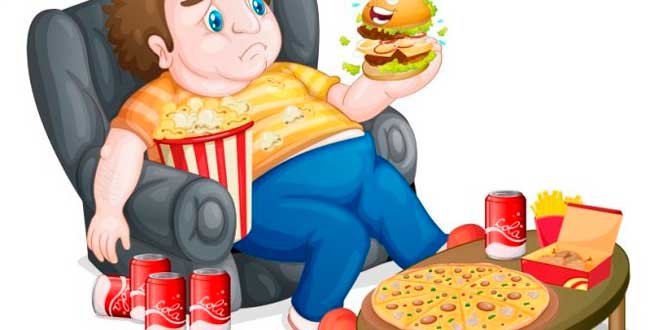
Myth 1: Low-Carb Diets Make You Lose More Fat Than Most Diets
This is the most repeated myth nowadays. As I mentioned above, I’m not a fan of diets where carbs make up 70% of daily calories, as many nutrition heavyweights recommend, but when it comes to body composition, luckily it doesn’t change much.
If years ago fats were blamed for overweight and cardiovascular diseases, now carbs are…
Studies: High-Fat Diets VS High-Carb Diets
When we look at studies comparing high-fat diets to high-carb diets, we find this:
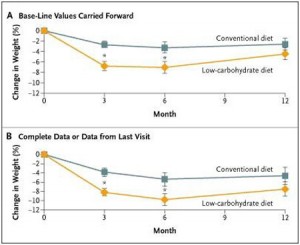
As we can see, people on a low-carb diet lost more weight compared to the conventional diet, but by 12 months the difference becomes much smaller.
This is because in most studies, low-carb diets have higher protein intake, which helps fat loss, and secondly, a loss of water since glycogen stores decrease.
We need to understand that on average, 1g of glycogen stores 3-4g of water (which is why many say creatine makes you gain weight, a concept that’s “bullshit“). In this study, however, people on low-carb diets had better lipid profiles (cholesterol), one of the reasons I support low-carb.

Myth 2: Ketogenic or Very High-Fat Diets Don’t Make You Gain Weight Because They Don’t Raise Insulin
For this myth, we need to split it into two parts:
- High-fat diets make us gain weight more easily
- Insulin also rises with fat
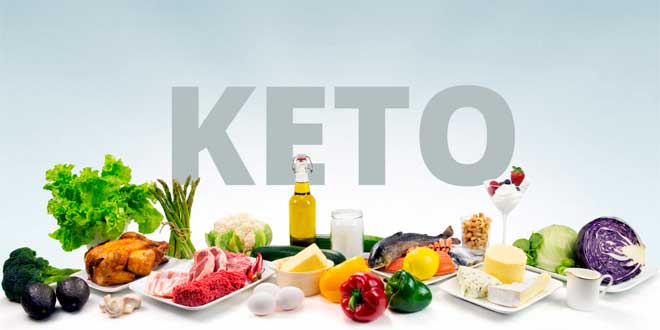
In fact, excess fat accumulates 20% more than the same amount of carbs.
When we follow a high-fat diet and exceed calorie intake, it accumulates as body fat through ASP (Acylation Stimulating Protein).
This happens because part of the excess carbs is stored as glycogen and part is oxidized by cells due to decreased lipolysis (the process that breaks down fat).
Fat Accumulation
In the case of excess fat and its stimulation of ASP, there’s an increase in glucose transport to fat cells (where fat is stored), insulin release increases, as I mentioned in point 2, and fat breakdown in the liver decreases.
In fact, as we see in the study, the body doesn’t need insulin to store fat
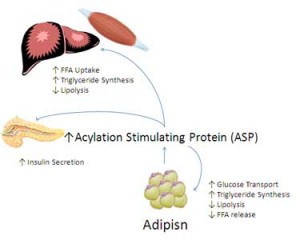
Regarding point 2, any macronutrient can raise insulin—carbs, fat, or protein. As shown in the study “An insulin index of foods: the insulin demand generated by 1000-kJ portions of common foods”.
Sedentary Lifestyle and Fat Gain
First, we need to understand that when carbs are ingested and absorbed into the bloodstream, they are transported to muscle and liver.
This process varies a lot between people due to insulin sensitivity and physical activity, meaning athletes’ cells can use glucose more efficiently than sedentary people, since their GLUT4 (glucose transporter) levels are higher.
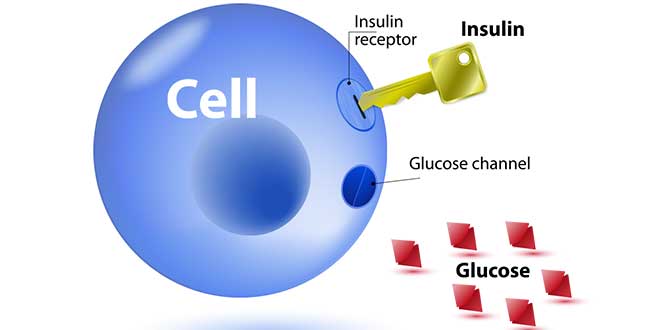
Also, sedentary people have cells that can oxidize fewer carbs, causing their tissues to become less sensitive to glucose, producing resistance and carbs being stored as fat (this is where the need for exercise starts to show).
De Novo Lipogenesis
It’s important to highlight that de novo lipogenesis (the conversion of carbs to fat stores) doesn’t happen overnight, so those “cheat days” won’t affect our body fat percentage; it takes several days of that intake for this to occur.
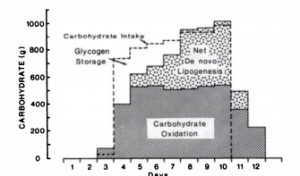
Even consuming over 600 g/day of carbs doesn’t lead to fat storage since most is used for cellular fuel and glycogen replenishment, only when these are full does fat synthesis begin.
What About High-Fat Diets?
In high-fat diets, GLUT4 decreases, increasing glucose resistance, which makes sense since cells will use whichever macronutrient is in excess.
So, high-fat diets lead to more fat use, and high-carb diets use glucose. However, exercise increases these receptors, so it’s not a big deal for active people.
 It’s worth noting that in high-fat diets, fat storage can also happen through PGC-1b and ASP, mentioned earlier.
This mechanism is very efficient, one of the main reasons it’s easier to gain fat on HYPERCALORIC high-fat diets than on carbs (always talking about unprocessed foods).
- Physical activity greatly affects metabolic processes on glucose and fat by acting on ppar, adiponectin, leptin, glucagon, and adrenaline
- Obesity is linked to refined sugars, not insulin.
We’ll focus on point 2, which in my opinion causes the most confusion.
Insulin and Blood Glucose
High glucose levels lead to high insulin levels, but high insulin levels don’t mean high glucose levels.
This paradox happens because insulin rises with any macronutrient we eat, and it can even rise more when combined with protein than with carbs alone.

Now, do these high insulin levels translate to higher blood glucose? The answer is no.
The Role of Protein
As we see in the next graph, the combination of Whey+Lactose results in one of the lowest glucose levels, just like milk, which ironically are two of the most banned foods in diets because they “hinder fat loss.”
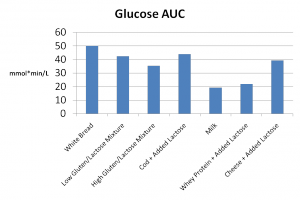 This tells us protein is an excellent insulin booster,
However, it’s the macronutrient that helps us most with fat loss since it preserves muscle mass, reduces hunger much better than carbs or fats (greater satiety), and has the highest thermogenic effect of the three.
Conclusions
As we’ve seen, high insulin levels aren’t always linked to high glucose levels, and increasing protein intake can lead to 50% more fat loss.
Sources
- (Foster GD, et al. A randomized trial of a low-carbohydrate diet for obesity. New England Journal of Medicine, 2003.
- (Apparent absence of stroke and ischaemic heart disease in a traditional Melanesian island: a clinical study in Kitava
- Cardiovascular risk factors in a Melanesian population apparently free from stroke and ischaemic heart disease: the Kitava study
- Low serum insulin in traditional pacific islanders—The Kitava study
- Age relations of cardiovascular risk factors in a traditional Melanesian society: the Kitava Study.
- Effect of acylation stimulating protein on the triacylglycerol synthetic pathway of human adipose tissue
- Enhanced triglyceride clearance with intraperitoneal human acylation stimulating protein in C57BL/6 mice.
- Acylation stimulating protein stimulates insulin secretion
- Targeting the signaling pathway of acylation stimulating protein
- An insulin index of foods: the insulin demand generated by 1000-kJ portions of common foods.
- Lund S., Holman G. D., Schmitz O., Pedersen O. (1995) Proc. Natl. Acad. Sci. U. S. A. 92:5817–5821.
- Rosholt M. N., King P. A., Horton E. S. (1994) Am. J. Physiol. 266:R95–R101
- Lund S., Holman G. D., Schmitz O., Pedersen O. (1993) FEBS Lett. 330:312–318
- Suppression of GLUT4 expression in skeletal muscle of rats that are obese from high fat feeding but not from high carbohydrate feeding or genetic obesity.
- Hyperlipidemic effects of dietary saturated fats mediated through PGC-1beta coactivation of SREBP.
- Review Metabolic control through the PGC-1 family of transcription coactivators.Lin J, Handschin C, Spiegelman BM
- Cardiovascular risk factors in a Melanesian population apparently free from stroke and ischaemic heart disease: the Kitava study.Lindeberg S, Nilsson-Ehle P, Terént A, Vessby B, Scherstén B.
- http://www.staffanlindeberg.com/TheKitavaStudy.html
- Insulin: An Undeserved Bad Reputation, Part 3…MOOOOO!!!!
- Protein, weight management, and satiety.Douglas Paddon-Jones, Eric Westman, Richard D Mattes, Robert R Wolfe, Arne Astrup, and Margriet Westerterp-Plantenga
- An insulin index of foods: the insulin demand generated by 1000-kJ portions of common foods.Holt SH, Miller JC, Petocz P.
- Effect of whey on blood glucose and insulin responses to composite breakfast and lunch meals in type 2 diabetic subjects
- Diet-induced thermogenesis and substrate oxidation are not different between lean and obese women after two different isocaloric meals, one rich in protein and one rich in fat.
Related Posts
- Keeping Insulin Low to Lose Fat?
- Insulin Sensitivity and Diet