 Fitness, Nutrition, Health and Sports Blog In the HSNstore Blog you will find tips about Fitness, sport in general, nutrition, and health – HSNstore.com
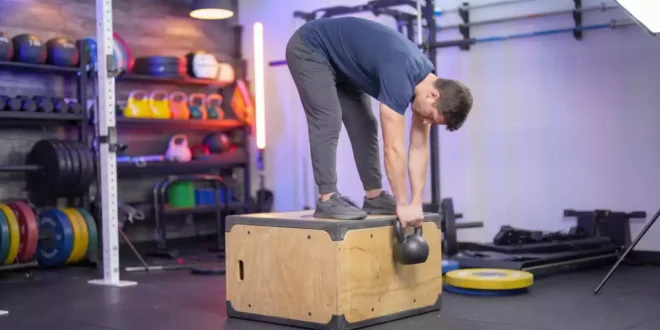


The Jefferson Curl is a weighted strength and mobility exercise that, although less well-known than others, has plenty to offer your training. It works the posterior chain and spinal mobility in a controlled manner and can help you increase your range of motion.
Before attempting it, work on your mobility and posterior chain strength, especially if you spend many hours sitting down. By following these steps, this exercise can become a valuable addition to your training and performance.
How to Perform the Jefferson Curl Step by Step
- Stand upright with your feet together and your legs straight. If you want to increase the range of motion, you can stand on a bench or raised surface (optional).
- Hold the weight (kettlebell or barbell) with your arms extended. If using a barbell, position your hands approximately shoulder-width apart.
- Flex your neck by bringing your chin towards your chest to begin lowering your upper body slowly.
- Flex your torso one vertebra at a time, allowing the weight to guide the movement in a controlled manner. Your knees may remain slightly bent.
- Keep your weight evenly distributed across your feet, without shifting it entirely onto your heels, and avoid suddenly leaning backwards.
- Create a smooth, even curve through your spine, drawing your belly button towards your back.
- Relax your shoulders and avoid lifting your head to look forwards.
- Return to the upright position one vertebra at a time, starting from the lower part of your spine.
- Keep your chin close to your chest until the final phase of the movement.
- Once you have finished, return your head to a neutral position.
Jefferson Curl Sets and Repetitions
This is an advanced exercise, so it is important to progress gradually:
- If you are performing it for the first time: start without any additional weight or with a minimal load, performing 2-3 sets of 5-6 slow repetitions with approximately 60-90 seconds of rest between sets.
- If you have experience and good movement control: perform 2-3 sets of 6-8 repetitions with a light load, increasing the weight only gradually.
Muscles Worked by the Jefferson Curl
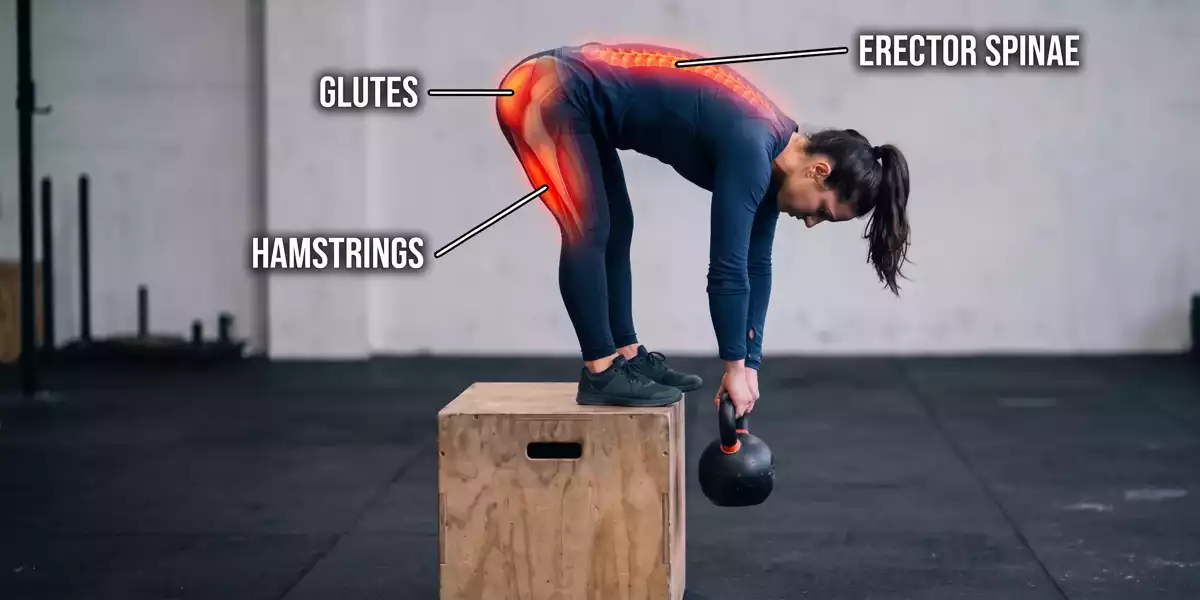
This exercise primarily engages the hamstrings, glutes and spinal erectors (posterior chain), while also requiring thoracic spine mobility and motor control.
Jefferson Curl Progression
As this is an advanced exercise, the best approach is to progress through different stages, only moving on to the next once you have mastered the previous one:
- Stage 1: No additional weight. Practise the full movement using only your body weight, moving one vertebra at a time at a slow pace. If you struggle to control the movement, remain at this stage.
- Stage 2: Minimal load. Add a very light weight (an unloaded barbell or a small kettlebell) while maintaining the same quality of movement.
- Stage 3: Gradually increase the load. Increase the weight little by little, but only if you can control the entire range of motion without compensatory movements.
- Stage 4: Greater range of motion. Once you have mastered the technique, you can stand on a bench or raised surface to increase your range of motion.
Common Mistakes
- Using too much weight: the load should be light enough to allow you to control the entire movement.
- Lowering your torso too quickly instead of moving one vertebra at a time.
- Forcing a range of motion you cannot control: only lower yourself as far as you can while maintaining control.
- Lifting your head to look forwards during the movement.
Can the Jefferson Curl Cause Injuries?
The Jefferson Curl is a subject of some debate. It requires a high level of motor control, thoracic spine mobility and posterior chain strength, and poor technique or excessive loading can be counterproductive. For this reason, it is considered an advanced exercise and is not suitable for everyone. If you have back pain or have previously suffered an injury, consult a qualified professional before attempting it.
Tip: gradual progression is essential. Start by practising the spinal movement without any additional weight, then introduce resistance gradually without overloading yourself.Related Articles
- Have You Heard of the Platón Curl?
- How to Perform the Nordic Curl Correctly