Fitness, Nutrition, Health and Sports Blog In the HSNstore Blog you will find tips about Fitness, sport in general, nutrition, and health – HSNstore.com

Blood pressure is a cardiovascular parameter that reflects changes in cardiac output (Q), heart rate (HR), and peripheral vascular resistance (PVR).
- PVR are the forces opposing blood flow by narrowing arterioles, and they’re controlled by the autonomic nervous system. An increase in peripheral vascular resistance will raise pressure in the arteries, and vice versa.

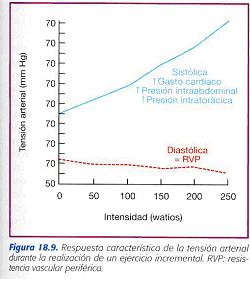
Systolic blood pressure (SBP) and diastolic blood pressure (DBP) show different responses during exercise depending on the type of exercise, dynamic or static.
- SBP depends on Q and will always increase during dynamic exercise.
- DBP barely changes in dynamic exercises but will increase in static (strength) exercises. Peripheral resistance is the main factor here.
Incremental dynamic exercises
- SBP rises in direct proportion to output (max values between 200-250 mm Hg in healthy, endurance-trained subjects). This SBP increase is linked to the rise in Q during exercise.
- DBP changes little in dynamic exercises due to local muscle vasodilation. If it exceeds 115 mm Hg during aerobic stress tests, the test is stopped.
- The difference in increases (ΔSBP – ΔDBP) should grow since SBP rises more than DBP.
SBP is higher the smaller the muscle mass involved at the same exercise intensity (arms vs. legs). Less muscle mass worked also means smaller blood vessel size.
Constant load dynamic exercises
Blood pressure changes depending on the power output, training level, and individual characteristics. SBP can reach a steady-state phase.
Recovery and adaptation to dynamic endurance training
SBP recovers quickly, just like Q and HR, and can even drop below resting values (exercise hypotensive response) lasting up to 12 hours. Blood pooling in the viscera and/or lower limbs might be one cause. This is the theoretical basis for recommending multiple daily dynamic exercise sessions for hypertensive individuals.
In general, endurance training lowers resting SBP and during submaximal exercises, and reduces DBP and MAP (mean arterial pressure) during maximal exercises. This happens because training promotes renal Na+ excretion, reducing blood volume and SBP.
Static or strength exercises
They increase both blood pressure components (systolic and diastolic) through the following process:
- During an isometric contraction and/or concentric phase, muscles compress peripheral arteries, reducing local blood flow proportional to the percentage of maximal voluntary contraction (%MVC).
- This causes an increase in DBP during the static phase.
- Catecholamine action leads to an increase in SBP.
The magnitude of the BP response depends on the force and muscle mass involved (max SBP values reported up to 400 mmHg). Strength training causes big rises in SBP and DBP that don’t cause resting SBP and DBP elevations and can even reduce them.

If you also understand the effect of diet on blood pressure, you can improve your lifestyle and health by combining diet and exercise. Remember, hyper/hypotension can be prevented and even reversed.
Sources
- American College of Sports Medicine. (2008). Manual de consulta para el control y la prescripción del ejercicio (Vol. 44). Barcelona. Editorial Paidotribo.
- López, J., & Fernández, A. (2006). Fisiología del ejercicio. Madrid: Panamericana.
- Wilmore, J. H., & Costill, D. L. (2004). Fisiología del esfuerzo y del deporte. Barcelona. Editorial Paidotribo.