Fitness, Nutrition, Health and Sports Blog In the HSNstore Blog you will find tips about Fitness, sport in general, nutrition, and health – HSNstore.com

To know if an exercise and diet program is working properly, the most commonly used method due to its simplicity and availability is weighing yourself. Also, anthropometric measurements like taking perimeters, contours, and skinfolds, as well as bioimpedances, are other methods put into practice.
Not long ago, a somewhat questionable experiment was carried out to show the general public the percentage of validity of these procedures and raise awareness that it’s not all about fat loss or lean mass gain.
A sports scientist, Ross Edgley, decided to put himself to the test with the following protocol:
- phase 1: weight loss in 1 day
- phase 2: recovery of lost weight in 1 day.
Phase 1: Weight loss
For a whole day, Ross followed a carb-free diet, water, and salt, exercising, using slimming belts, garments to facilitate water loss, and saunas with the goal of losing as much weight as possible.
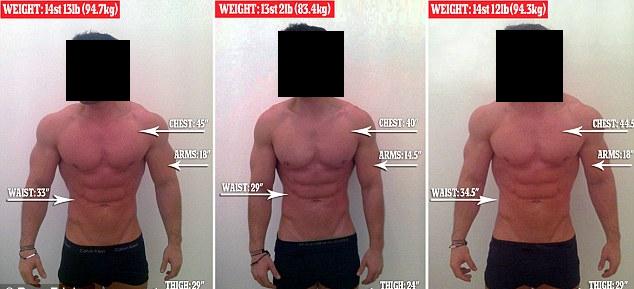
The result was more than remarkable, as in 24h he lost around 11 kg. Here’s the before and after of his first day:

Phase 2: Recovery of lost weight
The next day, Ross, after calculating the necessary intake of food and water, set the goal to recover the lost weight. The protocol he followed was:
- Water loading: 1 liter of water enriched with carbs, electrolytes, and vitamins per hour (18 liters in total, since he slept 6 hours). We have to remember that 50-70% of our body weight is made up of water, so this strategy allowed him to recover quite a bit of weight.
Also, micronutrients (minerals and vitamins) have as one of their main functions regulating body fluids, helping maintain blood pH balance within a healthy range and creating electrical impulses for all aspects of physical activity.
Since the day before Ross had literally dehydrated, he needed to replenish these electrolytes as soon as possible.
- Specific sodium loading: Adding salt to most meals helps the body retain the ingested water better due to sodium.
- Carb loading: Rice, bread, cereals, oats, pancakes, bars, simple sugars, junk food… were the main base of the diet to recover and increase muscle glycogen.
- No exercise.
The result was the gain, again, of the weight lost the previous day (11 kg).

Conclusions
The main conclusion, and the goal of the experiment, is that body measurements fluctuate due to many factors beyond fat or lean mass. Weighing yourself often (daily, every two days, etc.) or regularly using any other measurement methods listed at the start aren’t the best strategies to assess progress in a program.
So… how often should I weigh/measure myself?
There’s no set time range, but it could be appropriate to:
- Weigh yourself once a week or every two weeks, always under the same conditions and preferably at the same time.
- Take anthropometric measurements every mesocycle (6-8 weeks), always under the same conditions and preferably at the same time.
- Get a bioimpedance every mesocycle (6-8 weeks). This method is highly influenced by water intake.
Also, the question shouldn’t be about the exact fat percentage or the exact kilos lost or gained, but about the overall direction of the program: “Is it working for my goal?”. That’s why daily assessments don’t really provide useful data.
Sources
- López Chicharro, Fernández Vaquero (2006). Exercise Physiology. 3rd edition. Ed. Médica Panamericana. Madrid.
- Sirvent Belando, Garrido Chamorro. (2009). Anthropometric assessment of body composition: Cineanthropometry. University of Alicante.
- http://www.dailymail.co.uk/health/article-2510097/Ross-Edgley-lost-2-stone-24-hours-ON-DAY.html (Last visited November 21, 2013).