Fitness, Nutrition, Health and Sports Blog In the HSNstore Blog you will find tips about Fitness, sport in general, nutrition, and health – HSNstore.com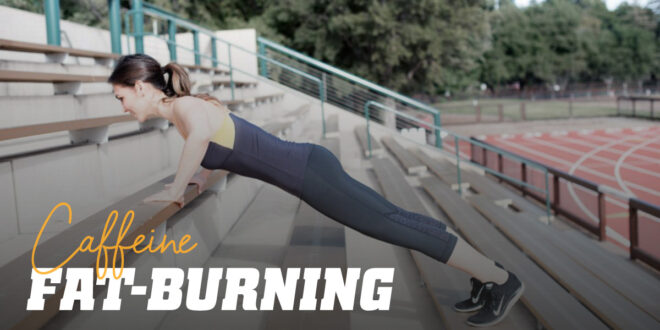

How many times have you thought that the first step is the hardest one when it comes to training? Then you realise and are pleased to see that it is precisely in that moment of sluggishness that an optimal pre-workout activates and motivates you enough to perform an effective and quality workout. Who do you owe it to? Perhaps it’s the caffeine.
Caffeine improves performance and fat loss
Caffeine is a world-famous molecule with a legion of sports fans. It’s not every day that you meet a powerful stimulant of its size, which helps to reduce the feeling of fatigue and has a lipolytic effect, especially if you take it as a pre-workout.

Why take it before training?
Caffeine is probably the most sought-after of all stimulants and the sports world is no stranger to it. In fact, it is surprising how many pre-workout supplements incorporate it.
With such strong credentials, it is not surprising that many researchers have studied its effects in the peri-workout (pre-, intra- and post-workout time period), compared to a high-carbohydrate drink.
The result? It was observed that, after one hour of pre-workout caffeine consumption, oxygen consumption and the use of free fatty acids (FFA) as an energy source increased. In other words, caffeine promoted fat utilisation by the cell.
There is a possibility that this effect on lipid metabolism may contribute to the oxidation of more fat throughout the day, thereby improving performance and body composition.
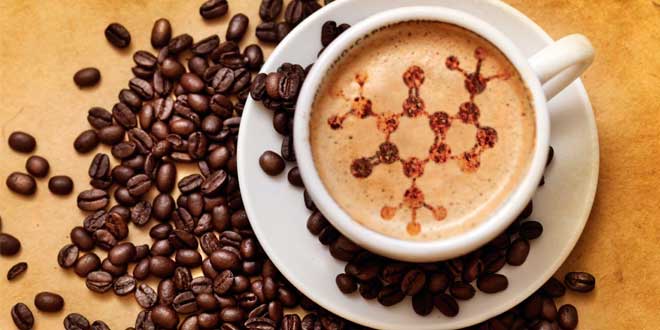
Are you looking to get active and burn fat? Have a pre-workout coffee! You won’t find a better way.
Guaranteed efficiency
Some people say that caffeine has little impact on calorie burn or the feeling of fatigue. In other words, they call it a “placebo supplement”. In our opinion, nothing could be further from the truth.
In fact, studies have shown that intakes of between 5 and 10 mg caffeine/kg body weight increase oxygen consumption and free fatty acid levels after a few hours. This conclusion supports the studies cited above.
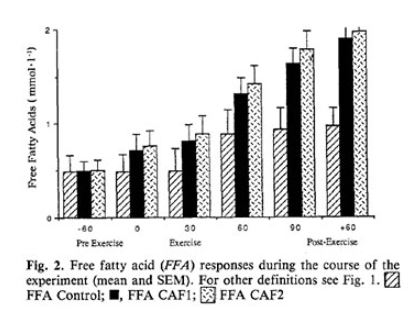
As time went on, the caffeine-consuming group saw their FFA (free fatty acid) levels increase.
Caffeine and EPOC (also known as “afterburn”), a good relationship?
It is safe to claim that high-intensity training or simply an exercise that produces a strong muscular contraction, such as weight training, is capable of improving your body composition as long as it is accompanied by caffeine, as the latter will enhance the effect of the former.

Pre-workout caffeine study
The participants refrained from taking any drugs or supplements so that the results would not be altered. They followed a simple protocol: one hour before a near-failure weight training routine, they took caffeine or a placebo.
What were the results and what was the respiratory coefficient?
The results obtained differed very little from those reported so far. In the caffeine group, an increase in oxygen uptake was observed (10-20% more than in the placebo group). And one significant fact worth noting: the variation in the respiratory coefficient, or in other words, the parameter that measures whether the cell is using fat or glucose as a source of energy.
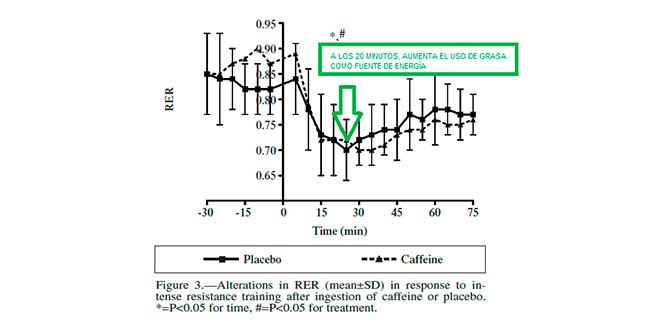
Improving fat burning: a real champion

All these data lead to the conclusion that the ideal intake would be 5-6 mg/kg body weight, in people who are NOT overweight. The usual problem is that many people have a daily intake of about 3.5 mg/kg body weight.
What’s the solution? Take caffeine supplements that meet daily requirements.
It is clear that, in many cases, this intake may fall short of what is needed, which is why there are studies that show no benefit from caffeine in certain athletes. For more information, click here.
High-intensity training routines, great allies
HSN recommends training that involves high muscle contraction, such as weight training, or high metabolic impact ((↑ATP→AMP), as for example sprints or HIT.
The reason is that, although these exercises consume a high amount of glucose while the exercise lasts, in the following hours they favour the use of fat by your body. This will be of great benefit to you in achieving your goal: fat loss.
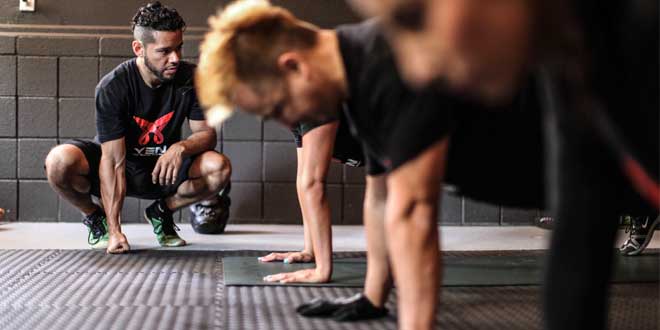
Are you among the high percentage of athletes who do not train at a high enough intensity to maintain that EPOC effect (also known as “afterburn”) for more than 70 minutes? Join the trend of the Tabata Method, one of the most effective ways to apply this methodology.
More information on the topic:
- Coffee as a source of caffeine.
- Read more about the lack of effect, why?.
- Find out about the formats in which you can find this supplement: click here.
- In this article we explain the benefits of caffeine and endurance sports.
Bibliography
- Enhanced metabolic response to caffeine in exercise-trained human subjects. J. LeBlanc , M. Jobin , J. Cote , P. Samson , A. Labrie
- The effects of substrate utilization, manipulated by caffeine, on post-exercise oxygen consumption in untrained female subjects. Chad K, Quigley B.
- The effects of two levels of caffeine ingestion on excess postexercise oxygen consumption in untrained women. Donelly K, McNaughton L.
- Effect of acute caffeine ingestion on EPOC after intense resistance training. Astorino
- Circuit weight training and its effects on excess postexercise oxygen consumption. Haltom RW, Kraemer RR, Sloan RA, Hebert EP, Frank K, Tryniecki JL.