Fitness, Nutrition, Health and Sports Blog In the HSNstore Blog you will find tips about Fitness, sport in general, nutrition, and health – HSNstore.com

In this article, we’re going to take a look at the main bodybuilding myths that still stick around when it comes to this sport.
A high-protein diet wrecks your kidneys
These functions can go unmet if intake is excessively restricted, especially when there’s a lack of EAAs (essential amino acids that the body can’t synthesize).
Excess amino acids are filtered by the kidneys in a degradation process the body uses to balance the anabolic/catabolic metabolism of amino acids, since they can’t be stored. Amino acids can be broken down through transamination and/or oxidative deamination.
It was hypothesized that putting the kidney through the detoxification process of ammonia produced by oxidative deamination in the urea cycle increased glomerular pressure and hyperfiltration.
However, despite this making some sense, there’s no evidence that high protein intake harms kidneys in healthy individuals (Martin, Armstrong & Rodriguez, 2005).
In patients with uremic syndrome, protein intake should be controlled by a specialist, as there is a real risk in this population.
Creatine can make you retain water
Chronic creatine intake saturates free creatine stores inside muscle cells, promoting phosphocreatine synthesis through phosphorylation of available free molecules, thus boosting our capacity to sustain anaerobic efforts.
Creatine intake is linked to a weight gain caused by increased total body water. While this is true, the increase in water concentration happens inside muscle cells, as shown by Powers et al. (2003), who found “fluid distribution did not change.”
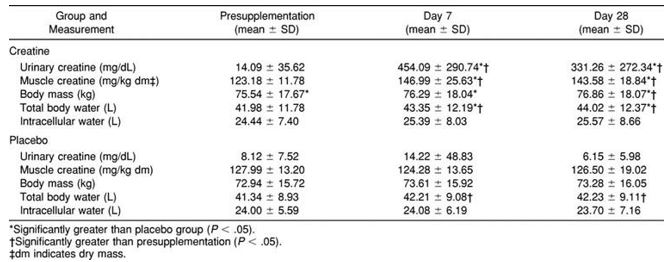
Figure I. Changes in total body water and intracellular water after 7 and 28 days of creatine vs placebo administration (Powers et al., 2003)
Salt makes you retain water
This causes a shift in the osmolarity of the extracellular and intracellular environment, which inhibits aldosterone (the hormone responsible for sodium reabsorption and osmotic pressure maintenance).
Therefore, fluid losses are reduced to maintain and increase fluid volume and to reduce, not increase, osmolarity through a solute (sodium) dilution mechanism.
Carbs are to blame for weight gain and/or not losing fat
Insulin, whose production is stimulated by consuming large amounts of carbs, can acutely inhibit lipolysis.
But this isn’t significant when people follow a weight loss program with two groups on isocaloric diets (low-fat -0.9 kg vs low-carb -2.0 kg), based on conclusions from Hu et al. (2012).
You only gain muscle between 6 and 12 reps
The key to muscle gains is working in a rep range between 8 and 35 reps with a high effort level (close to muscle failure).
Schoenfeld’s studies show that after 8 weeks, there were no significant differences in muscle gain between the high-rep group (LL=25-35RM) and the low-rep group (HL=8-12RM) when effort was maximal volitional.
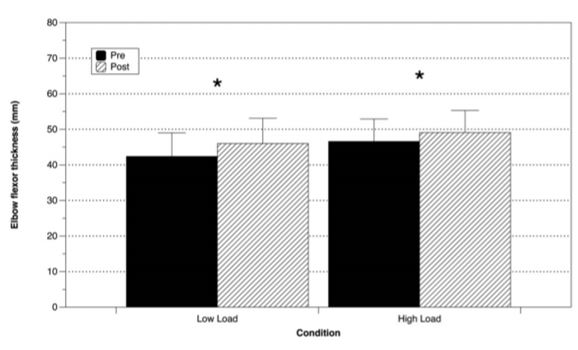
Figure II. Changes in elbow flexor thickness after intervention in groups doing high vs low loads (Schoenfeld et al., 2017)
Post-workout is the best time to take protein
Taking protein around training can have metabolic benefits compared to consuming it at other times;
However, the need to consume protein post-workout depends on intake pre- and intra-workout
In a study, Schoenfeld & Aragon (2017) showed that consuming 25 g of whey protein pre- or post-workout didn’t cause significant differences in body composition over the intervention.

Figure III. Changes in vastus lateralis thickness after intervention in groups consuming protein pre- vs post-workout (Schoenfeld et al., 2017)
More reps with less weight to get defined
This isn’t entirely false, as studies show that depending on the energy characteristics of the exercise, energy expenditure can vary from ≈3 to 30 kcal·min−1, reaching up to 40 kcal·min−1 in exercises involving large muscle mass (Reis et al., 2011).
However, to lose fat, energy balance is the biggest factor determining whether fat loss happens.
So the number of reps performed is actually a minor factor for this
That said, based on the above, knowing muscle gains are similar between heavier and lighter loads (more or fewer reps) as long as effort is close to maximal volitional, it might be interesting to include exercises involving large muscle mass with higher rep ranges to induce greater energy expenditure.
Meanwhile, in single-joint exercises involving less muscle mass, the difference in energy expenditure between an 8RM and 30RM set is negligible.
NO PAIN, NO GAIN, or more is always better
You need to reach a minimum work threshold for the stimulus to be enough to generate adaptations, but too much volume is counterproductive if it exceeds recovery capacity for future sessions, forcing you to reduce load and/or frequency.
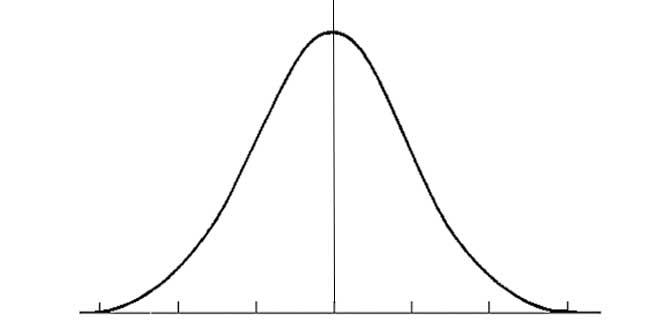
Figure IV. Gaussian bell curve explaining training volume effectiveness (X axis: work amount, Y axis: training adaptations)
Regarding intensity, to maximize hypertrophy and muscle gain, the most effective sets are those close to muscle failure. So training with high effort is necessary to trigger adaptations.
References
- Hu, T., Mills, K. T., Yao, L., Demanelis, K., Eloustaz, M., Yancy, W. S. J., … Bazzano, L. A. (2012). Effects of low-carbohydrate diets versus low-fat diets on metabolic risk factors: a meta-analysis of randomized controlled clinical trials. American Journal of Epidemiology, 176 Suppl 7(Suppl 7), S44-54.
Martin, W. F., Armstrong, L. E., & Rodriguez, N. R. (2005). Dietary protein intake and renal function. Nutrition & Metabolism, 2, 25. - Powers, M. E., Arnold, B. L., Weltman, A. L., Perrin, D. H., Mistry, D., Kahler, D. M., … Volek, J. (2003). Creatine Supplementation Increases Total Body Water Without Altering Fluid Distribution. Journal of Athletic Training, 38(1), 44–50.
- Schoenfeld, B. J., & Aragon, A. A. (2018). How much protein can the body use in a single meal for muscle-building? Implications for daily protein distribution. Journal of the International Society of Sports Nutrition, 15(1), 10.
- Schoenfeld, B. J., Peterson, M. D., Ogborn, D., Contreras, B., & Sonmez, G. T. (2015). Effects of Low- vs. High-Load Resistance Training on Muscle Strength and
- Hypertrophy in Well-Trained Men. Journal of Strength and Conditioning Research, 29(10), 2954–2963.
Related Posts
- Big Nutrition Myths
- Fat Myths: Spot Reduction
- Hybrid Training: Get More Muscle Hypertrophy
- How Much Protein Can We Absorb Per Meal?
- NO Brain NO Gain